De Hyphenated Foreign Policy and Air Defence
Source:Indian Express ↗
Why It Matters
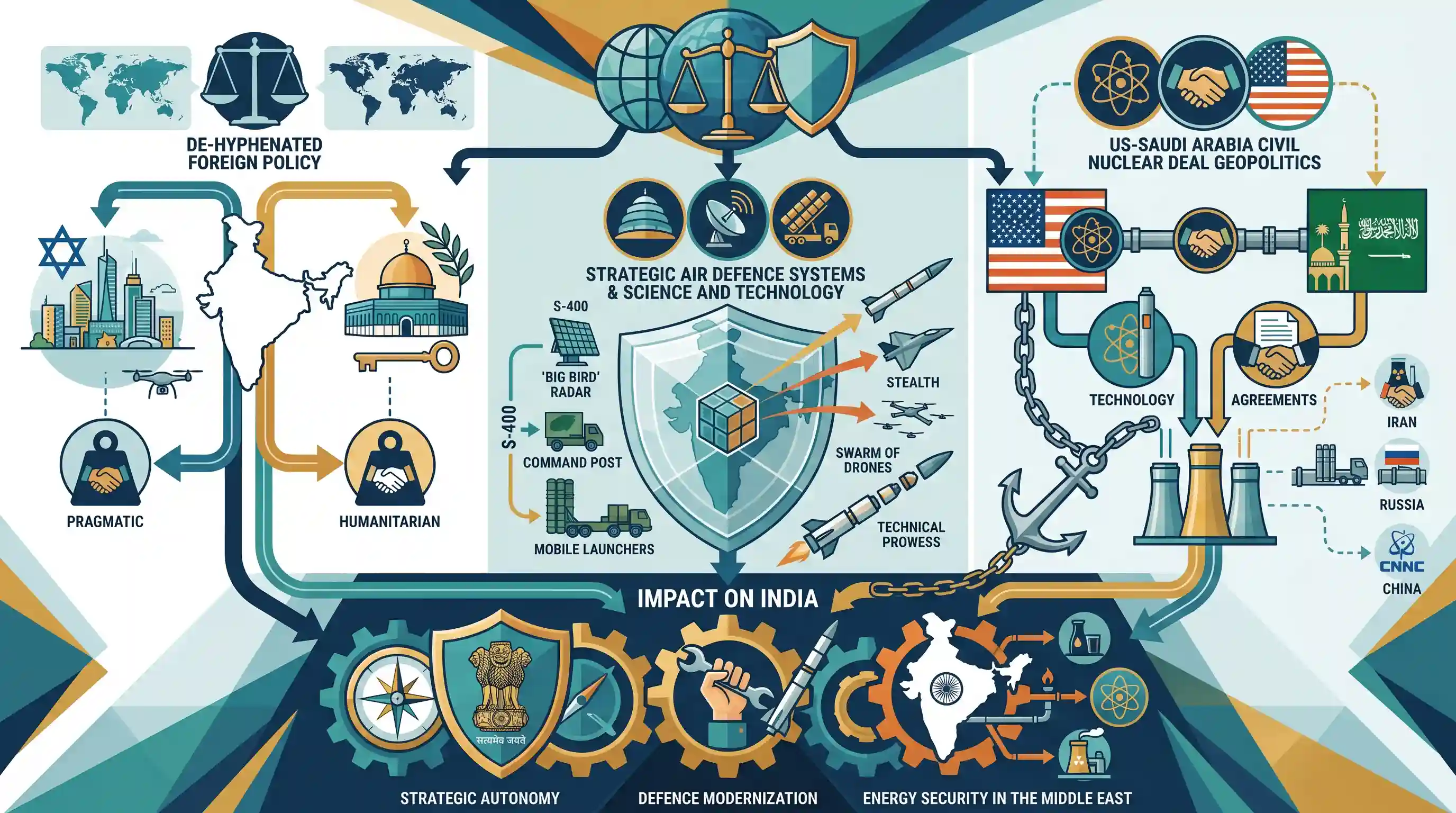
India's shift towards a de-hyphenated foreign policy is a core aspect of its strategic autonomy. Similarly, air defence modernization directly addresses India's border threats, while Middle Eastern geopolitical shifts (like a US-Saudi nuclear pact) heavily influence India's energy security and diaspora interests.
Summary
The article highlights three critical areas for UPSC aspirants: the concept of 'de-hyphenated' foreign policy (notably India's independent stances on Israel and Palestine), the strategic necessity and technological prowess of modern Air Defence Systems (like the S-400), and the complex geopolitics of a potential US-Saudi Arabia civil nuclear deal. These developments significantly impact India's strategic autonomy, defence modernization, and energy security interests in the Middle East.
Key Points
- De-hyphenated foreign policy allows India to pursue independent, strategic relationships with rival nations (e.g., Israel and Palestine) without linking the bilateral ties.
- Advanced Air Defence Systems, such as the S-400 or Iron Dome, provide multi-layered security against aerial threats including ballistic missiles, drones, and aircraft.
- A potential US-Saudi civil nuclear deal could reshape Middle East geopolitics, carrying implications for non-proliferation norms and the regional balance of power, especially concerning Iran.
- Middle East stability is paramount for India's energy security, trade routes, and the welfare of its diaspora, making regional security pacts a key area of strategic interest.
Important Terms
De-hyphenated Foreign Policy

A diplomatic approach where a country engages with two rival nations (e.g., Israel and Palestine) independently, based on bilateral merits rather than viewing one through the prism of the other.
UPSC context
GS Paper II (International Relations). Tests understanding of India’s pragmatic shift from traditional ideological stances to interest-based bilateralism.
Hyphenated Foreign Policy
The historical practice of linking relations with one country to those of another, often limiting diplomatic potential due to zero-sum perceptions (e.g., the US previously hyphenating India and Pakistan).
UPSC context
GS Paper II (International Relations). Contextualizes evolution of India's West Asia and South Asia policies.
S-400 Triumf
A mobile Russian long-range surface-to-air missile (SAM) system capable of engaging aircraft, drones, and missiles up to 400 km away; inducted into India as 'Sudarshan Chakra'.
UPSC context
GS Paper III (Security/Science & Tech). Relevant for air defense modernization and India-Russia strategic ties.
Strategic Autonomy
The ability of a nation to pursue its national interests and foreign policy independently without being coerced by other states or superpowers.
UPSC context
GS Paper II (International Relations). Fundamental concept in Indian diplomacy, tested via India’s stance on global conflicts and defense deals.
CAATSA
A 2017 US federal law imposing sanctions on countries engaging in significant transactions with Russian, Iranian, or North Korean defense/intelligence sectors, impacting India's S-400 deal.
UPSC context
GS Paper II (International Relations/Effect of Policies of Developed Countries). Tests awareness of external legal hurdles to India's defense procurement.
123 Agreement
A framework for peaceful nuclear cooperation between the US and a partner nation, mandated by Section 123 of the US Atomic Energy Act of 1954.
UPSC context
GS Paper II (Bilateral Agreements). Essential for understanding civil nuclear energy treaties and US non-proliferation requirements.
US-Saudi Civil Nuclear Agreement
A proposed pact for US nuclear technology sharing with Riyadh, tied to regional security guarantees and potential normalization of ties between Saudi Arabia and Israel.
UPSC context
GS Paper II (International Relations). Impacts West Asian stability, energy security, and India's interests in the Gulf.
Prelims Trap
"India's de-hyphenated foreign policy implies the abandonment of its historical support for the Palestinian two-state solution."
De-hyphenation means pursuing independent, standalone relations with Israel and Palestine on their own merits. It does not mean India has abandoned its official support for a sovereign Palestinian state.
Static Concepts Connected
What are '123 Agreements' in US civil nuclear cooperation?
- Legal Basis: Derives from Section 123 of the US Atomic Energy Act of 1954, governing nuclear transfers.
- Core Condition: Mandates strict non-proliferation criteria, ensuring partner nations cannot divert civilian nuclear technology for weapons.
- India's Exemption: The 2008 Indo-US deal was a 123 Agreement where India received an unprecedented NSG waiver despite not signing the NPT.
How do the S-400 and Iron Dome air defence systems differ?
- S-400 Triumf: Russian long-range system (up to 400km) capable of engaging stealth fighters, UAVs, and ballistic missiles.
- Iron Dome: Israeli short-range system optimized for localized urban defence against rockets, artillery, and mortars (C-RAM).
- Multi-tier Defence: India employs systems like the S-400 alongside indigenous PAD/AAD interceptors to create a comprehensive, layered national security shield.
Cross-Topic Patterns
Abraham Accords & IMEEC transit linkage
The US-Saudi nuclear pact acts as a lever for Saudi-Israel normalization, a geopolitical prerequisite for successfully operationalizing the India-Middle East-Europe Economic Corridor (IMEEC).
Project Kusha and Atmanirbhar Bharat
Studying imported air defence (S-400) directly connects to GS3 Defence Indigenisation, specifically DRDO's 'Project Kusha' aiming to build an indigenous Long Range Surface-to-Air Missile (LR-SAM) shield.

Expect a 2026 prelims question conflating US '123 Agreement' criteria for Saudi Arabia with India's unique 2008 NPT and NSG waivers.
Linked PYQs · 3
Linked PYQs · 3
- 2018MainsGS2
“India’s relations with Israel have, of late, acquired a depth and diversity, which cannot be rolled back.” Discuss.
- 2021MainsGS3
How is S-400 air defence system technically superior to any other system presently available in the world?
- 2025MainsGS2
"Energy security constitutes the dominant kingpin of India's foreign policy, and is linked with India's overarching influence in Middle Eastern countries.” How would you integrate energy security with India's foreign policy trajectories in the coming years?
