Himalayan Vulture Conservation and Land Inequality
Source:Indian Express ↗
Why It Matters
These topics touch upon core areas of the UPSC syllabus. Vulture conservation relates to GS-3 Biodiversity and the historic ban on diclofenac. HFC phase-down is central to India's climate action plans and global environmental negotiations. Land inequality is a foundational issue in GS-3 Agriculture and GS-1 Indian Society, directly linking to poverty, land reforms, and rural development.
Summary
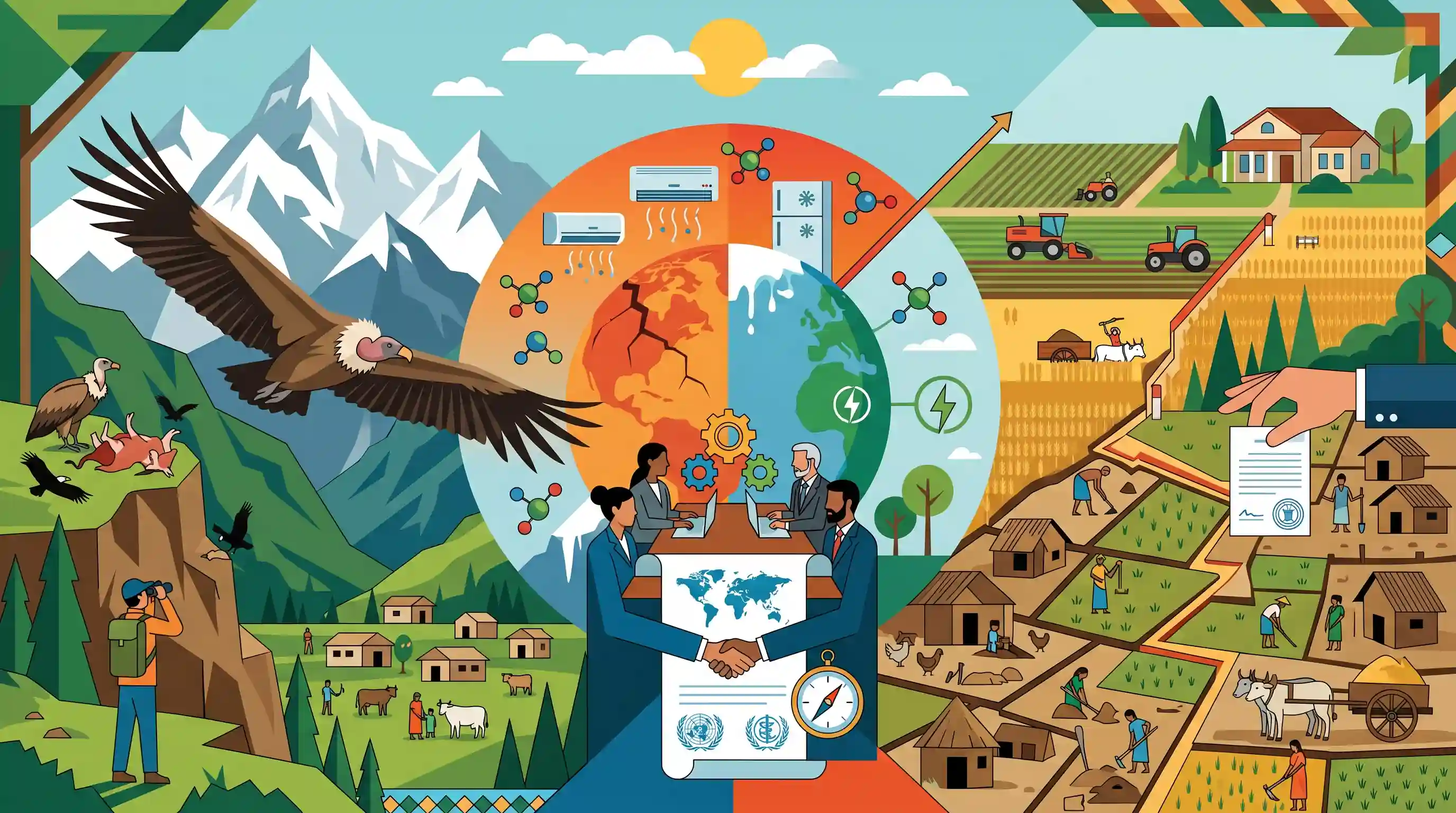
The article covers three diverse yet crucial topics: the ecological importance and conservation challenges of the Himalayan Griffon Vulture, the climate impact and international regulation of Hydrofluorocarbons (HFCs) through the Kigali Amendment, and the persistent socio-economic issue of land inequality in India. It underscores the intersection of biodiversity, global environmental treaties, and structural agrarian reforms.
Key Points
- The Himalayan Griffon Vulture is a vital scavenger in the Himalayan ecosystem, facing persistent threats from habitat loss and veterinary drugs like diclofenac.
- Hydrofluorocarbons (HFCs) are potent greenhouse gases that are being phased down globally under the Kigali Amendment to the Montreal Protocol to combat climate change.
- Land inequality in India continues to be a structural hurdle in the agricultural sector, causing fragmentation of holdings and hindering rural economic mobility.
- Effective land reforms and ceiling policies remain essential to address socio-economic disparities and boost agricultural productivity.
Important Terms
Kigali Amendment

A 2016 legally-binding amendment to the Montreal Protocol aiming to phase down hydrofluorocarbons (HFCs) by 80-85% by 2047 to prevent up to 0.5°C of global warming.
UPSC context
GS Paper 3 (Environment); tests international climate treaties and India's specific phase-down obligations starting in 2028.
Montreal Protocol
A landmark 1987 treaty protecting the ozone layer by phasing out ozone-depleting substances (ODS); it is uniquely the only UN treaty with universal ratification.
UPSC context
GS Paper 3 (Environment); foundational for understanding global environmental governance and successful multilateral protocols.
Himalayan Griffon Vulture
A large Old World vulture species native to high altitudes, currently listed as 'Near Threatened' by the IUCN and susceptible to diclofenac poisoning.
UPSC context
GS Paper 3 (Biodiversity); essential for species conservation status, threats to Indian raptors, and Vulture Action Plan 2020-25.
Hydrofluorocarbons (HFCs)
Synthetic gases used primarily in cooling systems that replaced ozone-depleting substances but act as potent greenhouse gases with high global warming potential.
UPSC context
GS Paper 3 (Environment/Pollution); tests knowledge of greenhouse gas chemistry and climate change mitigation strategies.
Land Inequality
The disproportionate concentration of land ownership; in rural India, a World Inequality Lab study shows the top 10% own roughly 44% of land.
UPSC context
GS Paper 3 (Agriculture/Land Reforms); critical for questions on agrarian distress, Gini coefficients, and structural rural poverty.
UNEP
The UN's leading environmental authority (est. 1972) based in Nairobi, coordinating global environmental responses and producing flagship reports like the Emissions Gap Report.
UPSC context
GS Paper 2/3 (International Institutions/Environment); tests the role of international bodies in environmental policy and reporting.
Prelims Trap
"Hydrofluorocarbons (HFCs) are potent ozone-depleting substances that are being phased out globally."
HFCs have zero Ozone Depleting Potential (ODP). They were introduced as alternatives to CFCs. The Kigali Amendment targets them solely for their massive Global Warming Potential (GWP), not ozone protection.
Static Concepts Connected
How does the Kigali Amendment differ from the original Montreal Protocol?
- Protocol Targets: The original Montreal Protocol mandates the phase-out of Ozone Depleting Substances (ODS) like CFCs and HCFCs.
- Amendment Target: The Kigali Amendment mandates the phase-down of HFCs, which do not deplete ozone but are potent greenhouse gases.
- Differentiated Timelines: It enforces a legally binding phase-down timeline, divided into groups with different baseline years for developed and developing nations (India falls in Group 2).
What are the core pillars of post-independence Land Reforms in India?
- Intermediary Abolition: Removing Zamindars and Jagirdars to establish a direct relationship between the state and the actual tillers.
- Tenancy Reforms: Regulation of rent, security of tenure, and conferment of ownership rights to continuous tenants.
- Land Ceilings: Fixing maximum legal limits on land ownership and redistributing surplus land to landless agricultural laborers.
- Consolidation of Holdings: Merging fragmented and scattered land parcels into contiguous blocks to improve agricultural efficiency.
Cross-Topic Patterns
Veterinary pharmacology & biodiversity decline
Vulture decline links biodiversity to veterinary pharmacology. UPSC frequently tests the ecological impact of specific toxic NSAIDs (Diclofenac, Ketoprofen, Aceclofenac) versus safe alternatives like Meloxicam.
Agrarian distress & structural inequality
Land fragmentation and structural inequality tie directly into GS3 themes like rural indebtedness, disguised unemployment, and why minimum support price (MSP) primarily benefits large landholders rather than marginalized farmers.

Expect a multi-statement Prelims question contrasting Montreal/Kigali targets with Paris targets, specifically testing ODP vs GWP of HFCs.
Linked PYQs · 5
Linked PYQs · 5
- 2012PrelimsGS1
Vultures which used to be very common in Indian countryside some years ago are rarely seen nowadays. This is attributed to
- 2023PrelimsGS1
Consider the following: 1. Aerosols 2. Foam agents 3. Fire retardants 4. Lubricants In the making of how many of the above are hydrofluorocarbons used?
- 2015PrelimsGS1
Which one of the following is associated with the issue of control and phasing out of the use of ozone-depleting substances?
- 2023MainsGS3
State the objectives and measures of land reforms in India. Discuss how land ceiling policy on landholding can be considered as an effective reform under economic criteria.
- 2016MainsGS3
Discuss the role of land reforms in agricultural development. Identify the factors that were responsible for the success of land reforms in India.
