Great Nicobar Project and Geopolitical Flashpoints
Source:Indian Express ↗
Why It Matters
The article provides essential case studies for the Mains examination: the Great Nicobar Project is a prime example for GS Paper 3 (Sustainable Development vs. Infrastructure) and GS Paper 1 (Vulnerable Tribes). The Middle East crisis and back-channel diplomacy are foundational concepts for GS Paper 2 (International Relations).
Summary
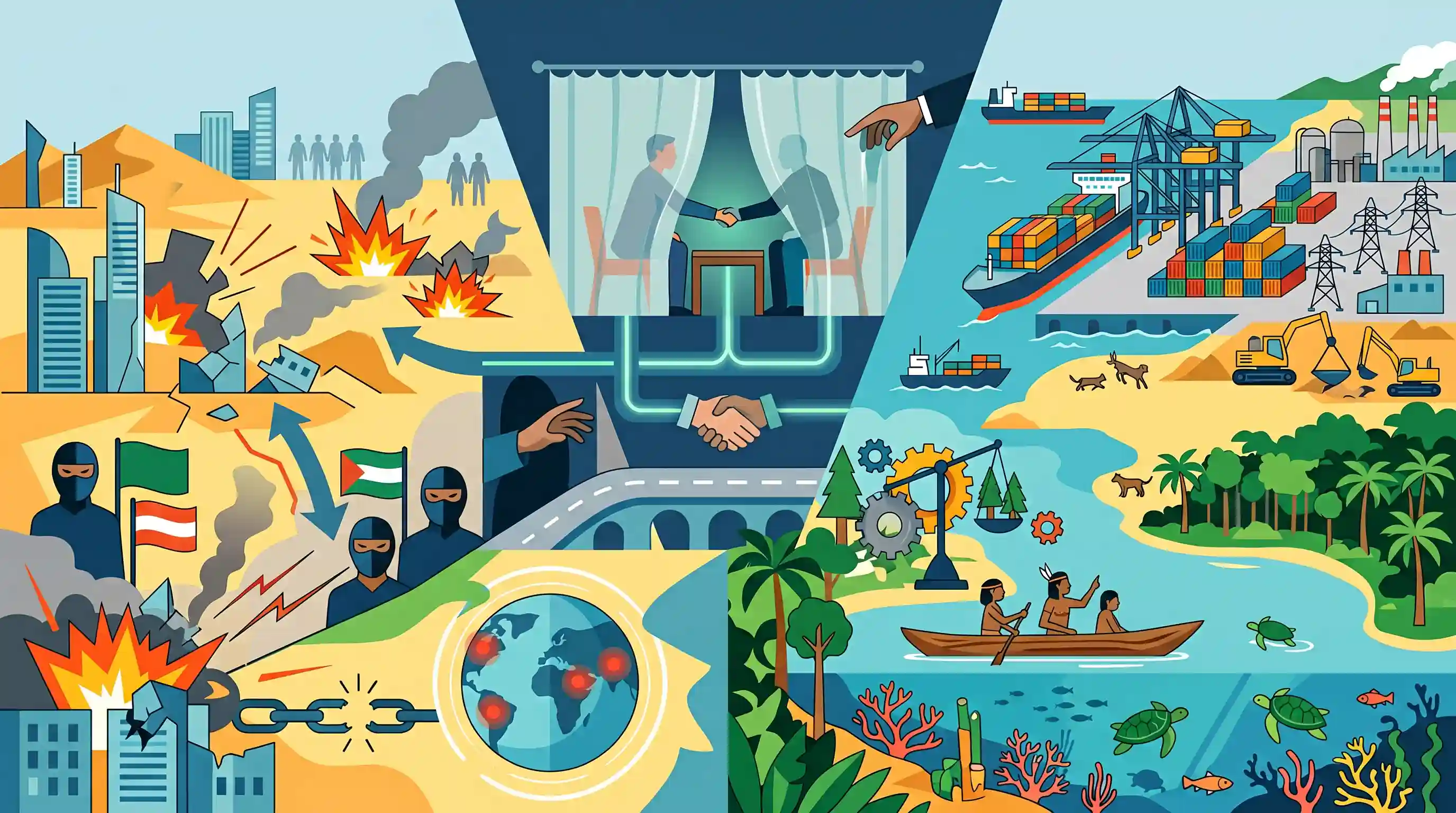
This UPSC Key edition explores three critical topics: the geopolitical ramifications of Hezbollah's actions in the Middle East conflict, the strategic and environmental debates surrounding the Great Nicobar Project, and the significance of back-channel diplomacy in international relations. The Great Nicobar initiative highlights the classic 'development versus environment' dilemma, impacting the pristine Galathea Bay and indigenous tribes like the Shompen. Meanwhile, the Middle East dynamics and the nuances of Track II diplomacy offer vital insights into global conflict resolution and India's strategic interests.
Key Points
- Hezbollah's involvement in the Lebanon-Israel dynamics significantly shapes Middle Eastern geopolitics, with direct implications for global stability and energy security.
- The ambitious Great Nicobar Project aims to establish a mega transshipment port at Galathea Bay, enhancing India's strategic and economic footprint in the Indian Ocean Region (IOR).
- The infrastructure push in Great Nicobar faces severe criticism due to its potential irreversible impact on the region's fragile ecology and the displacement of vulnerable indigenous groups like the Shompen and Nicobarese tribes.
- Back-channel diplomacy, or Track II diplomacy, serves as a crucial unofficial negotiation tool between adversarial nations, enabling conflict resolution when formal diplomatic channels are frozen.
Important Terms
Great Nicobar Development Project

A ₹72,000-crore mega-infrastructure plan for Great Nicobar Island, featuring a transshipment port, dual-use airport, and integrated township to enhance India's strategic presence and maritime security in the Indo-Pacific.
UPSC context
GS Paper III (Infrastructure/Environment); tests the ability to balance strategic national interests with ecological conservation and indigenous rights.
Hezbollah
A Lebanon-based Shia Islamist political and militant organization, funded primarily by Iran. It serves as a key regional proxy in the conflict against Israel and influences Middle Eastern geopolitics.
UPSC context
GS Paper II (International Relations); relevant for understanding West Asian dynamics and their impact on global security and energy interests.
Back-channel Diplomacy
Informal, non-governmental dialogues (Track II) involving experts, scholars, or retired officials. It provides a platform to explore conflict resolution when official government channels are stalled or politically sensitive.
UPSC context
GS Paper II (International Relations); tests knowledge of unconventional negotiation mechanisms and their role in resolving bilateral disputes.
Shompen Tribe
An indigenous, semi-nomadic Mongoloid community on Great Nicobar Island. Classified as a PVTG, they lead a hunter-gatherer lifestyle and face significant threats from external developmental activities and diseases.
UPSC context
GS Paper I (Society/Tribals); important for questions on tribal welfare, indigenous rights, and demographic challenges in isolated regions.
Galathea Bay
A strategic site on Great Nicobar Island designated for a transshipment terminal. It is an ecologically sensitive area and a primary nesting ground for the endangered Giant Leatherback Turtle.
UPSC context
GS Paper III (Environment); focuses on biodiversity hotspots and legal challenges between large-scale development and environmental protection.
PVTG (Particularly Vulnerable Tribal Groups)
A government classification for tribal groups characterized by stagnant/declining populations, low literacy, and pre-agricultural technology. They require special protection and targeted welfare schemes under the Ministry of Tribal Affairs.
UPSC context
GS Paper II (Social Justice); critical for understanding administrative measures for the most disadvantaged sections of Indian society.
Prelims Trap
Both the Shompen and Nicobarese tribes of Great Nicobar are classified as Particularly Vulnerable Tribal Groups (PVTGs).
While both reside in the Andaman and Nicobar Islands, only the Shompen are classified as a PVTG. The Nicobarese are a Scheduled Tribe but do not meet PVTG criteria.
Static Concepts Connected
What criteria define a Particularly Vulnerable Tribal Group (PVTG) in India?
- Technology Level: The community must exhibit a pre-agricultural level of technology.
- Population Trend: The community must have a stagnant or declining population growth rate.
- Literacy & Economy: Extremely low literacy levels alongside a subsistence-based, backward economy.
How do Track I, Track 1.5, and Track II diplomacy differ?
- Track I: Official, formal negotiations conducted directly between authorized government representatives and diplomats.
- Track II: Unofficial dialogues involving non-state actors like academics, NGOs, and retired officials to build trust.
- Track 1.5: Hybrid diplomatic efforts involving a collaborative mix of official government actors and non-official experts.
Cross-Topic Patterns
Strategic Island Infra vs. CRZ Norms
The Great Nicobar transshipment port highlights the tension between India's maritime security footprint in the Indian Ocean and the relaxation of Island Coastal Regulation Zone (ICRZ) rules for strategic assets.
Non-State Actors & India's Energy Security
Hezbollah's involvement in the Levant connects directly to maritime choke point vulnerabilities, linking Middle-Eastern non-state militancy with India's macro-economic imported inflation and energy security risks.

Expect a 2026 prelims question matching A&N tribes (Shompen/Nicobarese) with their PVTG status, or Galathea Bay's ecological features.
Linked PYQs · 5
Linked PYQs · 5
- 2023PrelimsGS1
Consider the following pairs: Regions often mentioned in news Reason for being in news 1. North Kivu and Ituri : War between Armenia and Azerbaijan 2. Nagorno-Karabakh : Insurgency in Mozambique 3. Kherson and Zaporizhzhia : Dispute between Israel and Lebanon How many of the above pairs are correctly matched?
- 2015PrelimsGS1
The area known as 'Golan Heights' sometimes appears in the news in the context of the events related to
- 2025MainsGS2
"Energy security constitutes the dominant kingpin of India's foreign policy, and is linked with India's overarching influence in Middle Eastern countries.” How would you integrate energy security with India's foreign policy trajectories in the coming years?
- 2019MainsGS3
Define the concept of carrying capacity of an ecosystem as relevant to an environment. Explain how understanding this concept is vital while planning for sustainable development of a region.
- 2019MainsGS3
It is argued that the strategy of inclusive growth is intended to meet the objectives of inclusiveness and sustainability together. Comment on this statement.
