Parliamentary Guillotine and Geographical Indication Framework
Source:Indian Express ↗
Why It Matters
Understanding the Guillotine process highlights the limitations of legislative financial oversight. GI tags are crucial for rural economic empowerment and global trade compliance. The concept of Post-Truth is highly relevant for analyzing modern governance, media ethics, and societal values in the digital age.
Summary
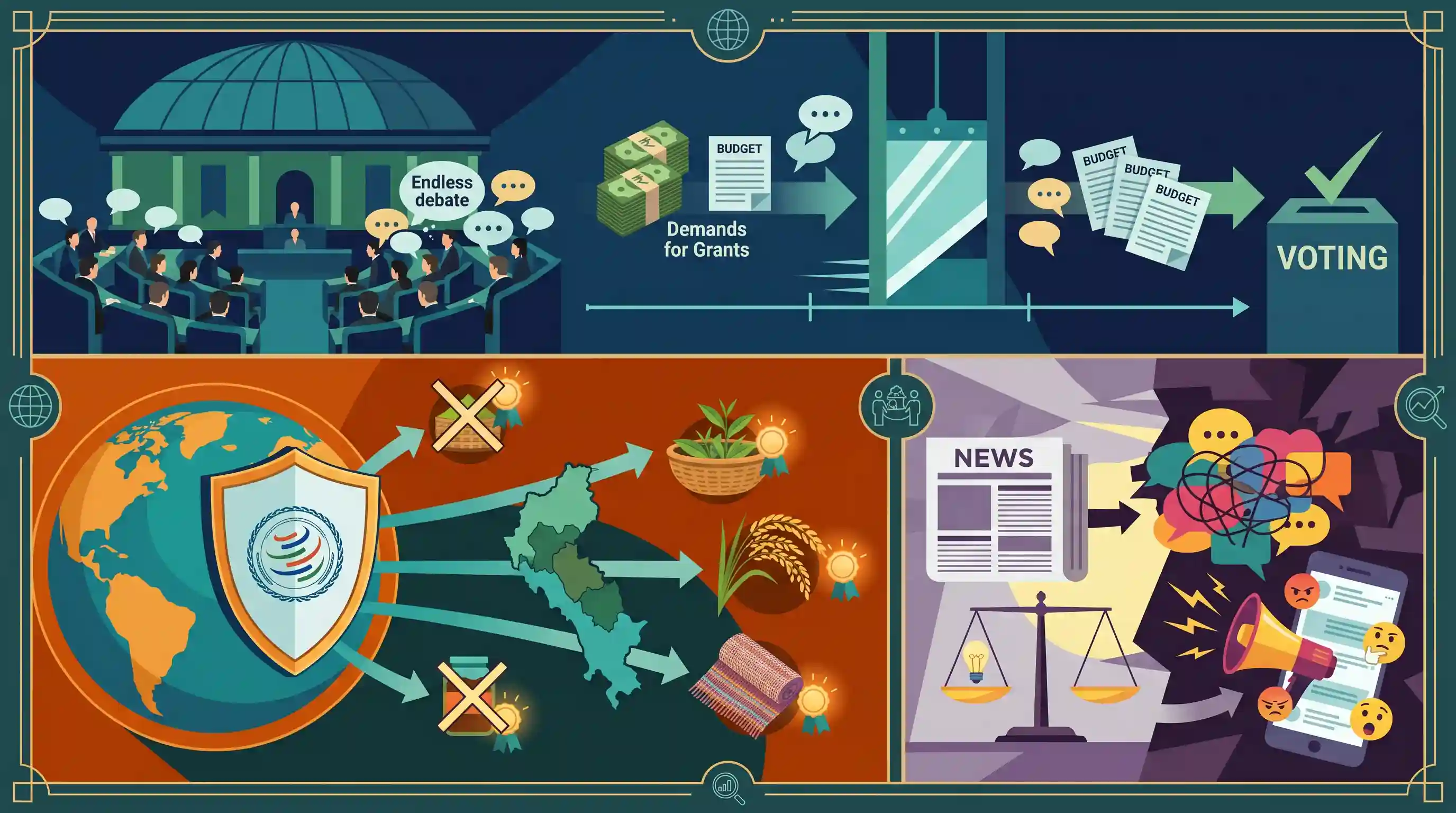
The article unpacks three important concepts for UPSC preparation: the parliamentary mechanism of the 'Guillotine', the framework surrounding 'Geographical Indications' (GI), and the sociological phenomenon of 'Post-Truth'. It explains how the Guillotine limits debate on budget grants, how GI tags protect regional products under the WTO TRIPS agreement, and how the post-truth era undermines objective facts through emotional appeals and misinformation.
Key Points
- The 'Guillotine' is a parliamentary procedure used to fast-track the passage of the Union Budget by clubbing and voting on undiscussed Demands for Grants without debate due to time constraints.
- Geographical Indications (GI) are Intellectual Property Rights identifying goods originating from a specific territory with distinctive quality, protected globally under WTO's TRIPS and locally under the GI Act of 1999.
- 'Post-truth' denotes circumstances where objective facts are less influential in shaping public opinion than appeals to emotion and personal belief, posing a challenge to rational decision-making.
- The interplay of these topics touches upon legislative oversight (GS2), economic trade and IPR (GS3), and contemporary ethical challenges exacerbated by digital misinformation (GS4/Essay).
Important Terms
Guillotine

A parliamentary procedure in the Lok Sabha where the Speaker puts all outstanding Demands for Grants to vote without further discussion on the last day of budget consideration.
UPSC context
GS Paper II/Polity; tests knowledge of parliamentary tools used to ensure timely passage of financial business despite time constraints.
Geographical Indications of Goods (Registration and Protection) Act, 1999
The Indian legislation providing a legal framework for registering and protecting regional products whose quality or reputation is attributable to their geographical origin.
UPSC context
GS Paper III/Economy & IPR; critical for questions on protecting traditional Indian knowledge and regional development.
TRIPS Agreement
The WTO’s Agreement on Trade-Related Aspects of Intellectual Property Rights, establishing the global minimum standards for protecting and enforcing intellectual property.
UPSC context
GS Paper III/International Relations; tests understanding of international trade treaties and India’s IPR compliance obligations.
Post-Truth
A sociological era where objective facts are less influential in shaping public opinion than appeals to emotion, personal belief, and misinformation.
UPSC context
GS Paper IV/Ethics; relevant for discussions on media ethics, governance challenges, and the impact of misinformation on democracy.
Annual Financial Statement
The constitutional term (Article 112) for the Union Budget, detailing the government's estimated receipts and expenditure for a specific financial year.
UPSC context
GS Paper II/Constitution; tests knowledge of the executive's constitutional obligations and legislative control over public finances.
Prelims Trap
"The Guillotine procedure is invoked in both Houses of Parliament to fast-track the passage of the Union Budget."
Demands for Grants are voted upon exclusively in the Lok Sabha. The Rajya Sabha only has recommendatory powers, meaning the Guillotine for financial grants is a Lok Sabha-only mechanism.
Static Concepts Connected
What are the key stages of enacting the Union Budget in Parliament?
- Presentation: The Annual Financial Statement is laid before Parliament by the Finance Minister.
- General Discussion: A broad debate takes place on the budget as a whole, without moving any cut motions.
- Committee Scrutiny: Departmental Standing Committees examine the specific Demands for Grants of various ministries.
- Voting and Guillotine: The Lok Sabha votes on grants, culminating in the 'Guillotine' for any undiscussed demands due to time limits.
- Final Passage: The Appropriation Bill and Finance Bill are passed to authorize spending and taxation respectively.
How do Geographical Indications (GIs) fundamentally differ from Trademarks?
- Nature of Right: GIs are collective community rights tied to a region, whereas Trademarks are private property rights belonging to a specific enterprise.
- Source Identifier: GIs identify goods originating from a specific geographical territory, while Trademarks identify goods or services of a particular company.
- Transferability: Trademarks can be licensed globally to third parties; GIs cannot be decoupled from their native geographic region and its traditional producers.
Cross-Topic Patterns
Guillotine vs. Legislative Oversight
The frequent use of the Guillotine highlights the fundamental tension in parliamentary democracies between ensuring timely legislative action and preserving rigorous opposition scrutiny of executive spending.
GI Tags + ODOP Scheme + Export Promotion
GI protection naturally overlaps with the 'One District One Product' (ODOP) initiative, leveraging traditional knowledge and TRIPS frameworks to boost regional exports and local rural employment.
Post-truth Era & Deepfake Misinformation
The sociological 'post-truth' phenomenon is deeply exacerbated by generative AI and deepfakes, tying directly into GS4 themes of cognitive biases, democratic integrity, and ethical media regulation.

A 2026 Prelims question will likely contrast the 10-year renewable validity and community ownership of GI tags against private Trademarks.
Linked PYQs · 5
Linked PYQs · 5
- 2018PrelimsGS1
India enacted The Geographical Indications of Goods (Registration and Protection) Act, 1999 in order to comply with the obligations to
- 2010PrelimsGS1
In order to comply with TRIPS Agreement, India enacted the Geographical Indications of Goods (Registration | Protection) Act, 1999. The difference/differences between a “Trade Mark” and a Geographical Indication is/are
- 2024PrelimsGS1
With reference to Union Budget, consider the following statements : 1. The Union Finance Minister on behalf of the Prime Minister lays the Annual Financial Statement before both the Houses of Parliament. 2. At the Union level, no demand for a grant can be made except on the recommendation of the President of India. Which of the statements given above is/are correct?
- 2024MainsGS2
“The growth of cabinet system has practically resulted in the marginalisation of the parliamentary supremacy.” Elucidate.
- 2014MainsGS3
In a globalized world, Intellectual Property Rights assume significance and are a source of litigation. Broadly distinguish between the terms-Copyrights, Patents and Trade Secrets.
