Parliamentary Guillotine GI Tags and Post Truth Phenomenon Analysis
Source:Indian Express ↗
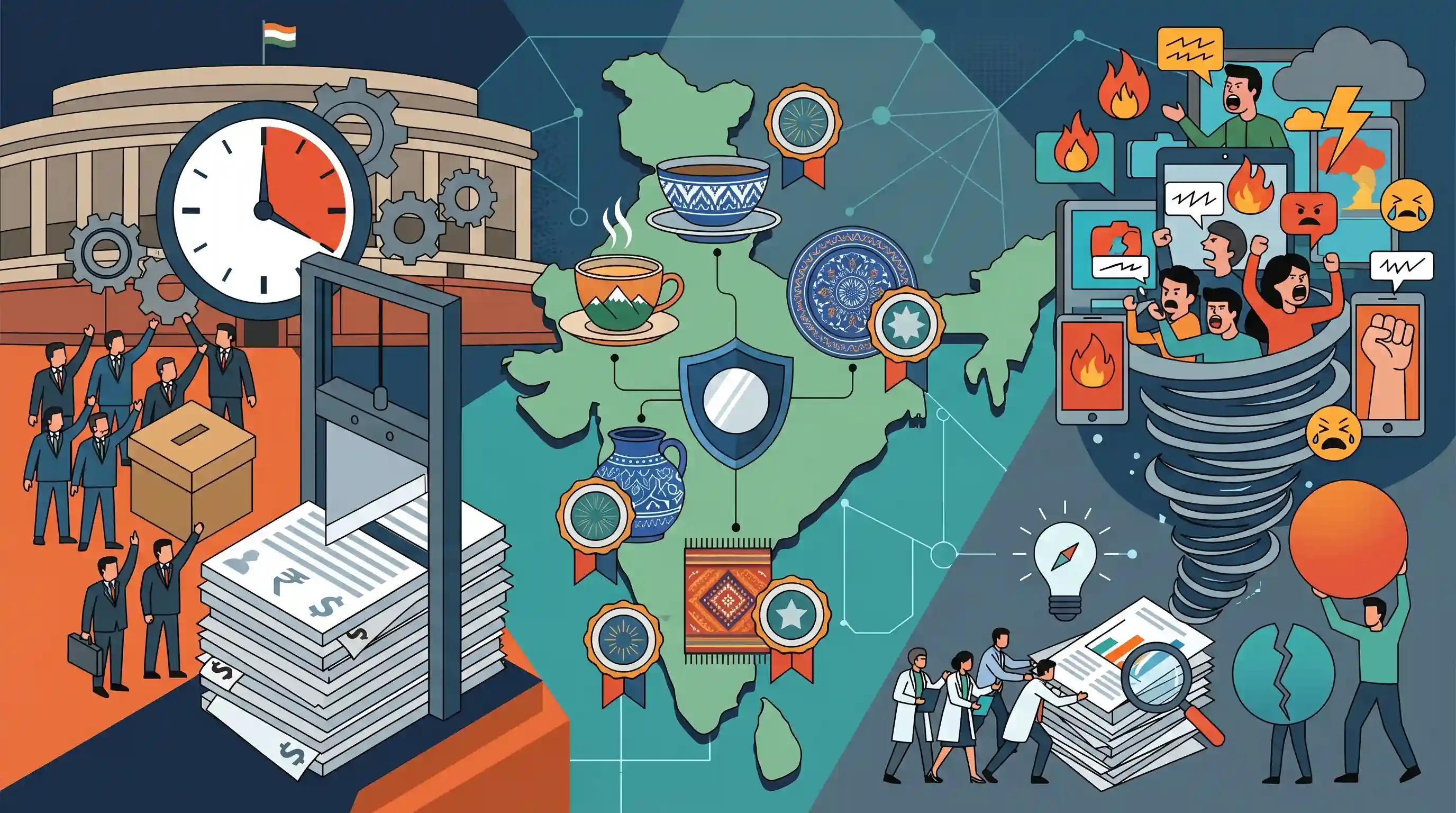
Why It Matters
The article covers fundamental concepts tested repeatedly across different stages of the UPSC examination. 'Guillotine' is critical for understanding the legislative process in Polity (GS2), 'Geographical Indication' is a core Economy and IPR topic (GS3/Prelims), and 'Post-Truth' addresses contemporary ethical dilemmas and media manipulation relevant to Ethics (GS4) and Essay writing.
Summary
This article explains three crucial UPSC concepts spanning different syllabus areas: the 'Guillotine', 'Geographical Indication' (GI), and the concept of 'Post-Truth'. The Guillotine refers to the parliamentary mechanism to pass undiscussed demands for grants during the budget session due to time constraints. Geographical Indications are intellectual property tags for products with specific geographical origins, protected in India under an act compliant with the WTO's TRIPS agreement. Lastly, Post-Truth highlights a socio-ethical phenomenon where objective facts are overshadowed by emotional appeals in shaping public opinion, a highly relevant topic for media ethics and the digital age.
Key Points
- The 'Guillotine' is a parliamentary procedure used in the Lok Sabha to bundle and pass all outstanding demands for grants without debate when the time allotted for the budget session expires.
- Geographical Indication (GI) is an Intellectual Property Right (IPR) recognizing goods whose quality or reputation is specifically linked to their geographical origin.
- India enacted the Geographical Indications of Goods Act in 1999 to comply with the WTO's TRIPS Agreement.
- 'Post-Truth' describes an era where objective facts have less influence on public opinion than emotional appeals and personal beliefs, posing significant ethical challenges in the digital and social media age.
Important Terms
Guillotine

A parliamentary procedure in the Lok Sabha to put all pending 'demands for grants' to vote together without discussion on the last day of the budget session.
UPSC context
GS Paper 2 (Polity); essential for understanding parliamentary budget approval processes and executive-legislative dynamics.
Geographical Indication (GI)
An intellectual property tag for products originating from a specific region, where quality or reputation is essentially attributable to that geographical location.
UPSC context
GS Paper 3 (Economy/IPR); frequently tested in Prelims regarding specific regional products and legal protection.
Post-Truth
A condition where objective facts are less influential in shaping public opinion than emotional appeals and personal beliefs.
UPSC context
GS Paper 4 (Ethics); vital for discussing media ethics, propaganda, and digital age social challenges.
Geographical Indications of Goods (Registration and Protection) Act, 1999
The Indian legislation providing for the registration and better protection of geographical indications, making India compliant with the WTO's TRIPS agreement.
UPSC context
GS Paper 3 (Economy/S&T); specific statutory framework for IPR governance in India.
TRIPS Agreement
A WTO-led international agreement setting minimum standards for the protection of intellectual property rights, including patents, copyrights, and GIs.
UPSC context
GS Paper 3 (Economy/International Relations); core part of global trade rules and IPR obligations.
World Trade Organization (WTO)
An intergovernmental organization that regulates and facilitates international trade between nations, established by the Marrakesh Agreement in 1995.
UPSC context
GS Paper 3 (International Institutions); crucial for understanding global trade governance and India’s trade relations.
Prelims Trap
"The Guillotine is a procedure used in both houses of Parliament to expedite the passage of outstanding demands for grants."
Only the Lok Sabha has the power to vote on Demands for Grants (Article 113). Therefore, the guillotine for grants is exclusively a Lok Sabha mechanism.
Static Concepts Connected
What is the Constitutional basis for voting on Demands for Grants?
- Article 113: Mandates that estimates of expenditure from the Consolidated Fund of India must be presented to the lower house as Demands for Grants.
- Lok Sabha exclusive: Only the Lok Sabha has the constitutional power to assent, refuse, or reduce a demand. The Rajya Sabha can only discuss them.
How does a Geographical Indication (GI) conceptually differ from a standard Trademark?
- Collective vs. Private: A GI is a collective community right based on a specific geography, whereas a trademark is generally a private, individual, or corporate right.
- Origin vs. Source: A GI guarantees a product's specific geographical origin and associated qualities, while a trademark simply distinguishes the commercial source of a good or service from its competitors.
Cross-Topic Patterns
Guillotine and Executive Financial Accountability
The frequent use of the guillotine highlights a governance tension: balancing the need for timely budget passage against the dilution of legislative financial control and executive accountability.
Post-Truth, Deepfakes, and GS4 Media Ethics
The 'post-truth' phenomenon directly links to GS3 tech topics, where Generative AI and deepfakes amplify emotional appeals, further eroding objective truth in democratic elections and posing severe media ethics challenges.
GI Tags and Traditional Indigenous Knowledge
GI tags bridge WTO economic obligations with GS1 Art & Culture, acting as a defensive intellectual property mechanism to protect indigenous knowledge, regional crafts, and traditional livelihoods from commercial exploitation.

Expect a 2026 Prelims multi-statement question pairing Guillotine mechanics with the Lok Sabha's exclusive Article 113 powers.
Linked PYQs · 5
Linked PYQs · 5
- 2024PrelimsGS1
With reference to Union Budget, consider the following statements : 1. The Union Finance Minister on behalf of the Prime Minister lays the Annual Financial Statement before both the Houses of Parliament. 2. At the Union level, no demand for a grant can be made except on the recommendation of the President of India. Which of the statements given above is/are correct?
- 2021MainsGS2
Do Department-related Parliamentary Standing Committees keep the administration on its toes and inspire reverence for parliamentary control? Evaluate the working of such committees with suitable examples.
- 2018PrelimsGS1
India enacted The Geographical Indications of Goods (Registration and Protection) Act, 1999 in order to comply with the obligations to
- 2010PrelimsGS1
In order to comply with TRIPS Agreement, India enacted the Geographical Indications of Goods (Registration | Protection) Act, 1999. The difference/differences between a “Trade Mark” and a Geographical Indication is/are
- 2014MainsGS3
In a globalized world, Intellectual Property Rights assume significance and are a source of litigation. Broadly distinguish between the terms-Copyrights, Patents and Trade Secrets.
