Uranium Enrichment and International Potato Center Research
Source:Indian Express ↗
Why It Matters
These topics represent core pillars of the GS3 syllabus (Science & Technology and Agriculture) and GS2 (International Relations). Understanding upcoming space missions tracks India's technological progress, agricultural research centers are key to climate-resilient food security, and nuclear technology forms the basis for global energy and geopolitical debates.
Summary
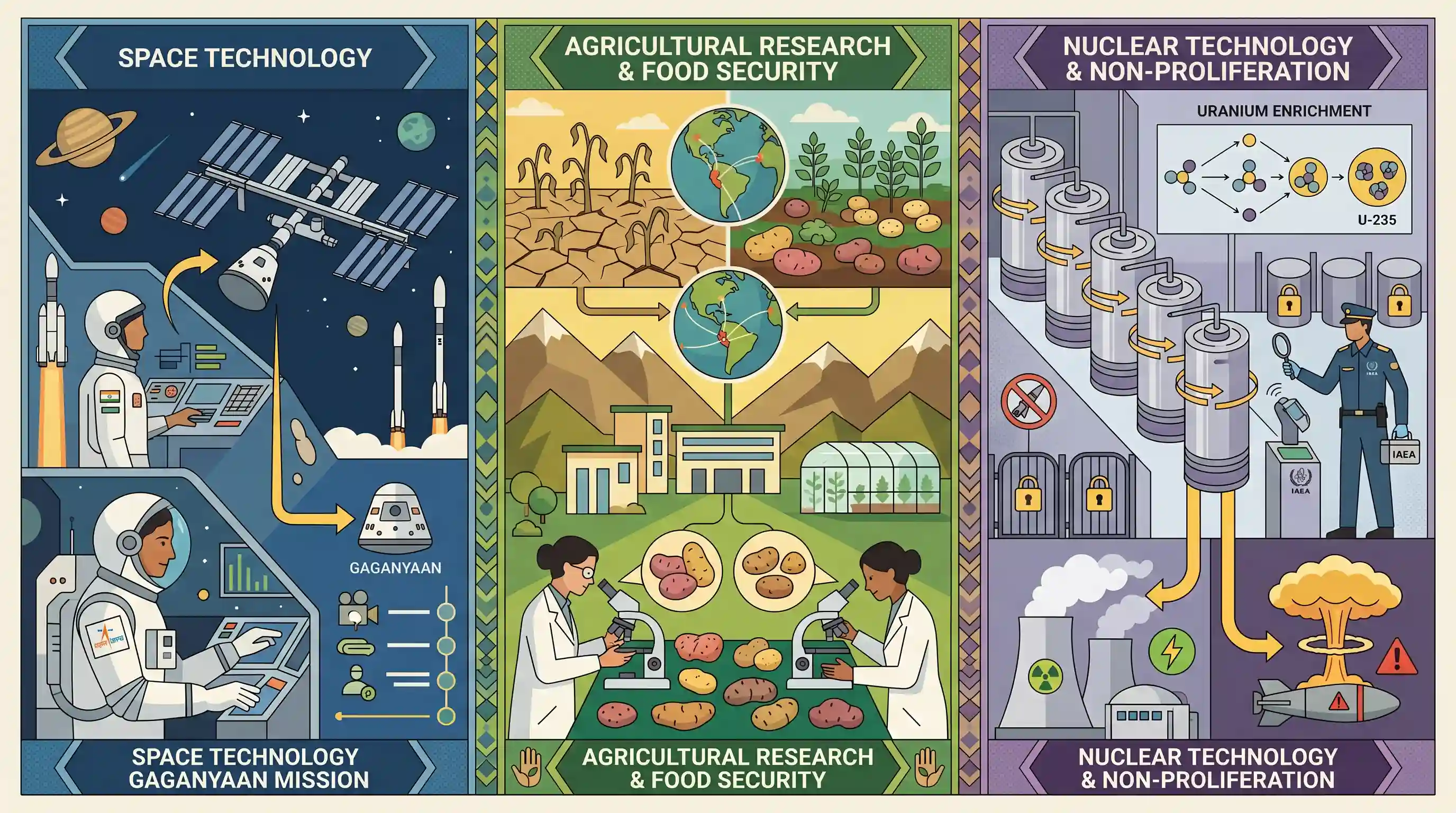
The article breaks down three important topics for UPSC aspirants. First, it discusses Group Captain Shubhanshu Shukla's selection for the Axiom-4 mission to the ISS, highlighting ISRO-NASA space cooperation and the groundwork being laid for India's Gaganyaan mission. Second, it highlights the International Potato Center (CIP) in Peru, detailing its role within the CGIAR network to promote climate-resilient agriculture and global food security through tuber research. Third, it explains the science of Uranium Enrichment—the process of increasing U-235 concentrations via centrifuges—and its dual-use nature for nuclear energy and weapons, which remains a critical flashpoint in international relations and IAEA monitoring.
Key Points
- Group Captain Shubhanshu Shukla is an Indian 'Gaganaut' selected for the Indo-US collaborative Axiom-4 mission to the International Space Station, serving as a precursor to India's indigenous Gaganyaan human spaceflight program.
- The International Potato Center (CIP), a CGIAR research center headquartered in Peru, conducts vital research on root and tuber crops (like potatoes and sweetpotatoes) to enhance global food security, climate resilience, and nutrition.
- Uranium enrichment is the process of increasing the concentration of the fissile U-235 isotope (using gas centrifuges) to fuel civil nuclear reactors (low-enriched) or to create nuclear weapons (highly enriched).
- The geopolitical dimensions of uranium enrichment are closely monitored by the International Atomic Energy Agency (IAEA) to enforce non-proliferation and ensure peaceful uses of nuclear technology.
Important Terms
Gaganyaan Mission

ISRO's indigenous mission to send Indian astronauts ('Gaganyatris') into Low Earth Orbit. It tests India's capability for human spaceflight, life support systems, and safe recovery.
UPSC context
GS Paper III (Science & Tech); tests awareness of India’s self-reliance in space and human-centric mission engineering.
Axiom-4 (Ax-4) Mission
A NASA-supported commercial mission to the ISS. In 2025, it included India’s Group Captain Shubhanshu Shukla, providing crucial operational training and microgravity research experience for ISRO.
UPSC context
GS Paper III (Science & Tech); highlights evolving ISRO-NASA diplomacy and the commercialization of Low Earth Orbit (LEO) operations.
International Potato Center (CIP)
A Peru-headquartered research center within the CGIAR network. It focuses on climate-resilient tuber crops like potatoes and sweetpotatoes to ensure global food and nutritional security.
UPSC context
GS Paper III (Agriculture); relevant for food security, climate-resilient varieties, and India’s South Asia Regional Centre in Agra.
JCPOA (Iran Nuclear Deal)
A 2015 agreement between Iran and P5+1 nations to curb Iran's nuclear program. Its 'snapback' provisions and enrichment limits remain central to global non-proliferation debates in 2025.
UPSC context
GS Paper II (International Relations); key to understanding Iran-India ties, global energy security, and non-proliferation diplomacy.
IAEA
The UN's 'Nuclear Watchdog' responsible for verifying that states use nuclear material for peaceful purposes. It plays a lead role in monitoring Iran's uranium enrichment levels.
UPSC context
GS Paper II (International Institutions); tests knowledge of regulatory bodies and their role in global security and technology oversight.
CGIAR
A global agricultural research partnership. It coordinates international centers to tackle rural poverty and food insecurity through scientific innovation in crops and natural resource management.
UPSC context
GS Paper III (Economy/Agriculture); focuses on the role of international institutional partnerships in promoting sustainable and innovative farming.
Prelims Trap
"Group Captain Shubhanshu Shukla will fly to the ISS aboard India's indigenous Gaganyaan spacecraft."
He is flying on the Axiom-4 mission, a private US commercial spaceflight. Gaganyaan is India's independent human spaceflight program, for which Ax-4 is merely preparation.
Static Concepts Connected
What distinguishes Low-Enriched Uranium (LEU) from Highly Enriched Uranium (HEU)?
- Natural Uranium: Contains only ~0.7% of the fissile U-235 isotope, with the vast majority being the non-fissile U-238.
- LEU (Reactor-grade): Enriched to roughly 3-5% U-235, which is sufficient to sustain reactions in commercial light water nuclear reactors.
- HEU (Weapons-grade): Enriched to 90% or above U-235, which is necessary for explosive chain reactions in nuclear weapons.
What is the CGIAR network's role in global agriculture?
- Global Partnership: An international agricultural research partnership dedicated to reducing poverty, enhancing food and nutrition security, and improving natural resources.
- Research Centers: Operates 15 global research centers, including CIP (Peru), IRRI (Philippines), and ICRISAT (India), focusing on climate-resilient crop varieties.
Cross-Topic Patterns
Gaganyaan + Space Commercialization
Using Axiom Space (a private US company) for astronaut training highlights the growing commercialization of Low Earth Orbit and deepens India-US space diplomacy under the iCET framework.
Agri-Centers + Bio-fortification
CIP's new regional center in Agra focusing on iron-rich potatoes connects directly to UPSC's recurring theme of bio-fortification to combat 'hidden hunger' and micronutrient deficiencies.
IAEA Safeguards + Nuclear Fuel Cycle
Uranium enrichment levels tie into India's civil nuclear liability laws, the Indo-US nuclear deal, and IAEA Additional Protocol safeguards differentiating military vs civilian facilities.

Mapping global agri-centers (CIP in Peru, ICRISAT in India) alongside their specific bio-fortification mandates is highly likely for 2026.
Linked PYQs · 5
Linked PYQs · 5
- 2025PrelimsGS1
Consider the following space missions : I. Axiom-4 II. SpaDeX III. Gaganyaan How many of the space missions given above encourage and support micro-gravity research?
- 2023MainsGS3
What is the main task of India's third moon mission which could not be achieved in its earlier mission? List the countries that have achieved this task. Introduce the subsystems in the spacecraft launched and explain the role of the Virtual Launch Control Centre' at the Vikram Sarabhai Space Centre which contributed to the successful launch from Sriharikota.
- 2021PrelimsGS1
In the context of India's preparation for Climate-Smart Agriculture, consider the following statements : 1. The 'Climate-Smart Village' approach in India is a part of a project led by the Climate Change, Agriculture and Food Security (CCAFS), an international research programme. 2. The project of CCAFS is carried out under Consultative Group on International Agricultural Research (CGIAR) headquartered in France. 3. The International Crops Research Institute for the Semi-Arid Tropics (ICRISAT) in India is one of the CGIAR's research centres. Which of the statements given above are correct?
- 2024PrelimsGS1
With reference to radioisotope thermoelectric generators (RTGs), consider the following statements: 1. RTGs are miniature fission reactors. 2. RTGs are used for powering the onboard systems of spacecrafts. 3. RTGs can use Plutonium-238, which is a by-product of weapons development. Which of the statements given above are correct?
- 2025MainsGS3
The fusion energy programme in India has steadily evolved over the past few decades. Mention India's contributions to the international fusion energy project International Thermonuclear Experimental Reactor (ITER). What will be the implications of the success of this project for the future of global energy?
