India advocates alternative global index and dairy sector growth
Source:Indian Express ↗
Why It Matters
These topics are highly relevant for GS2 (Global Governance, Government Interventions) and GS3 (Agriculture, Livestock). Understanding indices and rural development models helps in addressing both objective Prelims questions and analytical Mains questions.
Summary
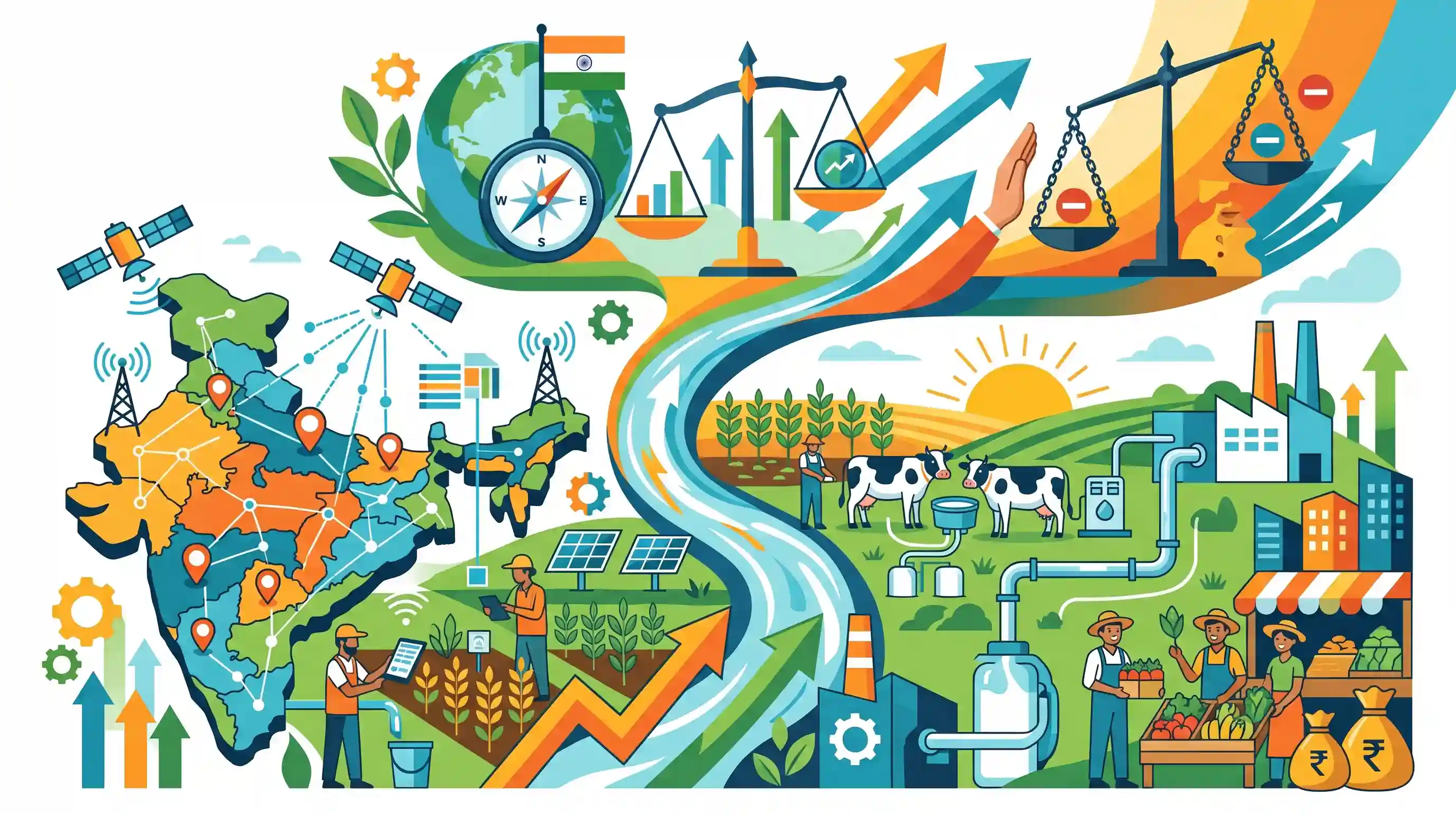
The article discusses three critical areas of current affairs: India's push for an alternative global governance index to counter biased international rankings, strategies to boost the dairy sector for rural economic growth, and the introduction of Aspirational Agriculture Districts to transform underdeveloped agrarian regions using data-driven governance.
Key Points
- India is advocating for a new global governance index to counter Western-centric biases in existing global indices and better represent the Global South.
- Revitalising the dairy and livestock sectors is essential for boosting rural employment and ensuring nutritional security.
- The Aspirational Agriculture Districts initiative aims to replicate the success of the Aspirational Districts Programme by implementing data-driven governance to transform backward agricultural regions.
Important Terms
Aspirational Agriculture Districts

A data-driven initiative targeting 100 low-productivity districts to transform them into high-yield, market-linked, and climate-resilient hubs through convergence of 36 central schemes.
UPSC context
GS Paper 3: Agriculture and Rural Development; tests knowledge of productivity-boosting schemes and regional disparity reduction.
White Revolution 2.0
A 2024 initiative by the Ministry of Cooperation to boost milk procurement by 50%, modernize cooperatives, and empower women in the dairy sector.
UPSC context
GS Paper 3: Economics of Animal Rearing; tests strategies for rural income doubling and cooperative reforms.
International Institute of Administrative Sciences (IIAS)
A Brussels-based organization where India currently holds the Presidency (2025-2028), using the platform to propose a new, unbiased International Governance Index.
UPSC context
GS Paper 2: International Institutions; tests India’s role in shaping global governance standards and countering Western-centric rankings.
Aspirational Districts Programme
Launched in 2018, this NITI Aayog flagship aims to transform 112 underdeveloped districts using a 3C strategy: Convergence, Collaboration, and Competition.
UPSC context
GS Paper 2: Governance and Federalism; core concept for evaluating decentralized development and competitive federalism models.
World Governance Indicators (WGI)
A World Bank-led report measuring governance across six dimensions; India has criticized its reliance on perception-based data from Western institutes.
UPSC context
GS Paper 2: Important Aspects of Governance; tests understanding of global metrics and India’s strategic pushback against methodology bias.
International Monetary Fund (IMF)
An intergovernmental organization established in 1944 to provide financial assistance and policy advice to member countries facing balance-of-payments problems.
UPSC context
GS Paper 2: International Institutions; crucial for understanding global financial stability and India's economic relations.
World Trade Organization (WTO)
An international body founded in 1995 that regulates global trade by negotiating agreements and resolving disputes between member nations.
UPSC context
GS Paper 3: Issues related to direct and indirect farm subsidies and MSP; critical for trade-policy questions.
Prelims Trap
Cereals and pulses constitute the largest share of India's agricultural GDP, followed by horticulture and dairy.
Aspirants often assume foodgrains dominate agri-GDP. In reality, the dairy sector alone accounts for nearly 31% of agricultural GDP, making it the single largest contributor.
Static Concepts Connected
How is the Aspirational Districts Programme (ADP) structured?
- Core Strategy: Rests on Convergence (of Central/State schemes), Collaboration (between multi-level officers), and Competition (district delta rankings).
- Key Themes: Primarily tracks Health & Nutrition, Education, Agriculture & Water Resources, Financial Inclusion & Skill Development, and Basic Infrastructure.
- Nodal Agency: Driven by NITI Aayog in partnership with State Governments and District Administrations to ensure localised implementation.
What makes dairy a unique sub-sector in Indian agriculture?
- Production Base: Dominated by smallholder and marginal farmers; largely relies on agricultural byproducts and crop residues rather than industrial feed.
- Economic Buffer: Provides regular, daily cash flow and acts as an essential insurance mechanism against monsoon failures and crop losses.
- Cooperative Model: The 3-tier 'Anand pattern' ensures a major share of the final consumer price directly reaches the primary producer.
Cross-Topic Patterns
Indices as Geopolitical Tools
India's push for a new IIAS governance index aligns with the Economic Survey's ongoing critique of biased sovereign credit ratings and Western-centric democracy indices.
Competitive Federalism in Agriculture
Applying the Aspirational Districts Programme's dashboard monitoring to PMDDKY integrates agricultural development into the broader UPSC theme of data-driven competitive federalism.
Livestock as a Climate Buffer
Dairy’s daily income generation makes it a critical socio-economic shock absorber for 80 million rural households facing climate-induced crop failures.

Expect a Prelims question comparing the specific selection criteria of Aspirational Agriculture Districts with NITI Aayog's original ADP.
Linked PYQs · 4
Linked PYQs · 4
- 2025MainsGS2
"The reform process in the United Nations remains unresolved, because of the delicate imbalance of East and West and entanglement of the USA vs. Russo-Chinese alliance.” Examine and critically evaluate the East-West policy confrontations in this regard.
- 2015MainsGS3
Livestock rearing has a big potential for providing non-farm employment and income in rural areas. Discuss suggesting suitable measures to promote this sector in India.
- 2017MainsGS3
Explain various types of revolutions, took place in Agriculture after independence in India. How these revolutions have helped in poverty alleviation and food security in India?
- 2019MainsGS2
Performance of welfare schemes that are implemented for vulnerable sections is not so effective due to absence of their awareness and active involvement at all stages of policy process. Discuss.
