Key Socioeconomic Metrics Impacting India Development Goals
Source:Indian Express ↗
Why It Matters
Understanding the Gini Index is crucial for evaluating India's inclusive growth trajectory and poverty alleviation (GS3). The concept of the Global South forms the cornerstone of India's contemporary foreign policy and pursuit of UN reform (GS2). Palm oil consumption relates directly to agricultural policy, import inflation, and environmental sustainability (GS3/GS1).
Summary
This article highlights three distinct subjects highly relevant to the UPSC syllabus: the Gini Index as a metric of income inequality, the geopolitical significance and strategic positioning of the 'Global South', and India's heavy reliance on palm oil imports. It touches upon the economic implications of wealth disparity, India's foreign policy goal of acting as the voice of developing nations, and the agricultural and ecological complexities of attempting self-sufficiency in edible oils.
Key Points
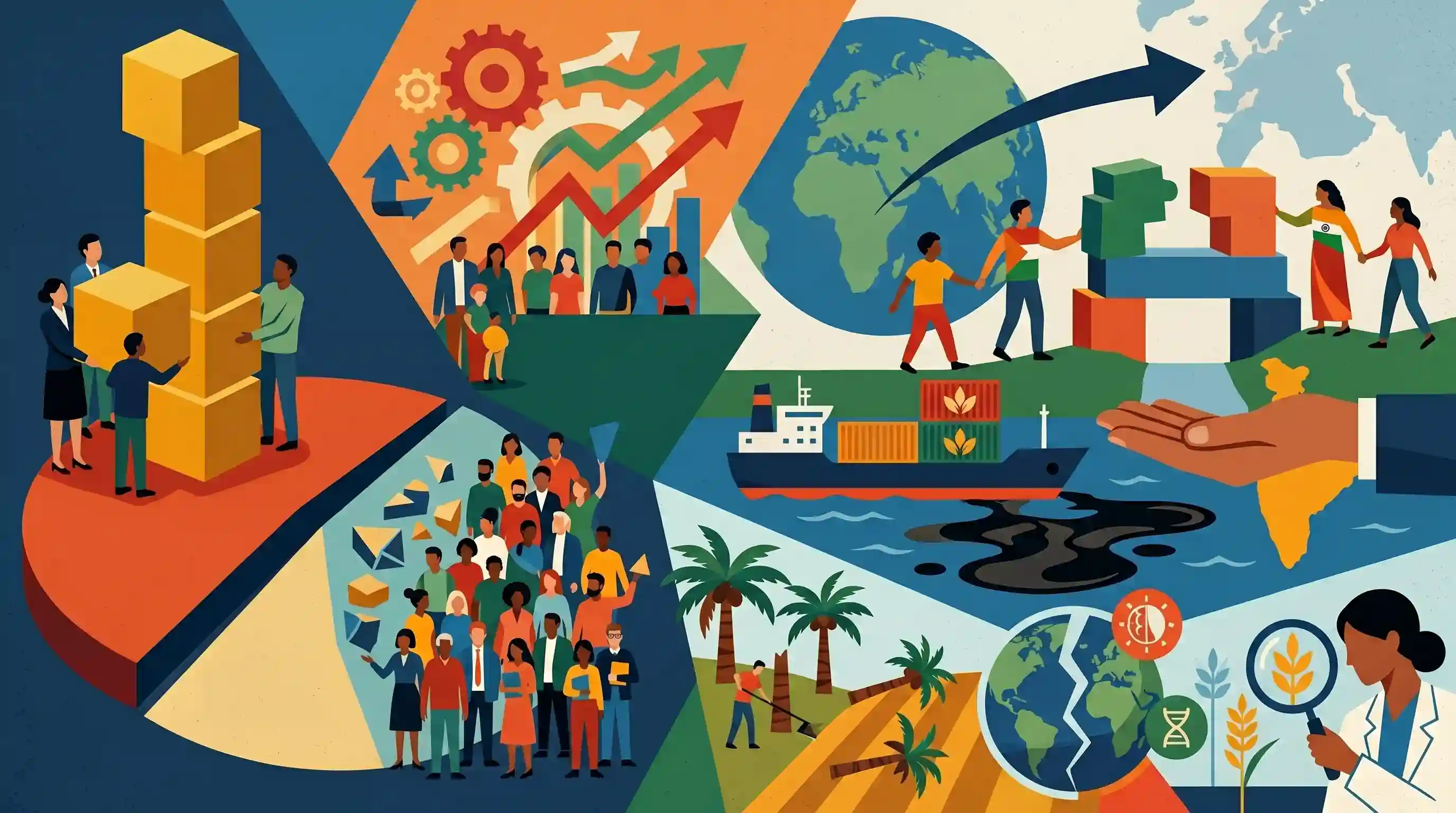
- The Gini Index (or Coefficient) measures income distribution across a population, serving as a critical statistical indicator for assessing economic inequality and inclusive growth.
- The term 'Global South' broadly refers to developing or underdeveloped nations in Asia, Africa, and Latin America, which are increasingly advocating for a reformed multilateral system and a greater geopolitical voice.
- India is one of the world's largest consumers and importers of edible oils, particularly palm oil, raising concerns about heavy import dependence, food security vulnerabilities, and imported inflation.
- To counter this, India is pushing domestic palm oil cultivation through initiatives like the National Mission on Edible Oils - Oil Palm, though this brings ecological concerns regarding deforestation and biodiversity loss.
Important Terms
Gini Index

A statistical measure of income or wealth distribution ranging from 0 (perfect equality) to 1 (perfect inequality). It is derived from the Lorenz Curve to assess economic disparity within a population.
UPSC context
GS Paper III (Economy); tests understanding of income inequality, inclusive growth, and the effectiveness of fiscal policies in wealth redistribution.
Global South
A geopolitical and economic term referring to developing or less-developed nations, primarily in Africa, Asia, and Latin America, sharing historical colonial experiences and seeking greater influence in global governance.
UPSC context
GS Paper II (International Relations); tests India's strategic positioning, foreign policy leadership, and advocacy for emerging economies in multilateral forums.
National Mission on Edible Oils - Oil Palm (NMEO-OP)
A 2021 centrally sponsored scheme aiming to achieve self-reliance in edible oils by expanding oil palm cultivation to 10 lakh hectares, with specific focus on Northeast India and Andaman & Nicobar.
UPSC context
GS Paper III (Agriculture); tests knowledge of government interventions to reduce import dependency and enhance domestic agricultural productivity and food security.
Inclusive Growth
Economic growth that is broad-based across sectors, ensuring equitable distribution of benefits and opportunities for all sections of society, particularly marginalized groups, to reduce poverty and inequality.
UPSC context
GS Paper III (Indian Economy); a core syllabus topic testing the link between GDP expansion and socio-economic justice.
Food Security
The state where all people have physical, social, and economic access to sufficient, safe, and nutritious food to meet dietary needs for an active and healthy life.
UPSC context
GS Paper III (Agriculture/Economics); involves Buffer Stocks, PDS, and self-sufficiency in essential commodities like edible oils.
Prelims Trap
A Gini coefficient of 1 signifies perfect income equality within a population.
Aspirants often invert the scale. In the Gini Index, 0 represents perfect equality, while 1 indicates absolute inequality where one person holds all the wealth.
Static Concepts Connected
How does the Gini Coefficient relate to the Lorenz curve?
- Lorenz Curve: A graphical representation of wealth distribution where a straight diagonal line represents perfect equality.
- Gini Coefficient: Mathematically derived from the Lorenz curve; it is the area between the curve and the perfect equality line divided by the total area under the line.
What are the primary geographical requirements for commercial Oil Palm cultivation?
- Climate: Requires a humid tropical climate with consistent high temperatures ranging from 22°C to 32°C year-round.
- Rainfall: Demands evenly distributed heavy rainfall of 2500-4000 mm annually, making the crop highly water-intensive and unsuited for arid regions.
- Soil Conditions: Requires deep, well-drained, medium-loam soil. It cannot thrive in highly alkaline, saline, or waterlogged soils.
Cross-Topic Patterns
Edible Oil Push vs. Island Ecology
NMEO-OP targets the Andaman & Nicobar islands, creating a syllabus intersection with the Great Nicobar Development Plan, tropical deforestation, and the protection of Particularly Vulnerable Tribal Groups (PVTGs).
Global South & WTO Asymmetries
India leverages its 'Voice of Global South' leadership to push for equitable WTO reforms, particularly demanding permanent solutions for public stockholding and protecting domestic food security programs.

Expect a 2026 multi-statement question mixing edible oil import stats (Palm>Soybean) with ecological risks of NMEO-OP in the Northeast.
Linked PYQs · 4
Linked PYQs · 4
- 2025MainsGS3
Distinguish between the Human Development Index (HDI) and the Inequality-adjusted Human Development Index (IHDI) with special reference to India. Why is the IHDI considered a better indicator of inclusive growth?
- 2022MainsGS3
Is inclusive growth possible under market economy ? State the significance of financial inclusion in achieving economic growth in India.
- 2016MainsGS2
The broader aims and objectives of WTO are to manage and promote international trade in the era of globalization. But the Doha round of negotiations seem doomed due to differences between the developed and the developing countries." Discuss in the Indian perspective.
- 2021PrelimsGS1
With reference to 'palm oil', consider the following statements : 1. The palm oil tree is native to Southeast Asia. 2. The palm oil is a raw material for some industries producing lipstick and perfumes. 3. The palm oil can be used to produce biodiesel. Which of the statements given above are correct?
