Gaganyaan Progress and Political Funding Reforms
Source:Indian Express ↗
Why It Matters
Understanding human spaceflight milestones is vital for GS-3 (Science & Tech). The regulation of political funding impacts GS-2 (Polity) discussions on free and fair elections, while the Atomic Energy Act frames India's nuclear doctrine and energy security debates.
Summary
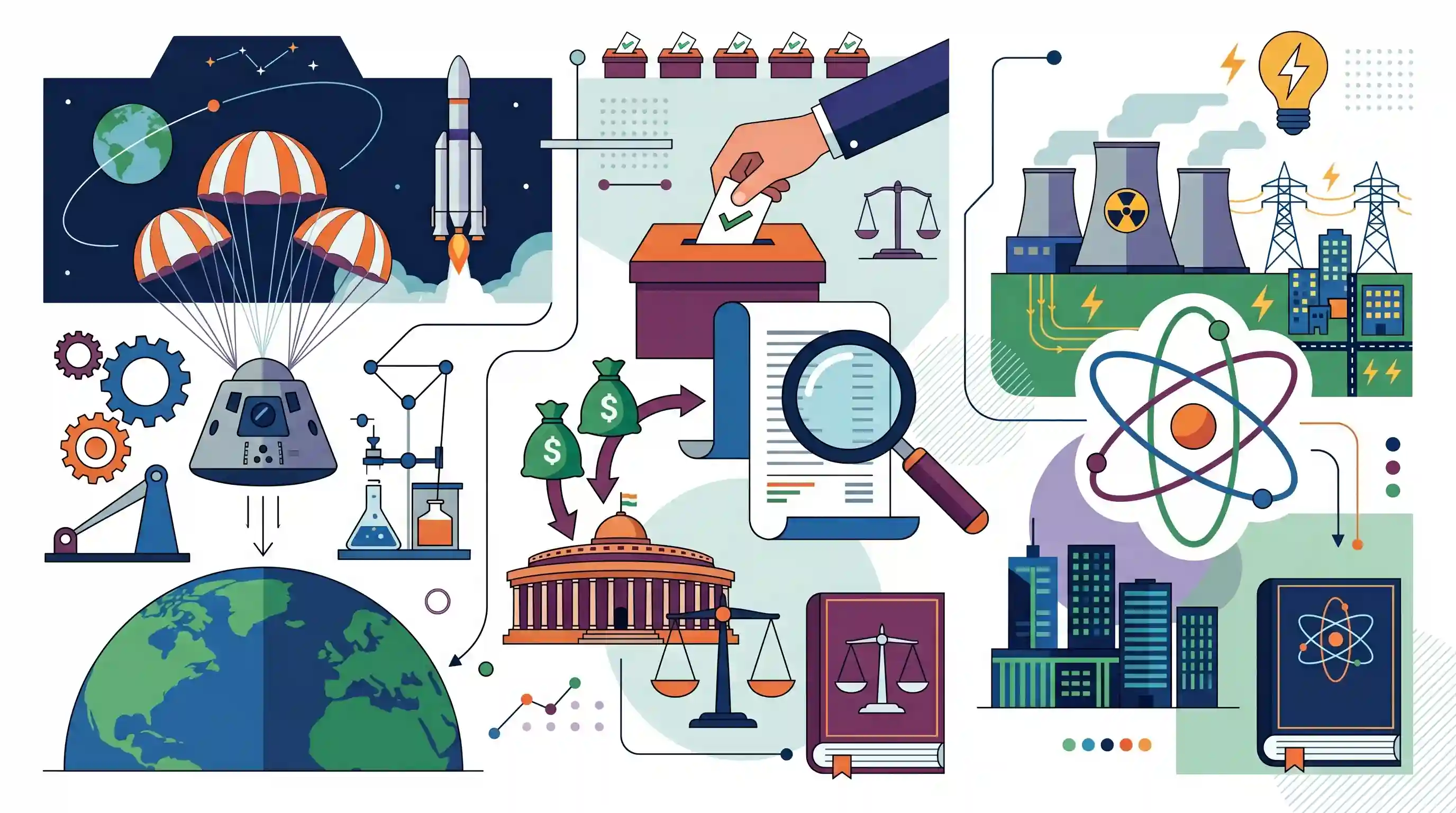
The article provides a roundup of critical UPSC topics spanning science, technology, and polity. It tracks the progress of ISRO's ambitious Gaganyaan human spaceflight mission, focusing on key safety and recovery tests like parachute deployment. In polity, it addresses the persistent debates surrounding the funding of political parties, electoral transparency, and associated legal frameworks like the Representation of the People Act. Finally, it delves into India's Atomic Energy Act, detailing the legislative backbone that governs India's dual-purpose nuclear energy program.
Key Points
- ISRO's Gaganyaan mission continues to make headway with crucial tests, including parachute systems critical for crew module recovery and astronaut safety.
- Funding mechanisms for political parties remain a focal point of electoral reform, emphasizing transparency and accountability under the Representation of the People Act.
- The Atomic Energy Act forms the statutory basis for India's nuclear program, regulating the development, control, and use of atomic energy for both civilian and strategic purposes.
Important Terms
Gaganyaan Mission

ISRO's mission to demonstrate indigenous human spaceflight capability by sending a three-member crew to a 400 km Low Earth Orbit for three days and returning them safely to Earth.
UPSC context
GS Paper III (Science & Technology); focuses on indigenization, space exploration milestones, and ISRO's technological advancements.
Representation of the People Act, 1951
A 1951 Act providing the legal framework for conducting elections, specifying candidate qualifications/disqualifications (e.g., Section 8), and regulating political party registration and electoral offenses.
UPSC context
GS Paper II (Polity/Governance); essential for topics on electoral reforms, transparency in funding, and disqualification of legislators.
Atomic Energy Act, 1962
The primary legislation governing India’s nuclear program, granting the Central Government exclusive control over nuclear minerals, energy production, and research while ensuring safety and secrecy.
UPSC context
GS Paper III (Infrastructure/Energy) and GS Paper II (Government Policies); deals with the legislative framework of India’s dual-purpose nuclear program.
Atomic Energy Regulatory Board (AERB)
A statutory body established in 1983 under the Atomic Energy Act to oversee and enforce safety and regulatory standards for all nuclear and radiation-related activities in India.
UPSC context
GS Paper II (Statutory Bodies/Governance); critical for understanding nuclear safety oversight and the functioning of the Department of Atomic Energy.
Election Commission of India (ECI)
A permanent constitutional body (Article 324) responsible for the superintendence, direction, and control of elections to Parliament, State Legislatures, and the offices of President and Vice-President.
UPSC context
GS Paper II (Constitutional Bodies); frequently tested on its powers, role in electoral transparency, and enforcement of the Model Code of Conduct.
International Atomic Energy Agency (IAEA)
An autonomous international organization established in 1957 that promotes the peaceful use of nuclear energy and ensures it is not used for military purposes through a system of safeguards.
UPSC context
GS Paper II (International Relations); relevant for India’s civil nuclear deals and the distinction between safeguarded (civilian) and non-safeguarded (military) reactors.
Prelims Trap
"Private sector entities are permitted to independently own and operate nuclear power plants in India."
The Atomic Energy Act of 1962 grants the Central Government a monopoly. Private companies can supply components or serve as contractors, but cannot independently own or operate nuclear plants in India.
Static Concepts Connected
What are the key statutory rules for political funding under the RPA 1951?
- Section 29B: Allows registered political parties to accept voluntary contributions but explicitly bans funds from government-owned companies and foreign sources.
- Section 29C: Mandates parties to submit a report to the ECI declaring individual donations exceeding ₹20,000 to remain eligible for income tax exemptions.
Why is Low Earth Orbit (LEO) selected for human spaceflight missions like Gaganyaan?
- Payload Efficiency: LEO (400 km for Gaganyaan) requires significantly less launch energy compared to higher orbits, allowing launch vehicles to carry heavier payloads like crew modules and life support systems.
- Radiation Shielding: Orbiting beneath the Van Allen radiation belts protects astronauts from severe cosmic and solar radiation, which is a critical necessity for human spaceflight safety.
Cross-Topic Patterns
Political Funding & FCRA Amendments
The RPA's ban on foreign funding must be read alongside retrospective FCRA amendments that redefined "foreign sources," deeply impacting the transparency of corporate and overseas political donations.
Atomic Energy Act & Climate Targets
India's Panchamrit targets (500 GW non-fossil capacity) are driving policy debates to amend the 1962 Atomic Energy Act, potentially allowing private sector investment and ownership in Small Modular Reactors (SMRs).

Expect a multi-statement Prelims question combining RPA Section 29C, IT Act exemptions, and FCRA limits on foreign political donations.
Linked PYQs · 5
Linked PYQs · 5
- 2025PrelimsGS1
Consider the following space missions : I. Axiom-4 II. SpaDeX III. Gaganyaan How many of the space missions given above encourage and support micro-gravity research?
- 2017MainsGS3
India has achieved remarkable successes in unmanned space missions including the Chandrayaan and Mars Orbitter Mission, but has not ventured into manned space missions. What are the main obstacles to launching a manned space mission, both in terms of technology and logistics? Examine critically.
- 2020PrelimsGS1
In India, why are some nuclear reactors kept under "IAEA Safeguards" while others are not?
- 2025MainsGS2
Discuss the 'corrupt practices' for the purpose of the Representation of the People Act, 1951. Analyze whether the increase in the assets of the legislators and/or their associates, disproportionate to their known sources of income, would constitute 'undue influence' and consequently a corrupt practice.
- 2020MainsGS2
There is a need for simplification of procedure for disqualification of persons found guilty of corrupt practices under the Representation of Peoples Act". Comment.
