Free Trade Agreements and Soil Health Management
Source:Indian Express ↗
Why It Matters
It covers a diverse mix of GS2 and GS3 topics, connecting macro-economic trade policies, crucial agricultural sustainability schemes, and emerging social health issues in the digital age.
Summary
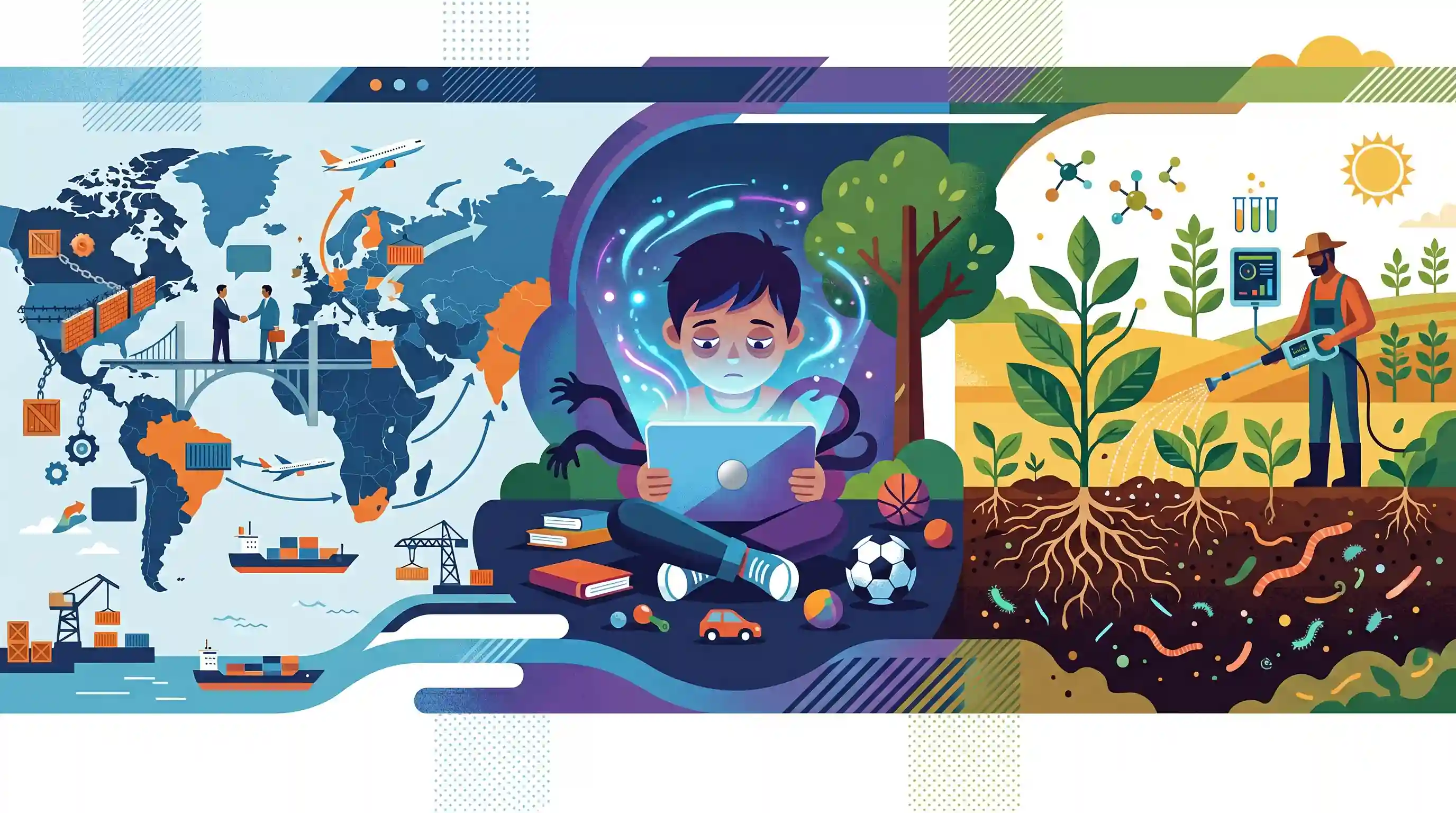
This UPSC Key highlights three critical areas for aspirants: the economic implications of Free Trade Agreements in a protectionist global environment, the social and health challenges of screen addiction among children, and the agricultural necessity of preserving soil health through optimized fertilizer use.
Key Points
- Free Trade Agreements (FTAs) are crucial for India to navigate the shift from multilateralism to bilateralism and integrate into global value chains.
- Screen addiction among children has become a major public health and social challenge in the digital era, necessitating robust policy interventions.
- Maintaining soil health is fundamental for sustainable agriculture, with schemes like the Soil Health Card aiming to optimize fertilizer use and improve crop productivity.
Important Terms
Free Trade Agreements (FTAs)

Agreements between two or more countries to reduce or eliminate trade barriers like tariffs and quotas, facilitating easier cross-border movement of goods and services.
UPSC context
GS Paper 2/3: Crucial for India's foreign trade policy, global supply chain integration, and bilateral economic relations.
Soil Health Card Scheme
A flagship agricultural scheme launched in 2015 to provide farmers with crop-specific reports on 12 soil nutrient parameters and recommended fertilizer dosages.
UPSC context
GS Paper 3: Essential for sustainable agriculture, soil fertility management, and optimizing input costs for farmers.
National Commission for Protection of Child Rights (NCPCR)
A statutory body established under the CPCR Act, 2005, to ensure that all laws and policies in India safeguard the rights of children.
UPSC context
GS Paper 2: Important for topics on statutory bodies, social justice, and child welfare mechanisms.
World Trade Organization (WTO)
The only global international organization dealing with the rules of trade between nations, established in 1995 to ensure trade flows smoothly and predictably.
UPSC context
GS Paper 2/3: Relevant for multilateralism, global trade rules, and India's position in international trade disputes.
Prelims Trap
"The Soil Health Card assesses only primary macronutrients (NPK) to evaluate agricultural soil."
The Soil Health Card actually measures 12 distinct parameters, including secondary nutrients (S), micronutrients (Zn, Fe, Cu, Mn, Bo), and physical soil properties (pH, EC, OC).
Static Concepts Connected
What differentiates forward and backward linkages in Global Value Chains?
- Forward Linkages: Domestic value-added that is exported and used by other countries as inputs to produce their own exports (e.g., India exporting raw steel).
- Backward Linkages: Foreign value-added (imported inputs) embedded in a country's own exports, crucial for sectors like electronics assembly and advanced manufacturing.
What is the statutory mandate of the NCPCR?
- Statutory Origin: Established under the CPCR Act, 2005 to safeguard child rights outlined in the Indian Constitution and the UN Convention on the Rights of the Child.
- Key Powers: Can inquire into complaints, take suo motu cognizance of child rights violations, and inspect juvenile or protective homes.
Cross-Topic Patterns
Fertilizer Subsidy + Ecological Ruin
The heavily skewed urea subsidy drives the imbalanced NPK application, linking India's fiscal deficit directly to soil degradation and necessitating alternative schemes like PM-PRANAM.
Screen Addiction + DPDP Act 2023
Pediatric digital wellbeing directly connects to the Digital Personal Data Protection (DPDP) Act's strict mandate requiring verifiable parental consent before processing the data of minors.

Expect a multi-statement Prelims question mixing the 12 parameters of Soil Health Cards with PM-PRANAM objectives in 2026.
Linked PYQs · 3
Linked PYQs · 3
- 2025MainsGS3
What are the challenges before the Indian economy when the world is moving away from free trade and multilateralism to protectionism and bilateralism? How can these challenges be met?
- 2017PrelimsGS1
Consider the following statements: The nation-wide 'Soil Health Card Scheme' aims at 1. expanding the cultivable area under irrigation. 2. enabling the banks to assess the quantum of loans to be granted to farmers on the basis of soil quality. 3. checking the overuse of fertilizers in farmlands. Which of the above statements is/are correct?
- 2025MainsGS2
The National Commission for Protection of Child Rights has to address the challenges faced by children in the digital era. Examine the existing policies and suggest measures the Commission can initiate to tackle the issue.
