Fertiliser subsidies, executive framework, and fertility trends
Source:Indian Express ↗
Why It Matters
The topics straddle multiple core syllabus areas: GS2 (Polity and Governance), GS3 (Agriculture, Subsidies, and Economy), and GS1 (Society and Population). Understanding how subsidies impact the exchequer, how constitutional appointments operate, and what a declining TFR means for India's demographic dividend is essential for both Prelims and Mains.
Summary
This curated 'UPSC Key' daily current affairs brief examines three critical areas for civil services preparation: the fiscal and agricultural implications of fertiliser subsidies, the constitutional provisions concerning the Prime Minister and the Council of Ministers following an election or swearing-in, and the demographic shifts associated with India's declining Total Fertility Rate (TFR). The analysis bridges economic policy (subsidies), polity (executive formation), and sociology/geography (population dynamics).
Key Points
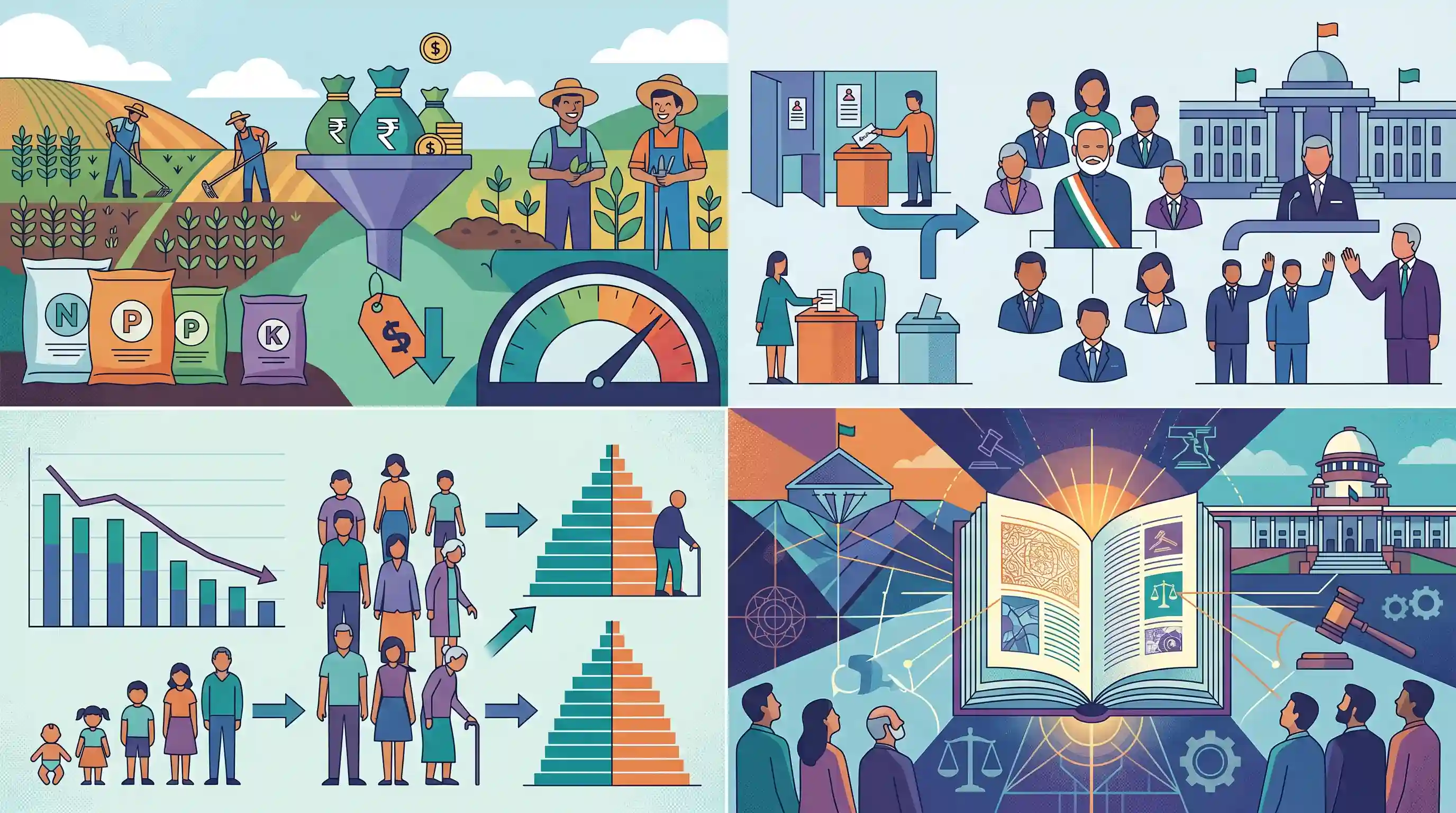
- Fertiliser Subsidy: Analyzes the economic rationale and fiscal burden of subsidizing fertilisers (like urea) in India, highlighting the need for rationalization, balanced nutrient application, and the role of Direct Benefit Transfer (DBT).
- Executive Functioning: Reviews the constitutional mechanisms surrounding the appointment of the Prime Minister and the Council of Ministers, focusing on Articles 74 and 75, and the principle of collective responsibility.
- Total Fertility Rate (TFR): Examines India's trajectory towards replacement-level fertility, its implications for the demographic dividend, and the intersection of population stabilization with women's education and empowerment.
Important Terms
Direct Benefit Transfer (DBT)

A mechanism delivering subsidies directly to beneficiaries via Aadhaar-linked accounts. In fertilizers, it currently releases subsidies to manufacturers only after Aadhaar-authenticated Point-of-Sale (PoS) transactions at retail outlets.
UPSC context
GS-III: Indian Economy/Agriculture. Critical for understanding fiscal consolidation, subsidy leakages, and digital governance reforms.
Nutrient Based Subsidy (NBS)
A 2010 scheme where the government provides a fixed per-kilogram subsidy based on the nutrient content (N, P, K, S) of non-urea fertilizers to promote balanced soil health.
UPSC context
GS-III: Agriculture. Tests knowledge of fertilizer pricing distortions, soil nutrient imbalance, and agricultural productivity.
Council of Ministers
The constitutional body (Articles 74-75) headed by the Prime Minister to aid and advise the President. Its strength is capped at 15% of the Lok Sabha's total membership.
UPSC context
GS-II: Polity/Union Executive. Fundamental to understanding parliamentary democracy and the executive's accountability to the legislature.
Total Fertility Rate (TFR)
The average number of children a woman is expected to have during her reproductive years (15–49). India’s TFR has currently fallen to approximately 1.9-2.0.
UPSC context
GS-I: Social Issues/Geography. Essential for analyzing demographic transitions, population stabilization, and the 'demographic dividend.'
Parliament of India
The supreme legislative body of India (Articles 79-122), consisting of the President and two Houses: the Rajya Sabha (Council of States) and the Lok Sabha (House of the People).
UPSC context
GS-II: Polity/Legislature. Tests bicameralism, law-making functions, and the structural organization of the Indian State.
Prelims Trap
"Under the fertiliser DBT scheme, subsidy amounts are directly credited to the bank accounts of purchasing farmers."
False. Fertiliser subsidies are paid to manufacturing companies, not farmers. The payment is triggered only after the retail sale is authenticated via Aadhaar on PoS machines at the retail shop.
Static Concepts Connected
How does the pricing regime differ between Urea and P&K fertilisers?
- Urea Pricing: The government fixes the Maximum Retail Price (MRP) at heavily subsidized rates. It is strictly excluded from the Nutrient Based Subsidy (NBS) scheme.
- P&K Pricing: Covered under the NBS scheme where a fixed subsidy per nutrient is provided, but the MRP is technically market-determined and decontrolled.
- Ecological Impact: This disparity causes farmers to overuse cheaper Urea (Nitrogen), heavily skewing India's NPK usage ratio away from the ideal 4:2:1.
Where do the 'Council of Ministers' and 'Cabinet' find mention in the Constitution?
- Council of Ministers: Originally enshrined in Articles 74 and 75 to aid and advise the President, and to enforce collective responsibility to the Lok Sabha.
- The Cabinet: Not in the original Constitution. It was inserted later by the 44th Amendment Act, 1978, specifically under Article 352 concerning the proclamation of a National Emergency.
Cross-Topic Patterns
Subsidy distortions and Soil Health Cards
The exclusion of Urea from NBS drives excessive nitrogen use, directly counteracting the objectives of the Soil Health Card scheme which aims to promote balanced macro and micro-nutrient application.
Declining TFR and post-2026 Delimitation
Uneven fertility decline (TFR drops) between Southern and Northern states creates a major political friction point for federalism regarding the impending post-2026 Lok Sabha delimitation and Finance Commission devolutions.

Expect a multi-statement question contrasting fertiliser DBT mechanics with PM-KISAN, or linking uneven TFR decline to 2026 delimitation.
Linked PYQs · 5
Linked PYQs · 5
- 2023MainsGS3
What are the direct and indirect subsidies provided to farm sector in India? Discuss the issues raised by the World Trade Organization (WTO) in relation to agricultural subsidies.
- 2015MainsGS3
In what way could replacement of price subsidy with Direct Benefit Transfer (DBT) change the scenario of subsidies in India ? Discuss.
- 2024PrelimsGS1
The total fertility rate in an economy is defined as:
- 2024PrelimsGS1
Consider the following countries : 1. Italy 2. Japan 3. Nigeria 4. South Korea 5. South Africa Which of the above countries are frequently mentioned in the media for their low birth rates, or ageing population or declining population?
- 2019MainsGS1
“Empowering women is the key to control population growth.” Discuss.
