Key current affairs themes span security and infrastructure policies
Source:Indian Express ↗
Why It Matters
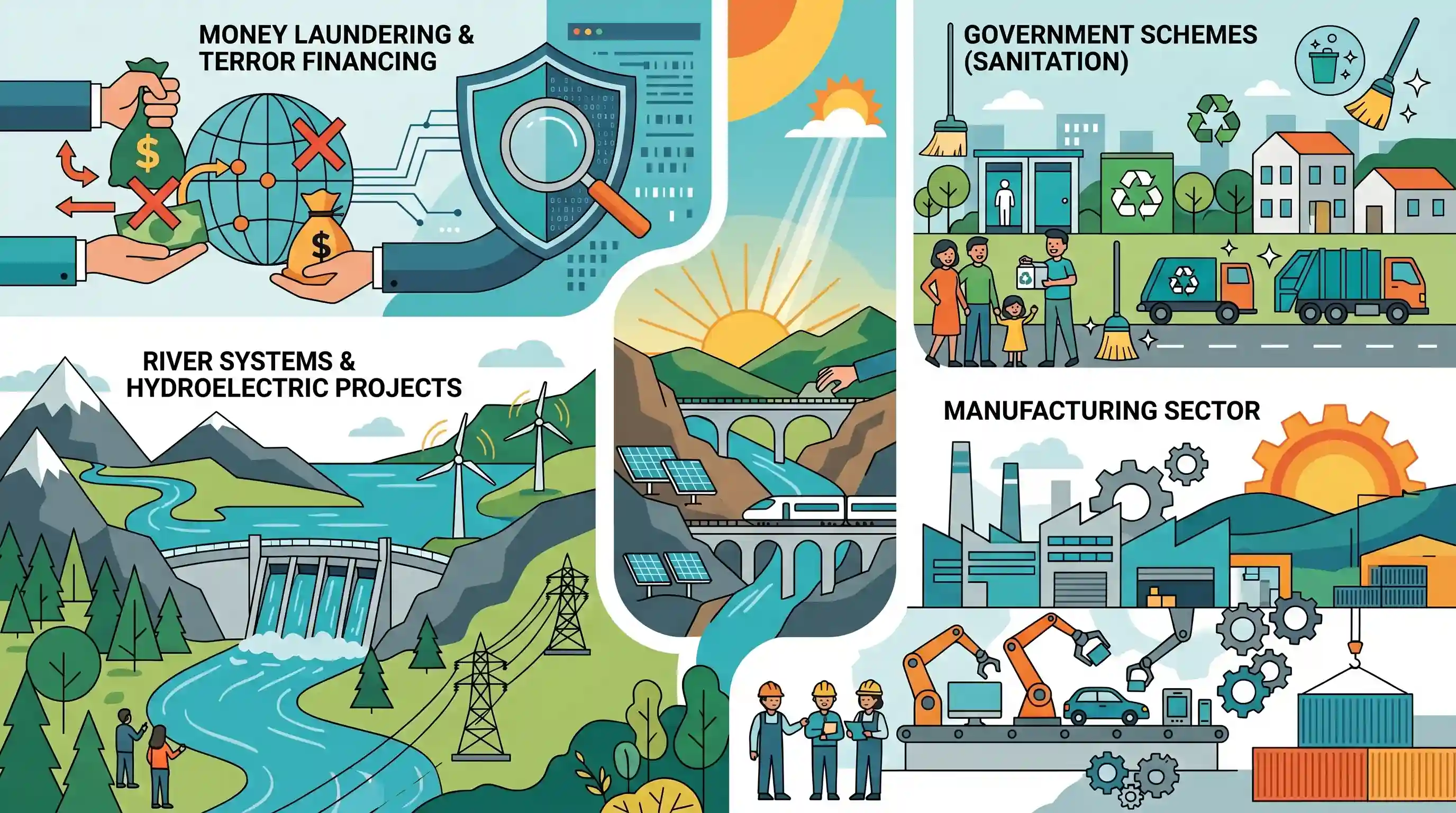
This multi-topic compilation covers fundamental themes across multiple General Studies papers, testing the aspirant's ability to interlink economic initiatives (Make in India), internal security (FATF), environmental geography (Siang Dam), and social justice (SBM).
Summary
The article provides a comprehensive overview of several key issues relevant to the UPSC examination, including international regulatory frameworks like the FATF, regional development through the Rising Northeast Summit, environmental and infrastructure debates surrounding the Siang Dam, sanitation advancements via the Swachh Bharat Mission (SBM), and economic growth strategies under Make in India. These topics span internal security, economic development, geography, and social welfare policies.
Key Points
- The FATF continues to be a central body in establishing international standards against money laundering and terror financing.
- The Rising Northeast Summit underscores the strategic and economic importance of infrastructure, connectivity, and development in India's northeastern states.
- The proposed Siang Dam in Arunachal Pradesh brings to the forefront the balance between tapping hydroelectric potential and managing ecological and displacement concerns on the Brahmaputra river system.
- The Swachh Bharat Mission (SBM) highlights the importance of targeted sanitation programs for achieving broader public health outcomes.
- The Make in India initiative remains pivotal in the government's strategy to increase the manufacturing sector's share in the GDP.
Important Terms
Financial Action Task Force (FATF)

An intergovernmental body established by the G7 in 1989 to set global standards for combating money laundering, terrorist financing, and the proliferation of weapons of mass destruction.
UPSC context
GS Paper II/III: Tests knowledge of international regulatory bodies and their impact on India’s internal security and financial compliance.
Swachh Bharat Mission (SBM)
A nationwide campaign launched in 2014 to achieve universal sanitation, eliminate open defecation, and improve solid waste management through infrastructure construction and behavioral change.
UPSC context
GS Paper II: Evaluates understanding of social welfare schemes, public health interventions, and governance strategies for sanitation.
Make in India
A flagship initiative launched in 2014 to transform India into a global manufacturing hub by facilitating investment, fostering innovation, and enhancing skill development across 27 sectors.
UPSC context
GS Paper III: Tests analysis of industrial policy, manufacturing growth, and strategies for economic self-reliance.
Siang Upper Multipurpose Project
A proposed 11,000 MW hydroelectric project in Arunachal Pradesh designed for flood control, power generation, and countering upstream Chinese dam construction on the Brahmaputra.
UPSC context
GS Paper I/II/III: Examines river systems, transboundary water disputes, and the infrastructure-environment balance.
Rising Northeast Summit
A strategic investor summit focused on transforming Northeast India into a development hub and gateway to ASEAN through infrastructure, tourism, and industrial investment.
UPSC context
GS Paper II/III: Focuses on regional development, the Act East Policy, and strategic connectivity in border regions.
Prelims Trap
FATF was established by the UN to combat money laundering and terror financing.
It was established by the G-7 (not UN). Furthermore, its initial 1989 mandate was strictly money laundering; terror financing was added in 2001.
Static Concepts Connected
How does the Brahmaputra river evolve as it enters India?
- Origin: Originates as the Yarlung Tsangpo in the Chemayungdung glacier of the Kailash range in Tibet.
- Entry into India: Enters Arunachal Pradesh through a deep gorge as the Siang or Dihang river.
- Name Change: Becomes the Brahmaputra in Assam only after merging with two left-bank tributaries: Dibang and Lohit.
What are the FATF Grey and Black lists?
- Grey List: Jurisdictions under increased monitoring that are actively working with FATF to address strategic deficiencies.
- Black List: Non-Cooperative Countries or Territories (NCCTs) facing severe global economic sanctions.
- Economic Impact: Listed nations face restricted access to international loans from bodies like the IMF, World Bank, and ADB.
Cross-Topic Patterns
Siang Dam + Lower-Riparian Rights
India's push for the Siang mega-dam is strategically linked to establishing lower-riparian user rights in response to China's upstream run-of-the-river projects on the Yarlung Tsangpo.
Northeast Geography + Act East Policy
The Rising Northeast framework relies heavily on physical geography, testing aspirants on the exact routing of strategic projects like the Kaladan Multi-Modal transit and IMT Trilateral Highway.

Expect a multi-statement Q linking NE hydro-projects (Siang) with downstream ecology, lower-riparian rights, and Brahmaputra tributaries.
Linked PYQs · 5
Linked PYQs · 5
- 2021MainsGS3
Discuss how emerging technologies and globalisation contribute to money laundering. Elaborate measures to tackle the problem of money laundering both at national and international levels.
- 2023MainsGS3
Give out the major sources of terror funding in India and the efforts being made to curtail these sources. In the light of this, also discuss the aim and objective of the 'No Money for Terror (NMFT)' Conference recently held at New Delhi in November 2022.
- 2016PrelimsGS1
Which of the following is/are tributary/tributaries of Brahmaputra? 1. Dibang 2. Kameng 3. Lohit Select the correct answer using the code given below.
- 2023MainsGS3
Faster economic growth requires increased share of the manufacturing sector in GDP, particularly of MSMEs. Comment on the present policies of the Government in this regard.
- 2017MainsGS2
To ensure effective implementation of policies addressing water, sanitation and hygiene needs the identification of the beneficiary segments is to be synchronized with the anticipated outcomes." Examine the statement in the context of the WASH scheme.
