Ethanol Blending and Biodiversity Conservation Focus of Policy Review
Source:Indian Express ↗
Why It Matters
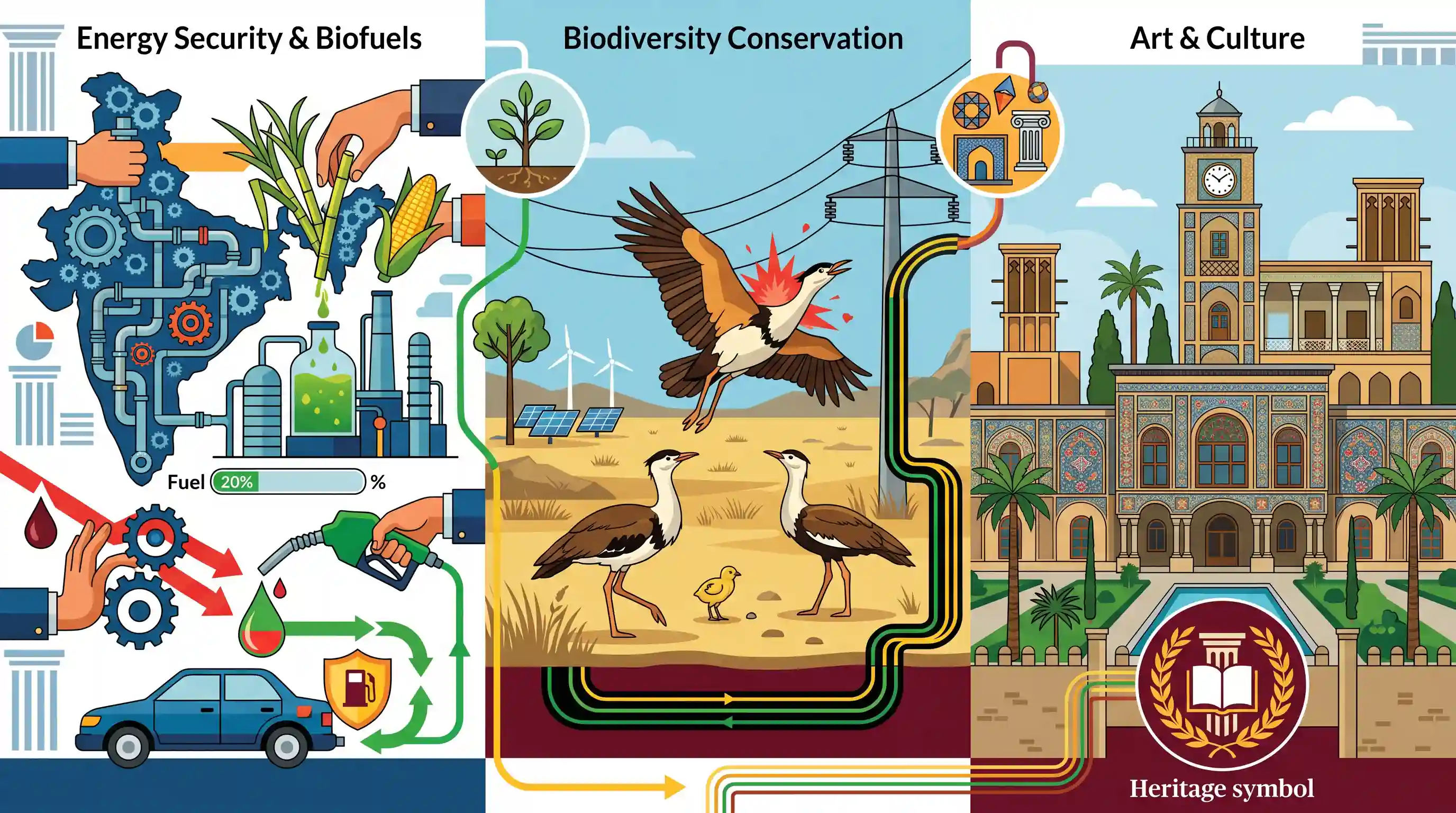
Ethanol blending and renewable energy are central to India's climate commitments and economic security (GS3). The Great Indian Bustard frequently appears in Prelims regarding endangered species, while UNESCO sites like Golestan Palace touch upon global cultural heritage (GS1).
Summary
The article highlights key topics for UPSC preparation, focusing on India's push for ethanol blending to mitigate the energy crisis and reduce import dependence. It details the ecological challenges facing the critically endangered Great Indian Bustard, particularly threats from overhead power transmission lines. Additionally, it explores the cultural and historical significance of the Golestan Palace, a UNESCO World Heritage site in Iran, representing the architectural innovations of the Qajar era.
Key Points
- Ethanol blending is a critical component of India's strategy to address the energy crisis, reduce fossil fuel import reliance, and achieve green energy transitions.
- The Great Indian Bustard is a critically endangered avian species whose population is severely threatened by collisions with overhead power lines, primarily in its remaining habitats in Rajasthan and Gujarat.
- The Golestan Palace in Tehran, Iran, is a recognized UNESCO World Heritage site that exemplifies Qajar-era architecture by blending traditional Persian crafts with Western architectural influences.
Important Terms
Ethanol Blended Petrol (EBP) Programme

A government initiative launched in 2003 to blend ethanol (a biofuel) with petrol to reduce crude oil imports and carbon emissions.
UPSC context
GS Paper 3 (Energy Security); tests knowledge of biofuel mandates and the E20 target by 2025-26.
Wildlife Protection Act (WPA), 1972
India's primary legal framework for protecting wild animals, birds, and plants, categorizing species into Schedules based on their protection status.
UPSC context
GS Paper 3 (Environment); tests understanding of legal safeguards for critically endangered species like the Great Indian Bustard.
Great Indian Bustard (GIB)
A critically endangered bird species endemic to India and Pakistan, primarily found in Rajasthan, and an indicator of grassland health.
UPSC context
GS Paper 3 (Biodiversity); frequent Prelims focus on its IUCN status and ecological threats from infrastructure.
Golestan Palace
A UNESCO World Heritage site in Tehran, Iran, showcasing the integration of traditional Persian crafts with 18th-century European architectural influences.
UPSC context
GS Paper 1 (Art and Culture); relevant for global heritage sites and historical architectural exchanges between East and West.
Supreme Court of India (Environmental Role)
India's apex court which has issued significant rulings on environmental conservation, including the protection of GIB habitats from power lines.
UPSC context
GS Paper 2 (Judiciary); tests judicial activism and the balance between development and ecological preservation.
National Policy on Biofuels, 2018
A policy aimed at achieving 20% ethanol blending in petrol by 2025-26, focusing on indigenous feedstock for fuel production.
UPSC context
GS Paper 3 (Environment/Economy); tests knowledge of renewable energy transitions and agricultural diversification.
Prelims Trap
First-generation (1G) ethanol is primarily produced from agricultural residues and non-food biomass.
UPSC frequently swaps biofuel generations. 1G ethanol comes from edible food crops (sugarcane, maize). It is 2G that utilizes agricultural residues and non-food biomass.
Static Concepts Connected
What are the four generations of biofuels?
- 1G Biofuels: Produced directly from food crops like sugarcane, maize, and starch.
- 2G Biofuels: Produced from non-food crops and agricultural waste (lignocellulosic biomass) like stubble or wood chips.
- 3G Biofuels: Derived from specially engineered algae that boast high lipid content.
- 4G Biofuels: Derived from genetically engineered crops specifically designed for high carbon capture and storage capability.
What is the ecological status and significance of the Great Indian Bustard?
- Conservation Status: Critically Endangered (IUCN), Schedule I (Wildlife Protection Act, 1972), and Appendix I (CITES).
- Habitat: Endemic to the Indian subcontinent, mostly confined to dry grasslands of Rajasthan (Desert National Park) and Gujarat.
- Ecological Role: Serves as a flagship indicator species representing the ecological health of dry grassland ecosystems.
Cross-Topic Patterns
Renewable Infrastructure vs. Biodiversity
The GIB's collision with solar and wind transmission lines highlights the growing policy trade-off between expanding renewable energy infrastructure and protecting vulnerable, critically endangered endemic ecology.
The Water-Energy-Food Nexus
Diverting water-intensive food crops like rice and sugarcane for ethanol production strains groundwater in drought-prone areas, linking bio-energy policy directly to agricultural vulnerabilities and food inflation.

Expect 2026 multi-statement questions matching critically endangered species (like GIB) directly to their specific anthropogenic threats.
Linked PYQs · 4
Linked PYQs · 4
- 2009PrelimsGS1
In the context of alternative sources of energy, ethanol as a viable bio-fuel can be obtained from
- 2025PrelimsGS1
Consider the following substances: I. Ethanol II. Nitroglycerine III. Urea Coal gasification technology can be used in the production of how many of them?
- 2012PrelimsGS1
Which one of the following groups of animals belongs to the category of endangered species?
- 2022MainsGS3
Do you think India will meet 50 percent of its energy needs from renewable energy by 2030 ? Justify your answer. How will the shift of subsidies from fossil fuels to renewables help achieve the above objective ? Explain.
