East Asia Summit Cash Transfers And Island States Vulnerability
Source:Indian Express ↗
Why It Matters
It spans core syllabus areas across international groupings, welfare economics, and climate vulnerabilities affecting small island states, making it high-yield for both Prelims and Mains.
Summary
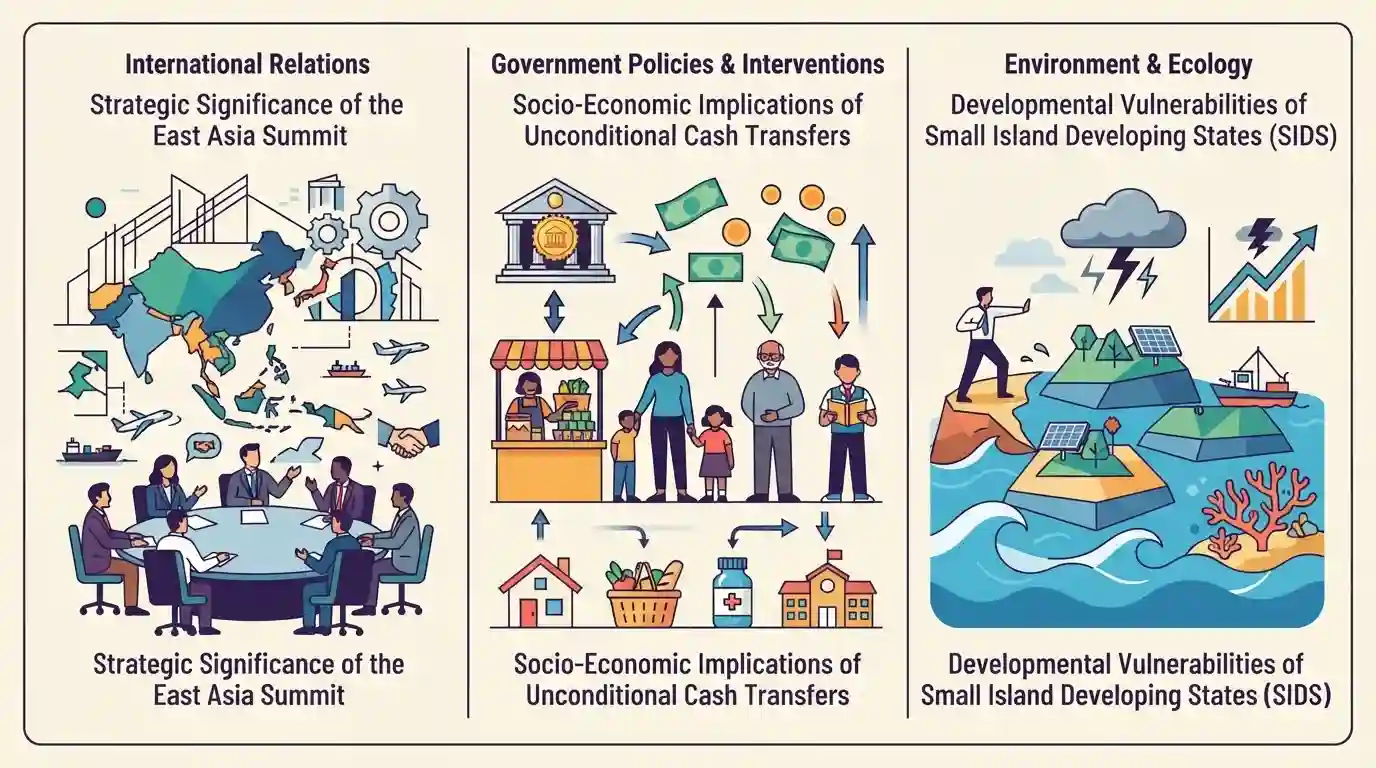
The article covers core current affairs themes important for UPSC preparation, including the strategic significance of the East Asia Summit in regional architecture, the socio-economic implications of unconditional cash transfers, and the unique developmental vulnerabilities confronting Small Island Developing States.
Key Points
- The East Asia Summit serves as a premier leader-led forum for strategic dialogue and cooperation in the Indo-Pacific region.
- Unconditional cash transfers are increasingly analyzed for their welfare impacts, poverty reduction, and economic efficiency compared to conditional or in-kind transfers.
- Small Island Developing States face severe disproportionate vulnerabilities due to climate change, sea-level rise, and economic shocks, requiring targeted global support.
Important Terms
East Asia Summit

A premier leaders-led strategic dialogue forum established in 2005, comprising 18 member countries, focusing on security, trade, and regional cooperation in the Indo-Pacific.
UPSC context
Crucial for GS Paper II (International Relations), specifically India's Indo-Pacific strategy, multilateral groupings, and regional security architecture.
Small Island Developing States
A distinct group of developing countries facing unique social, economic, and environmental vulnerabilities, notably extreme susceptibility to climate change, sea-level rise, and narrow economic bases.
UPSC context
Important for GS Paper III (Environment & Ecology, Climate Change) and GS Paper II (Global Groupings and Vulnerable Sections).
Prelims Trap
The East Asia Summit includes all member states of the European Union and the Asia-Pacific Economic Cooperation.
Aspirants often confuse EAS membership with ASEAN or APEC, incorrectly assuming all Asia-Pacific nations or EU members are part of the EAS.
Static Concepts Connected
What are the core membership criteria and foundational pillars of the East Asia Summit (EAS)?
- ASEAN Centrality: ASEAN centrality forms the bedrock, with the 10 ASEAN member states acting as the driving force of the forum.
- Dialogue Partners: Eight dialogue partners comprise India, China, Japan, South Korea, Australia, New Zealand, the United States, and Russia.
- Priority Areas: Six priority areas of cooperation include environment, energy, education, finance, global health, and disaster management.
What are the primary structural challenges confronting Small Island Developing States (SIDS) in global climate negotiations?
- Disproportionate Impact: Disproportionate impact suffer severe climate vulnerabilities, sea-level rise, and extreme weather events despite negligible global greenhouse gas emissions.
- Economic Narrowness: Economic narrowness dependence on tourism, remittances, and imported fossil fuels makes them acutely sensitive to external economic shocks.
- MVI Framework: Multidimensional Vulnerability Index advocates push for alternative financing criteria beyond per-capita GDP to access concessional climate finance.
Cross-Topic Patterns
Indo-Pacific Architectures & Climate Vulnerability Linkages
India leverages plurilateral leader-led architectures like the EAS to anchor its Indo-Pacific Oceans Initiative, balancing maritime security with economic resilience for climate-vulnerable island states.
Welfare Economics vs. Capital Expenditure Trade-offs
Debates over unconditional cash transfers intersect directly with fiscal deficit targets and capital expenditure prioritization under the Fiscal Responsibility and Budget Management Act.

Expect statement-based questions combining EAS membership criteria, SIDS financing frameworks, and fiscal impact of cash transfers.
Linked PYQs · 3
Linked PYQs · 3
- 2021MainsGS2
The newly tri-nation partnership AUKUS is aimed at countering China's ambitions in the Indo-Pacific region. Is it going to supersede the existing partnerships in the region? Discuss the strength and impact of AUKUS in the present scenario.
- 2015MainsGS3
In what way could replacement of price subsidy with Direct Benefit Transfer (DBT) change the scenario of subsidies in India ? Discuss.
- 2025PrelimsGS1
The World Bank warned that India could become one of the first places where wet-bulb temperatures routinely exceed 35 °C. Which of the following statements best reflect(s) the implication of the above-said report? I. Peninsular India will most likely suffer from flooding, tropical cyclones and droughts. II. The survival of animals including humans will be affected as shedding of their body heat through perspiration becomes difficult. Select the correct answer using the code given below.
