US foreign policy shift UAPA and merchandise trade deficit
Source:Indian Express ↗
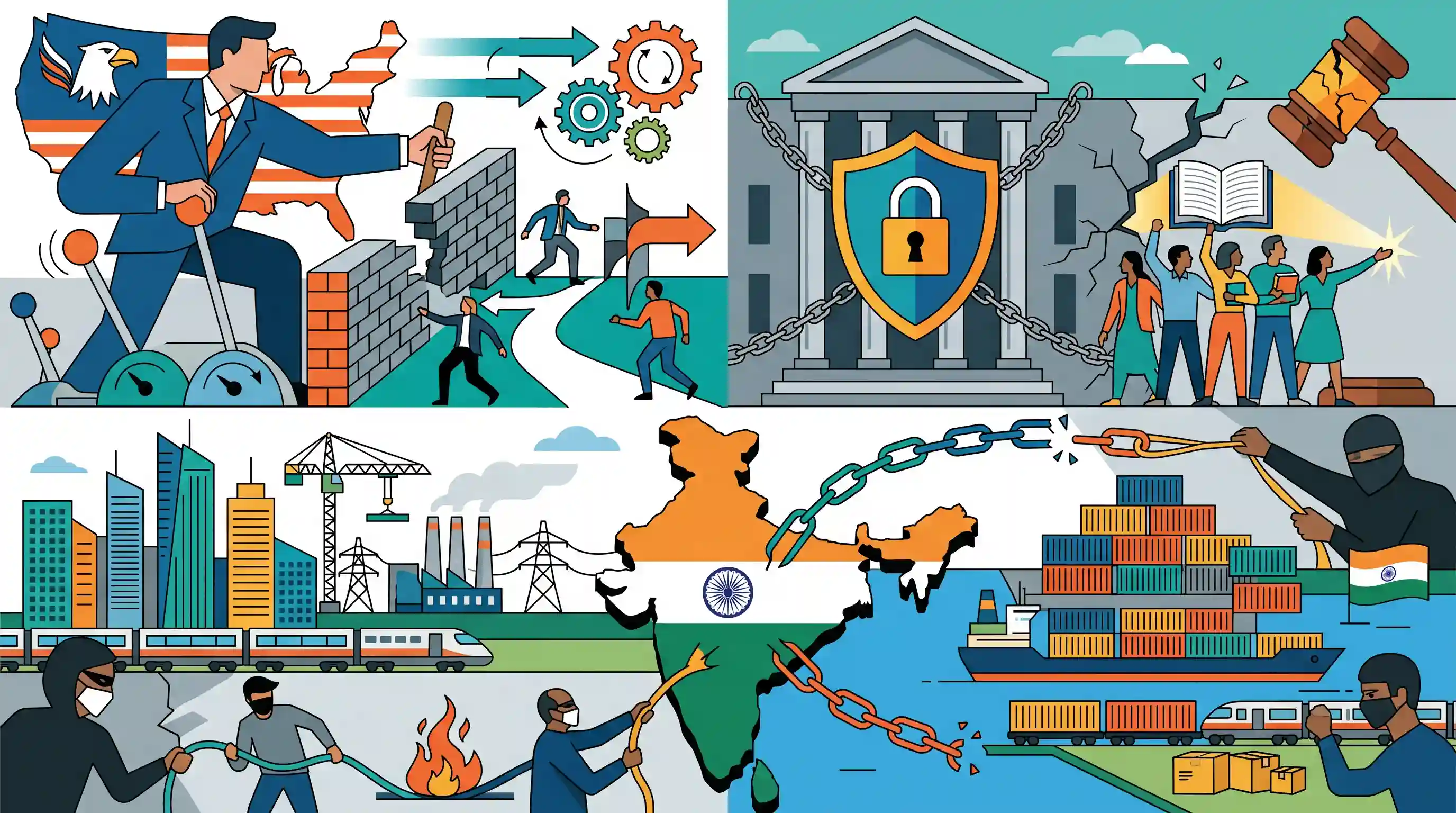
Why It Matters
This covers three highly tested UPSC themes: changing US hegemony/foreign policy (GS2 IR), the delicate balance of anti-terror laws like UAPA with human rights (GS2 Polity & GS3 Security), and structural challenges in India's balance of payments and trade dynamics (GS3 Economy).
Summary
This multi-topic analysis covers critical areas for UPSC aspirants: the emerging 'Donroe Doctrine' reflecting US protectionism and foreign policy recalibration, ongoing legal and rights-based debates surrounding the Unlawful Activities (Prevention) Act (UAPA), and the macroeconomic challenges posed by India's widening trade deficit. It highlights how India must adapt its foreign policy and economic strategies to navigate global trade fragmentation, while managing internal security laws that frequently intersect with civil liberties.
Key Points
- The 'Donroe Doctrine' represents a conceptual shift in US foreign policy, blending Donald Trump's 'America First' protectionism with the historical Monroe Doctrine, signaling inward-looking economic and strategic posturing.
- Such protectionist stances by developed nations complicate global trade architecture, requiring India to navigate bilateral challenges while pushing for self-reliance and diversified supply chains.
- The Unlawful Activities (Prevention) Act (UAPA) remains central to debates on internal security, specifically regarding its stringent bail conditions under Section 43D(5) and the balance between national security and fundamental rights.
- India's widening merchandise trade deficit underscores structural economic vulnerabilities, including heavy reliance on imported energy, electronics, and capital goods, despite a strong services surplus offsetting the overall current account deficit.
Important Terms
Donroe Doctrine

A portmanteau of "Donald" (Trump) and "Monroe," describing a 2026-era US foreign policy asserting exclusive security dominance over the Western Hemisphere and rejecting interference from non-hemispheric powers like China or Russia.
UPSC context
GS Paper 2: International Relations; tests understanding of shifting global power dynamics and US-led protectionism's impact on India.
Unlawful Activities (Prevention) Act (UAPA)
India’s primary anti-terror legislation (1967) used to prevent activities threatening national sovereignty. It grants the government powers to designate individuals/groups as terrorists and imposes stringent bail conditions.
UPSC context
GS Paper 3: Internal Security; focuses on the balance between national security laws and Fundamental Rights.
National Investigation Agency (NIA)
India's specialized counter-terrorism law enforcement agency established in 2008. It has pan-India jurisdiction to investigate and prosecute offenses under the UAPA and other scheduled acts.
UPSC context
GS Paper 3: Internal Security; relevant for questions on security architecture and central-state jurisdictional dynamics.
Trade Deficit
An economic condition where the value of a country's imports exceeds its exports. For India, a widening deficit impacts macroeconomic stability and the Current Account Deficit (CAD).
UPSC context
GS Paper 3: Indian Economy; tests ability to analyze trade balance, export competitiveness, and external sector vulnerabilities.
World Trade Organization (WTO)
The only global international organization dealing with the rules of trade between nations. It facilitates negotiations and settles disputes to ensure trade flows smoothly and predictably.
UPSC context
GS Paper 2 & 3: International Institutions; relevant for multilateral trade governance and India’s stance on subsidies.
Prelims Trap
India’s widening merchandise trade deficit has resulted in a proportionate and identical widening of its Current Account Deficit.
India's Current Account Deficit (CAD) does not widen proportionately to the merchandise trade deficit because India consistently runs a massive surplus in services exports and remittances, which significantly offsets the goods deficit.
Static Concepts Connected
What is the "prima facie" test for bail under UAPA Section 43D(5)?
- Strict Bail Standard: Courts must deny bail if reasonable grounds exist to believe the accusation against the individual is "prima facie true" based on the police case diary.
- Reversal of Norm: It functionally shifts the operational burden, prioritizing state security and making "jail the rule, bail the exception" in terror-related offenses.
- Constitutional Override: Despite the statutory bar, the Supreme Court has ruled that Constitutional courts can still grant bail if the Article 21 right to a speedy trial is violated.
What components differentiate Balance of Trade (BoT) from the Current Account Deficit (CAD)?
- Balance of Trade: Refers specifically to the net difference between the export and import of physical, tangible goods (merchandise).
- Current Account: Includes the BoT, plus net income from services (invisibles), primary income (profits, interest, dividends), and secondary income (remittances and grants).
- India's Position: India structurally runs a BoT deficit due to oil and electronics imports, but uses strong IT/BPO services exports and diaspora remittances to manage its CAD.
Cross-Topic Patterns
US Protectionism & WTO Paralysis
The 'Donroe Doctrine' accelerates US retreat from multilateralism, compounding the WTO's Appellate Body crisis and forcing India toward bilateral FTAs and plurilateral frameworks like IPEF.
Statutory Bail Bars vs. Article 21
UAPA's strict bail conditions link directly to Article 21 (Right to Speedy Trial). The Supreme Court has increasingly invoked fundamental rights to bypass statutory bail bars in cases of prolonged incarceration.

Expect a 2026 Prelims multi-statement question contrasting UAPA's 'prima facie' bail bar (Sec 43D5) with standard BNSS/CrPC principles.
Linked PYQs · 3
Linked PYQs · 3
- 2025MainsGS3
What are the challenges before the Indian economy when the world is moving away from free trade and multilateralism to protectionism and bilateralism? How can these challenges be met?
- 2019MainsGS3
Indian Government has recently strengthened the anti-terrorism laws by amending the Unlawful Activities (Prevention) Act (UAPA), 1967 and the NIA Act. Analyze the changes in the context of prevailing security environment while discussing the scope and reasons for opposing the UAPA by human rights organizations.
- 2020PrelimsGS1
With reference to the international trade of India at present, which of the following statements is/are correct? 1. India's merchandise exports are less than its merchandise imports. 2. India's imports of iron and steel, chemicals, fertilisers and machinery have decreased in recent years. 3. India's exports of services are more than its imports of services. 4. India suffers from an overall trade/current account deficit. Select the correct answer using the code given below:
