Delimitation Bilateral Ties and Female Labour Force Participation
Source:Indian Express ↗
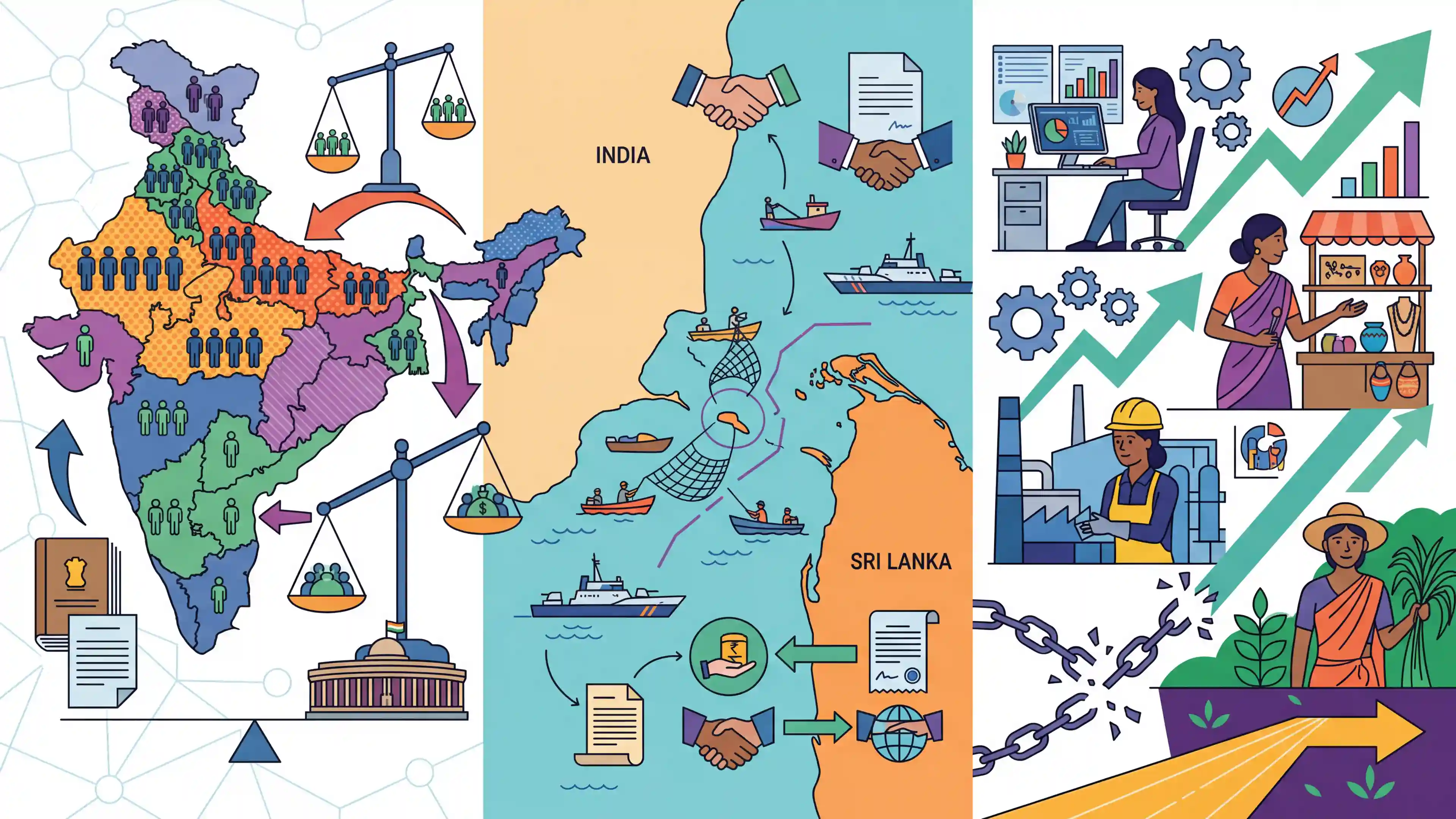
Why It Matters
These topics cover core syllabus areas across GS1, GS2, and GS3. The delimitation debate touches on the heart of India's asymmetric federalism and demographic shift. India-Sri Lanka relations are pivotal to India's maritime security and Indian Ocean strategy. FLFPR is a critical indicator of the nation's ability to harness its demographic dividend and promote gender justice in the economy.
Summary
The article analyzes three major UPSC-relevant topics: Delimitation, India-Sri Lanka relations, and the Female Labour Force Participation Rate (FLFPR). It discusses the constitutional and federal challenges surrounding the upcoming delimitation exercise, which threatens to reduce the political weight of Southern Indian states due to their slower population growth. In international relations, it highlights the historical and strategic nuances of India-Sri Lanka ties, focusing on the Katchatheevu maritime dispute, fishermen's rights, and India's economic diplomacy. Finally, it examines economic and social trends in India's FLFPR through the lens of recent Periodic Labour Force Survey (PLFS) data, emphasizing the structural barriers preventing women from achieving full economic empowerment.
Key Points
- The impending delimitation of Lok Sabha constituencies based on the next census raises federal concerns, as Southern states fear losing political representation despite successful population control measures.
- The Delimitation Commission is tasked with redrawing electoral boundaries to maintain equitable population representation across constituencies.
- India-Sri Lanka bilateral relations are heavily influenced by maritime boundary disputes, the historical ceding of Katchatheevu island, and recurring issues involving fishermen in the Palk Strait.
- India's "Neighbourhood First" policy was evident in its crucial economic assistance to Sri Lanka during its recent sovereign debt and economic crisis.
- The Female Labour Force Participation Rate (FLFPR), tracked by the Periodic Labour Force Survey (PLFS), is a key metric for assessing inclusive economic growth and women's empowerment.
- Despite some improvements in rural areas, structural barriers, societal norms, and unpaid care work continue to hinder women's participation in the formal, high-productivity workforce.
Important Terms
Delimitation Commission

An independent statutory body established to redraw electoral boundaries for Lok Sabha and Assembly constituencies based on census data, ensuring the principle of "one person, one vote, one value."
UPSC context
GS Paper II (Polity). Crucial for understanding federalism, representation, and constitutional mandates like Article 82.
Periodic Labour Force Survey (PLFS)
A nationwide survey conducted by the NSO since 2017 to provide frequent estimates of key employment indicators like LFPR, WPR, and Unemployment Rate.
UPSC context
GS Paper III (Economy). Essential for data-driven analysis of India’s labor market and demographic dividend.
Female Labour Force Participation Rate (FLFPR)
The percentage of women in the working-age population (15+) who are either employed or actively seeking work; a key metric for gender-inclusive growth.
UPSC context
GS Paper I (Social Issues) and Paper III (Economy). Critical for discussing gender empowerment and inclusive development.
Katchatheevu
An uninhabited island in the Palk Strait ceded to Sri Lanka by India in 1974, which remains a focal point of disputes regarding traditional fishing rights.
UPSC context
GS Paper II (International Relations). Tests knowledge of India-Sri Lanka bilateral ties and maritime boundary agreements.
National Statistical Office (NSO)
India’s central statistical body under MoSPI, formed in 2019 by merging the CSO and NSSO to coordinate national data on GDP, employment, and inflation.
UPSC context
GS Paper III (Economy). Important for understanding the institutional framework behind national accounts and official socio-economic data.
Article 82
The constitutional provision mandating Parliament to enact a Delimitation Act after every Census to readjust the allocation of seats in the Lok Sabha.
UPSC context
GS Paper II (Polity). Fundamental for understanding the constitutional requirement and timing of electoral boundary adjustments.
Prelims Trap
"The orders of the Delimitation Commission are subject to judicial review to ensure federal equity."
Orders of the Delimitation Commission have the force of law and cannot be questioned in any court to prevent indefinite electoral delays.
Static Concepts Connected
What are the constitutional provisions for the Delimitation Commission?
- Article 82: Parliament enacts a Delimitation Act after every Census to redraw electoral boundaries based on population.
- Binding Orders: Its orders have the force of law and cannot be challenged in any court.
- Composition: Headed by a retired Supreme Court judge, it includes the CEC and respective State Election Commissioners.
What key employment metrics does the Periodic Labour Force Survey (PLFS) measure?
- LFPR: Labour Force Participation Rate measures the percentage of the population working or actively seeking work.
- WPR: Worker Population Ratio indicates the percentage of employed persons within the total population.
- UR: Unemployment Rate calculates the percentage of unemployed persons strictly among those in the labour force.
Cross-Topic Patterns
Population Control vs. Political Power
Southern states achieved replacement-level fertility to aid demographic transition, but this economic success now threatens their Lok Sabha representation post-2026.
Unpaid Care Work and FLFPR
Recent rises in rural FLFPR often reflect distress-driven self-employment or unpaid family labor, masking the actual lack of formal, high-productivity job creation for women.
Maritime Boundaries & Executive Power
Unlike ceding sovereign land (requiring a Constitutional Amendment like the 100th CAA), settling the Katchatheevu maritime boundary was executed via a bilateral executive agreement.

Expect a multi-statement Prelims question contrasting the 1974 Katchatheevu executive agreement with the 100th CAA (Bangladesh LBA).
Linked PYQs · 5
Linked PYQs · 5
- 2024PrelimsGS1
How many Delimitation Commissions have been constituted by the Government of India till December 2023?
- 2023MainsGS2
Discuss the contribution of civil society groups for women's effective and meaningful participation and representation in state legislatures in India.
- 2022MainsGS2
“While the national political parties in India favour centralisation, the regional parties are in favour of State autonomy.” Comment.
- 2022MainsGS2
India is an age-old friend of Sri Lanka.’ Discuss India's role in the recent crisis in Sri Lanka in the light of the preceding statement.
- 2024MainsGS1
Distinguish between gender equality, gender equity and women's empowerment. Why is it important to take gender concerns into account in programme design and implementation?
