Counterterrorism policy frameworks and artificial intelligence stacks
Source:Indian Express ↗
Why It Matters
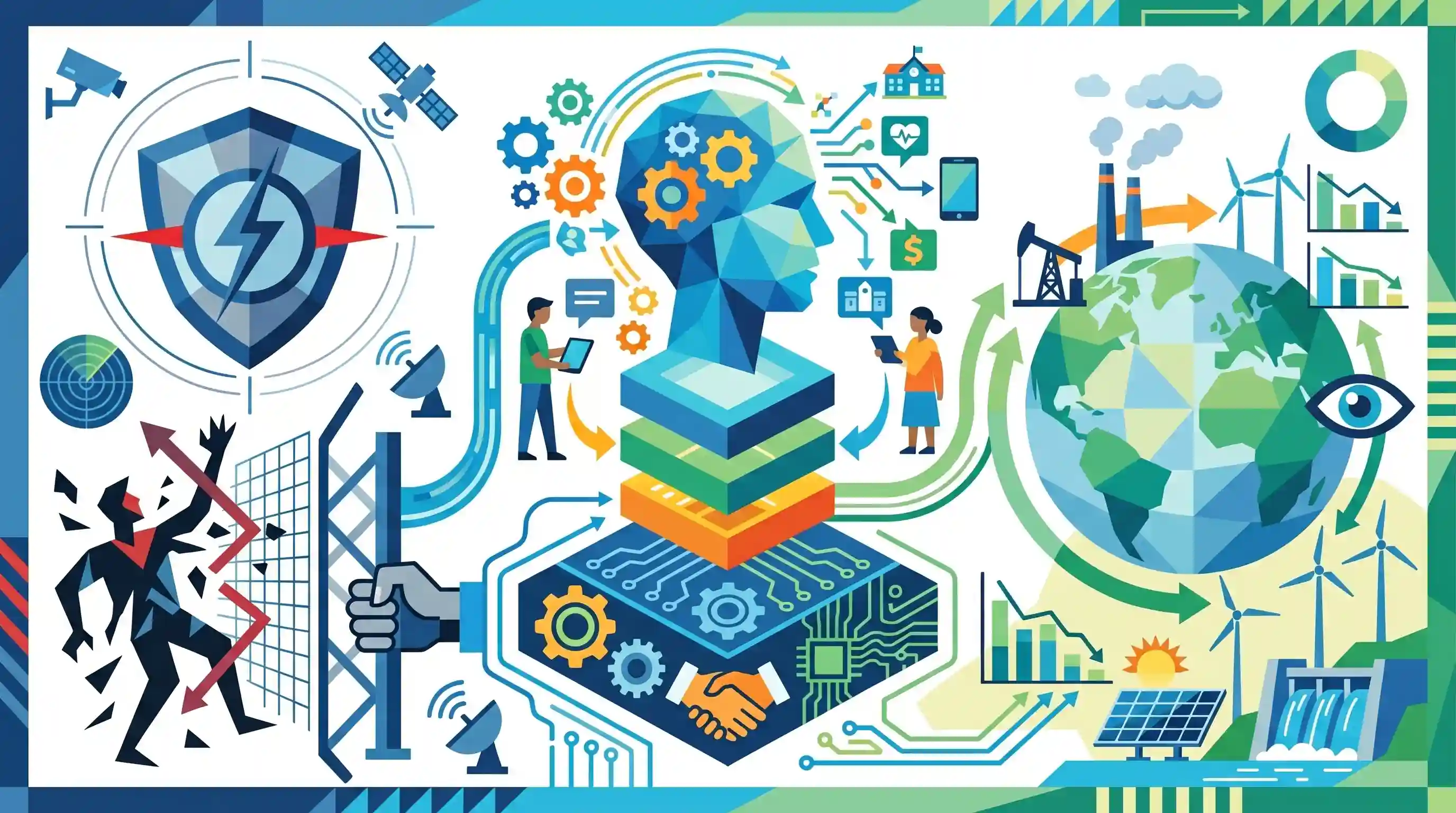
These themes represent critical frontiers for India's policymaking—securing internal borders against terrorism (Prahaar), pioneering digital governance through next-generation technology (AI Stack), and navigating global energy transitions (IEA).
Summary
This UPSC Key covers three critical policy and technological developments. First, the unveiling of the counter-terror policy 'Prahaar', signaling a robust operational and strategic approach to India's internal security threats. Second, the development of an 'AI Stack', which seeks to extend India's successful Digital Public Infrastructure (DPI) model to Artificial Intelligence, democratizing AI access for governance and socio-economic solutions. Third, the role of the International Energy Agency (IEA) in the context of global energy transitions, emissions tracking, and energy security.
Key Points
- The 'Prahaar' counter-terror policy emphasizes a proactive, coordinated approach to neutralizing internal security threats and dismantling terror networks.
- India's 'AI Stack' initiative aims to create a robust, scalable digital infrastructure to integrate Artificial Intelligence into public service delivery and governance, building on the success of Aadhaar and UPI.
- The International Energy Agency (IEA) continues to be a central institution in tracking global energy trends, emphasizing the need for sustainable energy transitions and robust energy security frameworks.
Important Terms
Prahaar policy

India's first comprehensive National Counter-Terrorism Policy (2026). It adopts a 'zero-tolerance' approach through a seven-pillar framework (P-R-A-H-A-A-R), focusing on intelligence-led prevention, inter-agency coordination, and human rights-compliant operations.
UPSC context
GS Paper 3 (Internal Security): Tests knowledge of national security doctrines, inter-agency synergy, and the evolution of India's counter-terror framework.
AI Stack
A framework applying Digital Public Infrastructure (DPI) principles to AI. It provides shared access to compute power, datasets, and foundational models as 'Digital Public Goods' to democratize AI for governance and socio-economic inclusion.
UPSC context
GS Paper 3 (Science & Tech): Relevant for AI governance, 'AI for All' strategy, and India's leadership in digital public platforms.
Digital Public Infrastructure (DPI)
A set of interoperable, open-standard digital systems (e.g., Aadhaar, UPI, DigiLocker) that serve as foundational blocks for delivering public services, financial inclusion, and data exchange at population scale.
UPSC context
GS Paper 2 & 3: Key concept for digital governance, e-governance reforms, and global digital cooperation (G20/UN).
International Energy Agency (IEA)
A Paris-based autonomous intergovernmental organization (est. 1974) that advises on energy security, economic development, and environmental sustainability. It coordinates collective responses to energy supply disruptions and clean energy transitions.
UPSC context
GS Paper 2 (International Organizations): Tests India's status as an Associate Country and its pursuit of full membership to influence global energy policy.
Prelims Trap
"India is a full member of the International Energy Agency (IEA)."
India is currently an "Association" country, not a full member. Full IEA membership strictly requires a country to first be a member of the OECD.
Static Concepts Connected
What are the foundational layers of India's Digital Public Infrastructure (India Stack)?
- Identity Layer: Provides foundational, biometric-backed digital identity (e.g., Aadhaar, e-KYC) to establish universal authentication.
- Payments Layer: Enables interoperable, high-volume, real-time financial transactions (e.g., UPI, Aadhaar Enabled Payment System).
- Data Empowerment Layer: Facilitates secure, consent-based digital data sharing and verification (e.g., DigiLocker, Account Aggregator framework).
What are India's primary federal institutions for counter-terrorism coordination?
- NIA: The central counter-terrorism law enforcement agency empowered to investigate and prosecute terror offenses across states without special permission.
- NATGRID: An integrated intelligence grid that links databases of various government departments for rapid access by intelligence agencies.
- MAC (Multi-Agency Centre): The nodal body functioning under the Intelligence Bureau (IB) designed specifically for sharing and coordinating terror-related intelligence.
Cross-Topic Patterns
Sovereign AI + Tech Diplomacy
India's push for the "India AI Stack" extends its Global South diplomacy, aiming to export indigenous tech infrastructure much like it did with UPI and Aadhaar during its G20 presidency.
Prahaar policy + FATF Commitments
The Prahaar policy's focus on choking terror finance aligns directly with India's regulatory crackdowns under the PMLA framework and its strict compliance with FATF mutual evaluation guidelines.

Expect a multi-statement Prelims question in 2026 integrating the 'India AI Stack' layers with 'Sovereign AI' and DPI concepts.
Linked PYQs · 4
Linked PYQs · 4
- 2021MainsGS3
Analyse the multidimensional challenges posed by external state and non-state actors, to the internal security of India. Also discuss measures required to be taken to combat these threats.
- 2025MainsGS3
Terrorism is a global scourge. How has it manifested in India? Elaborate with contemporary examples. What are the counter measures adopted by the State? Explain.
- 2022PrelimsGS1
Consider the following statements : 1. "The Climate Group" is an international non-profit organization that drives climate action by building large networks and runs them. 2. The International Energy Agency in partnership with the Climate Group launched a global initiative "EP100". 3. EP100 brings together leading companies committed to driving innovation in energy efficiency and increasing competitiveness while delivering on emission reduction goals. 4. Some Indian companies are members of EP100. 5. The International Energy Agency is the Secretariat to the "Under2 Coalition". Which of the statements given above are correct?
- 2023MainsGS3
Introduce the concept of Artificial Intelligence (AI). How does Al help clinical diagnosis? Do you perceive any threat to privacy of the individual in the use of Al in healthcare?
