Electoral Machinery and Grassroots Role of Booth Level Officers
Source:Indian Express ↗
Why It Matters
This compilation blends core polity concepts with environmental awareness. Understanding the foundational history of the Constituent Assembly and the grassroots mechanisms of the Election Commission (like BLOs) is highly relevant for GS2. The decline of the House Sparrow serves as a quintessential case study for urban biodiversity challenges and conservation strategies under GS3 Environment.
Summary
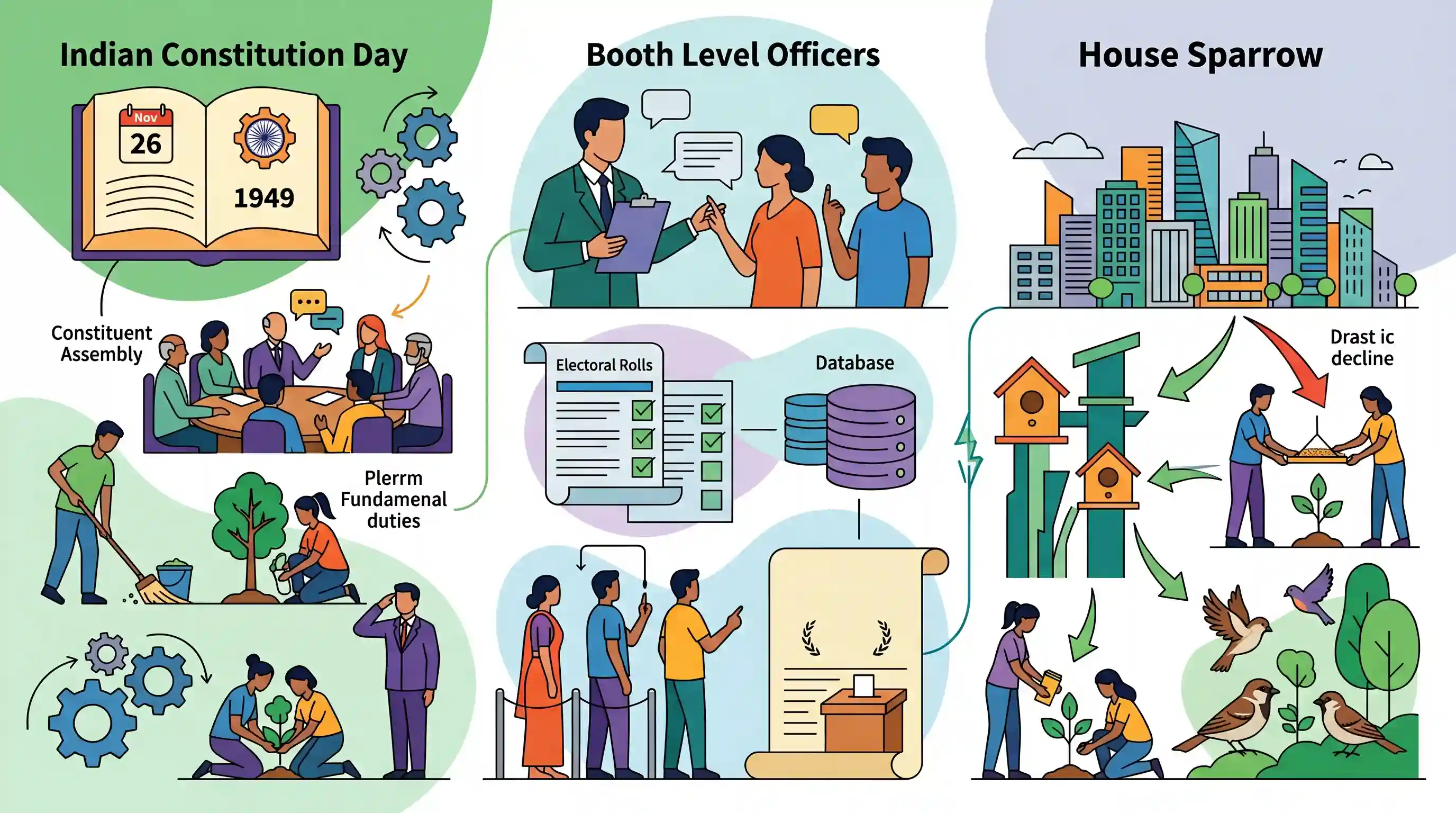
The article explores three distinct topics relevant to UPSC preparations: Constitution Day, the administrative role of Booth Level Officers (BLOs), and the conservation of the House Sparrow (referred to as Hayli or Halli Gubbi). Constitution Day, observed on November 26th, commemorates the adoption of the Constitution in 1949 and emphasizes fundamental duties and the vision of the Constituent Assembly. BLOs, governed by the Representation of the People Act, 1950, serve as the backbone of India's electoral machinery at the grassroots level, ensuring accurate electoral rolls and robust voter participation. Lastly, the article touches upon environmental concerns through the drastic decline of the House Sparrow due to urbanization and habitat loss, highlighting the need for urban biodiversity conservation efforts.
Key Points
- Constitution Day (Samvidhan Diwas) is celebrated annually on November 26 to commemorate the adoption of the Indian Constitution in 1949, officially notified in 2015 to honor Dr. B.R. Ambedkar's 125th birth anniversary.
- The day highlights the importance of constitutional values, the philosophy enshrined in the Preamble, and the fundamental duties of citizens in a democracy.
- Booth Level Officers (BLOs) are crucial grassroots-level representatives of the Election Commission of India (ECI), primarily responsible for maintaining and updating the accuracy of the electoral roll for a specific polling area.
- Under the Representation of the People Act, 1950, BLOs—typically local government or semi-government employees—conduct door-to-door surveys to verify, add, or delete voters and distribute voter information slips.
- The term 'Halli Gubbi' (often transliterated as Hayli Gubbi) refers to the House Sparrow in Kannada, a species that has witnessed a severe population decline due to rapid urbanization, modern architecture lacking nesting spaces, and pesticide use depleting insect food sources.
- Conservation efforts for the House Sparrow include community-driven initiatives like providing artificial nesting boxes, reflecting broader urban biodiversity concerns despite the species' global 'Least Concern' IUCN status.
Important Terms
Constituent Assembly

A body formed in 1946 to draft India's Constitution. Comprising indirectly elected representatives, it debated fundamental rights and governance structures until the document's adoption on November 26, 1949.
UPSC context
GS Paper II: Historical underpinnings and evolution of the Constitution; essential for understanding the source of India's democratic principles.
Election Commission of India (ECI)
An autonomous constitutional authority under Article 324 responsible for administering election processes in India, including those for the Parliament, State Legislatures, and the offices of President and Vice-President.
UPSC context
GS Paper II: Constitutional Bodies; crucial for understanding the machinery ensuring free, fair, and periodic elections.
Representation of the People Act, 1950
An Act of Parliament enacted to provide for the allocation of seats, delimitation of constituencies, and the preparation of electoral rolls for elections to the Lok Sabha and State Legislatures.
UPSC context
GS Paper II: Salient features of the RPA; tests knowledge of the legal framework governing the pre-election administrative structure.
Booth Level Officer (BLO)
A grassroots official, typically a local government employee, appointed under Section 13B of the RPA 1950. They act as the custodian of the electoral roll and assist voters at the booth level.
UPSC context
GS Paper II: Statutory and regulatory bodies/Elections; relevant for understanding the field-level execution of electoral management and voter facilitation.
Systematic Voters' Education and Electoral Participation (SVEEP)
A flagship voter education program launched by the ECI in 2009 to increase awareness, registration, and ethical participation among citizens, specifically targeting youth and marginalized groups.
UPSC context
GS Paper II: Governance and electoral reforms; focuses on measures taken to strengthen democratic participation and civic engagement.
International Union for Conservation of Nature (IUCN)
A global authority on the status of nature, known for assessing the conservation status of species. It lists the House Sparrow as 'Least Concern' on its Red List.
UPSC context
GS Paper III: Environmental conservation and biodiversity; essential for understanding species protection categories and international conservation frameworks.
Prelims Trap
"The House Sparrow is listed as 'Endangered' on the IUCN Red List due to rapid urban decline."
Despite severe regional population crashes in Indian cities due to habitat loss, its global population remains massive, keeping its status secure.
Static Concepts Connected
What is the core difference between the Representation of the People Act 1950 and 1951?
- RPA 1950: Deals with the allocation of seats, delimitation, voter qualifications, and preparation of electoral rolls (governs BLO duties).
- RPA 1951: Deals with the actual conduct of elections, qualifications/disqualifications of MPs/MLAs, corrupt practices, and election disputes.
Which Constitutional provisions came into force exactly on Constitution Day (Nov 26, 1949)?
- Immediate Enforcement: Provisions relating to Citizenship, Elections (Art 324), provisional Parliament, and temporary/transitional provisions came into immediate effect.
- Delayed Enforcement: The remaining major provisions, including Fundamental Rights and Directive Principles, came into force on January 26, 1950.
Cross-Topic Patterns
Election Machinery & Local Governance
BLOs rely on Anganwadi workers and Panchayat staff, linking Part XV (Elections) of the Constitution directly to grassroots local governance capacity (73rd Amendment).
Urbanisation vs. Indicator Species
The decline of the House Sparrow links unchecked urbanisation and modern architectural designs to the loss of ecological indicator species in urban micro-habitats.

Expect a 2026 Prelims statement differentiating RPA 1950 (electoral rolls/BLOs) from RPA 1951 (election conduct/disqualifications).
Linked PYQs · 5
Linked PYQs · 5
- 2023PrelimsGS1
Consider the following statements in respect of the Constitution Day: Statement-I: The Constitution Day is celebrated on 26th November every year to promote constitutional values among citizens. Statement-II: On 26th November, 1949, the Constituent Assembly of India set up a Drafting Committee under the Chairmanship of Dr. B. R. Ambedkar to prepare a Draft Constitution of India. Which one of the following is correct in respect of the above statements?
- 2020PrelimsGS1
The Preamble to the Constitution of India is
- 2017PrelimsGS1
Consider the following statements: 1. The Election Commission of India is a five-member body. 2. Union Ministry of Home Affairs decides the election schedule for the conduct of both general elections and bye-elections. 3. Election Commission resolves the disputes relating to splits/mergers of recognised political parties. Which of the statements given above is/are correct?
- 2024MainsGS2
Examine the need for electoral reforms as suggested by various committees with particular reference to "one nation one election" principle.
- 2011PrelimsGS1
The “Red Data Books” published by the International Union for Conservation of Nature and Natural Resources (IUCN) contain lists of 1. Endemic plant and animal species present in the biodiversity hotspots. 2. Threatened plant and animal species. 3. Protected sites for conservation of nature and natural resources in various countries. Select the correct answer using the codes given below:
