Himalayan Cloudbursts and Unified Pension Scheme Overview
Source:Indian Express ↗
Why It Matters
These topics represent a cross-section of the UPSC syllabus, touching upon Physical Geography (cloudbursts), Economy/Governance (pension reforms), and Art & Culture (Sarnath's Buddhist heritage).
Summary
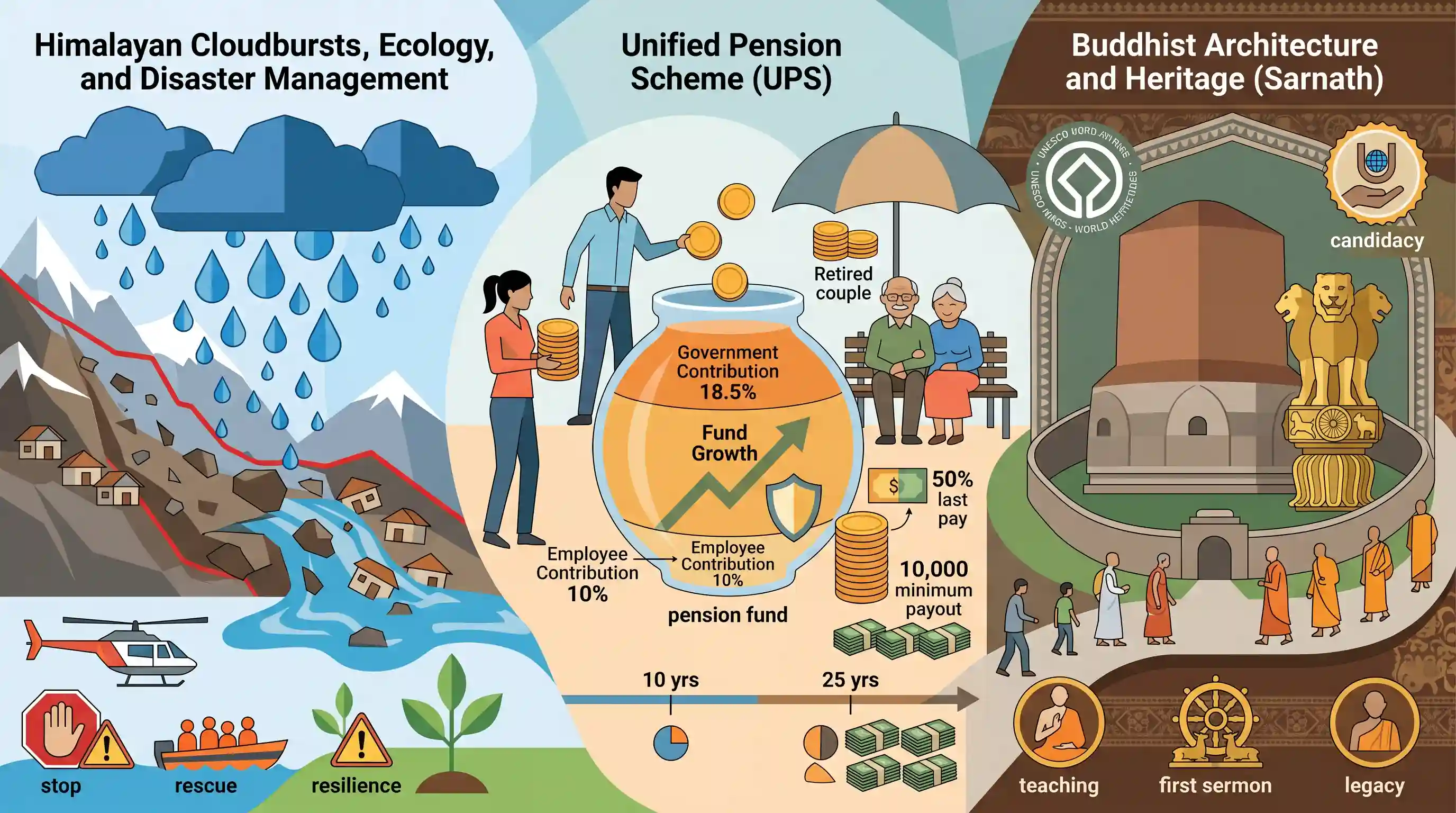
The article discusses three distinct topics of relevance for civil services preparation: the increasing incidence of cloudbursts and heavy rainfall in the Himalayas, highlighting geographical vulnerability and disaster management challenges; the introduction of the Unified Pension Scheme (UPS) as a significant shift in government employee social security; and the cultural importance of Sarnath as it is considered for UNESCO World Heritage status.
Key Points
- Cloudbursts and extreme rainfall events in the Himalayas are increasing, highlighting the region's ecological fragility and the need for better disaster management.
- The Unified Pension Scheme (UPS) has been introduced to offer assured pensions to government employees, addressing concerns regarding the market-linked National Pension System (NPS).
- Sarnath, the site of Buddha's first sermon, is in focus for potential inclusion in the UNESCO World Heritage list, emphasizing its rich architectural and cultural legacy.
Important Terms
Unified Pension Scheme (UPS)

A contributory, assured pension scheme for central government employees offering 50% of the average basic pay of the last 12 months as a guaranteed lifelong pension after 25 years of service.
UPSC context
GS Paper III: Government schemes and social security. Tests knowledge of welfare reforms and fiscal-pension balances.
National Pension System (NPS)
A market-linked, defined-contribution retirement savings scheme launched in 2004. It is regulated by PFRDA and provides a flexible, portable pension fund based on market performance without a guaranteed amount.
UPSC context
GS Paper III: Indian Economy. Relevant for understanding pension reforms and financial inclusion strategies.
Sarnath
An ancient Buddhist site in Uttar Pradesh where Gautama Buddha delivered his first sermon. It is home to the Dhamek Stupa and the Ashokan Lion Capital, India's national emblem.
UPSC context
GS Paper I: Art and Culture. Significant for Buddhist history and India's soft power through UNESCO nominations.
Cloudburst
An extreme weather event defined by the IMD as localized rainfall exceeding 100 mm per hour over a small area (10-30 sq km), often causing flash floods.
UPSC context
GS Paper I & III: Geography and Disaster Management. Important for understanding Himalayan vulnerability and climate change impacts.
Orographic Lifting
A meteorological phenomenon where moist air is forced to rise over mountain barriers, cooling and condensing into clouds and heavy precipitation, a primary cause of Himalayan cloudbursts.
UPSC context
GS Paper I: Physical Geography. Tests conceptual understanding of rainfall patterns in mountainous regions.
UNESCO World Heritage Site
A landmark recognized by UNESCO for having "Outstanding Universal Value." Sites are protected under the 1972 World Heritage Convention to ensure their preservation for future generations.
UPSC context
GS Paper I: Art and Culture. Vital for international heritage conservation and cultural diplomacy topics.
Prelims Trap
The Unified Pension Scheme (UPS) is a non-contributory scheme that completely reverts to the Old Pension Scheme (OPS) model.
UPS is NOT non-contributory. It retains the employee contribution model of the NPS, but guarantees a defined payout by increasing the government's contribution share to 18.5%.
Static Concepts Connected
What are the IMD criteria and drivers for a cloudburst?
- Rainfall threshold: Rainfall must exceed 100 mm per hour.
- Spatial extent: It must be highly localized, typically covering a geographical area of only 20-30 square kilometers.
- Orographic uplift: Primarily driven by rapid orographic uplift in hilly terrain, causing sudden, intense condensation.
What is the historical and cultural significance of Sarnath?
- First Sermon: The site of Buddha's first sermon, known as Dharmachakra Pravartana (turning the wheel of law).
- Ancient names: Historically referred to as Mrigadava (deer park) or Rishipatana.
- Architectural heritage: Home to the Dhamekh Stupa, Chaukhandi Stupa, and the Ashokan Lion Capital (India's National Emblem).
Cross-Topic Patterns
UPS + Fiscal Deficit & FRBM
The shift to a guaranteed pension scheme revives debates on state exchequer burdens, intergenerational equity, and adherence to FRBM Act fiscal glide paths.
Cloudbursts + Carrying Capacity
Orographic heavy rainfall in the Himalayas connects directly to the debate on mountain carrying capacity, unplanned infrastructure, and the necessity of strict Environmental Impact Assessments (EIA).

Expect a 2026 Prelims statement comparing UPS and NPS, specifically targeting the 18.5% govt contribution and AICPI-IW indexation.
Linked PYQs · 5
Linked PYQs · 5
- 2024MainsGS1
What is the phenomenon of 'cloudbursts'? Explain.
- 2022MainsGS3
Explain the mechanism and occurrence of cloudburst in the context of the Indian subcontinent. Discuss two recent examples.
- 2016MainsGS3
Rehabilitation of human settlements is one of the important environmental impacts which always attracts controversy while planning major projects. Discuss the measures to be adopted to mitigate the impact of the recent incidents of cloudbursts in many places of Uttarakhand.
- 2017PrelimsGS1
Who among the following can join the National Pension System (NPS)?
- 2023PrelimsGS1
With reference to ancient India, consider the following statements: 1. The concept of Stupa is Buddhist in origin. 2. Stupa was generally a repository of relics. 3. Stupa was a votive and commemorative structure in Buddhist tradition. How many of the statements given above are correct?
