UPSC Key Focus on Chicago Convention Heat Risk Index Strait of Hormuz
Source:Indian Express ↗
Why It Matters
These topics frequently feature in UPSC Prelims and Mains. The Strait of Hormuz is vital for map-based geography questions and IR discussions on energy security. Heatwaves and climate indices are recurring themes in Disaster Management and Environmental Geography. The Chicago Convention touches upon international regulatory frameworks.
Summary
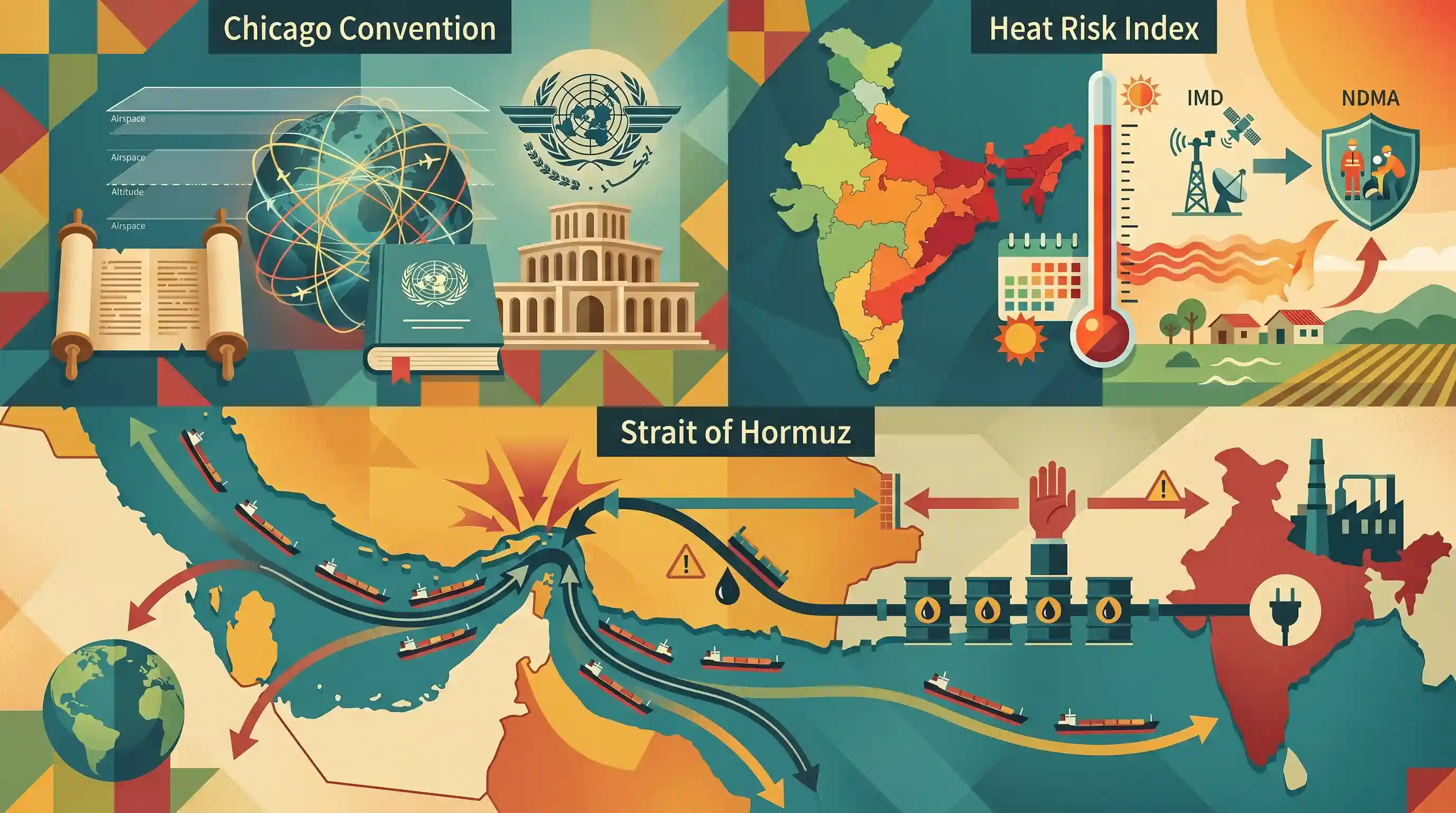
The article covers three diverse yet critical UPSC topics: the Chicago Convention, the Heat Risk Index, and the Strait of Hormuz. The Chicago Convention is the bedrock of international civil aviation, having established the rules for airspace and the foundation of ICAO. The Heat Risk Index highlights the ongoing efforts by Indian authorities like the IMD and NDMA to quantify and mitigate the severe impacts of extreme temperatures and heatwaves. Geopolitically, the Strait of Hormuz remains a highly sensitive chokepoint between the Persian Gulf and the Gulf of Oman, underscoring its immense strategic importance for global oil supplies and India's energy security.
Key Points
- The Chicago Convention (1944) established the core principles of global air navigation and transport, leading to the creation of the International Civil Aviation Organization (ICAO) under the UN.
- The Heat Risk Index serves as an important early-warning tool to help local administrations and the NDMA manage and mitigate the impacts of severe heatwaves on public health.
- The Strait of Hormuz is a crucial maritime chokepoint connecting the Persian Gulf and the Gulf of Oman, making it one of the world's most important shipping lanes for global oil trade and energy security.
Important Terms
Chicago Convention

A 1944 landmark treaty establishing the legal framework for international civil aviation, including principles of airspace sovereignty, aircraft registration, and safety standards.
UPSC context
GS Paper 2: International Treaties. Tests understanding of global aviation governance and sovereignty over national airspace.
International Civil Aviation Organization (ICAO)
A United Nations specialized agency established in 1944 to manage the administration of the Chicago Convention and set global aviation standards (SARPs).
UPSC context
GS Paper 2: Important International Institutions. Focuses on roles, mandates, and India's founding membership.
Strait of Hormuz
A critical maritime chokepoint between the Persian Gulf and the Gulf of Oman, handling over 20% of the world's oil and gas supplies.
UPSC context
GS Paper 2: Geopolitics & Energy Security. Tests knowledge of maritime trade routes and India’s energy import vulnerability.
India Meteorological Department (IMD)
India's principal agency for meteorological observations and weather forecasting, responsible for issuing official heatwave alerts and the experimental Heat Index.
UPSC context
GS Paper 1 & 3: Geography & Environment. Relevant for climate change patterns and disaster early-warning systems.
National Disaster Management Authority (NDMA)
India’s apex body for disaster management, which issues national guidelines for heatwave mitigation and coordinates Heat Action Plans (HAPs) with states.
UPSC context
GS Paper 3: Disaster Management. Tests the institutional framework for handling non-notified disasters like heatwaves.
Heat Index
A composite metric launched experimentally by the IMD that combines air temperature and humidity to measure the actual human "feel" of heat.
UPSC context
GS Paper 3: Environment & Disaster Management. Relevant for understanding impact-based forecasting and public health risks during extreme heat.
Prelims Trap
"IMD's Heat Risk Index is determined solely by the maximum daily air temperature recorded in a specific region."
The index actually calculates 'apparent temperature' by combining air temperature with relative humidity, as high humidity severely prevents sweat evaporation.
Static Concepts Connected
What are the IMD criteria for declaring a heatwave in India?
- Plains threshold: Maximum temperature reaches at least 40°C.
- Hilly regions: Maximum temperature reaches at least 30°C.
- Coastal areas: Maximum temperature reaches at least 37°C.
- Departure rule: A departure of 4.5°C to 6.4°C from normal temperature is classified as a heatwave.
What are the strategic maritime chokepoints in the Middle East?
- Strait of Hormuz: Connects Persian Gulf to Gulf of Oman; bordered by Iran and Oman (Musandam Peninsula).
- Bab el-Mandeb: Connects Red Sea to Gulf of Aden; bordered by Yemen, Djibouti, and Eritrea.
- Suez Canal: Artificial waterway connecting the Red Sea to the Mediterranean Sea through Egypt.
Cross-Topic Patterns
Heat Index + Wet-Bulb Temperature
IMD's Heat Index conceptually overlaps with 'wet-bulb temperature', a recurring UPSC theme highlighting the physiological limits of human survivability under accelerating climate change.
Chokepoints + Energy Security
Vulnerabilities in the Strait of Hormuz directly connect to questions on India's Strategic Petroleum Reserves (SPRs) policy and its broader macroeconomic push for energy import diversification.

Expect map-matching pairs of Middle East chokepoints (Hormuz/Oman) or a statement-based question on IMD's Heat Index parameters.
Linked PYQs · 5
Linked PYQs · 5
- 2025PrelimsGS1
The World Bank warned that India could become one of the first places where wet-bulb temperatures routinely exceed 35 °C. Which of the following statements best reflect(s) the implication of the above-said report? I. Peninsular India will most likely suffer from flooding, tropical cyclones and droughts. II. The survival of animals including humans will be affected as shedding of their body heat through perspiration becomes difficult. Select the correct answer using the code given below.
- 2022PrelimsGS1
The term "Levant" often heard in the news roughly corresponds to which of the following regions?
- 2025MainsGS2
"Energy security constitutes the dominant kingpin of India's foreign policy, and is linked with India's overarching influence in Middle Eastern countries.” How would you integrate energy security with India's foreign policy trajectories in the coming years?
- 2017MainsGS2
The question of India's Energy Security constitutes the most important part of India's economic progress. Analyze India's energy policy cooperation with West Asian countries.
- 2025PrelimsGS1
GPS-Aided Geo Augmented Navigation (GAGAN) uses a system of ground stations to provide necessary augmentation. Which of the following statements is/are correct in respect of GAGAN? I. It is designed to provide additional accuracy and integrity. II. It will allow more uniform and high quality air traffic management. III. It will provide benefits only in aviation but not in other modes of transportation. Select the correct answer using the code given below.
