Green Credit Programme and India China Border Patrols
Source:Indian Express ↗
Why It Matters
The piece synthesizes cross-disciplinary issues essential for the civil services exam: federalism and representation (GS2 Polity), environmental market mechanisms (GS3 Environment/Prelims), and neighborhood border disputes (GS2 IR and GS3 Security). Aspirants must understand the interlinkages, such as how census data dictates political power and how green credits complement global climate pacts.
Summary
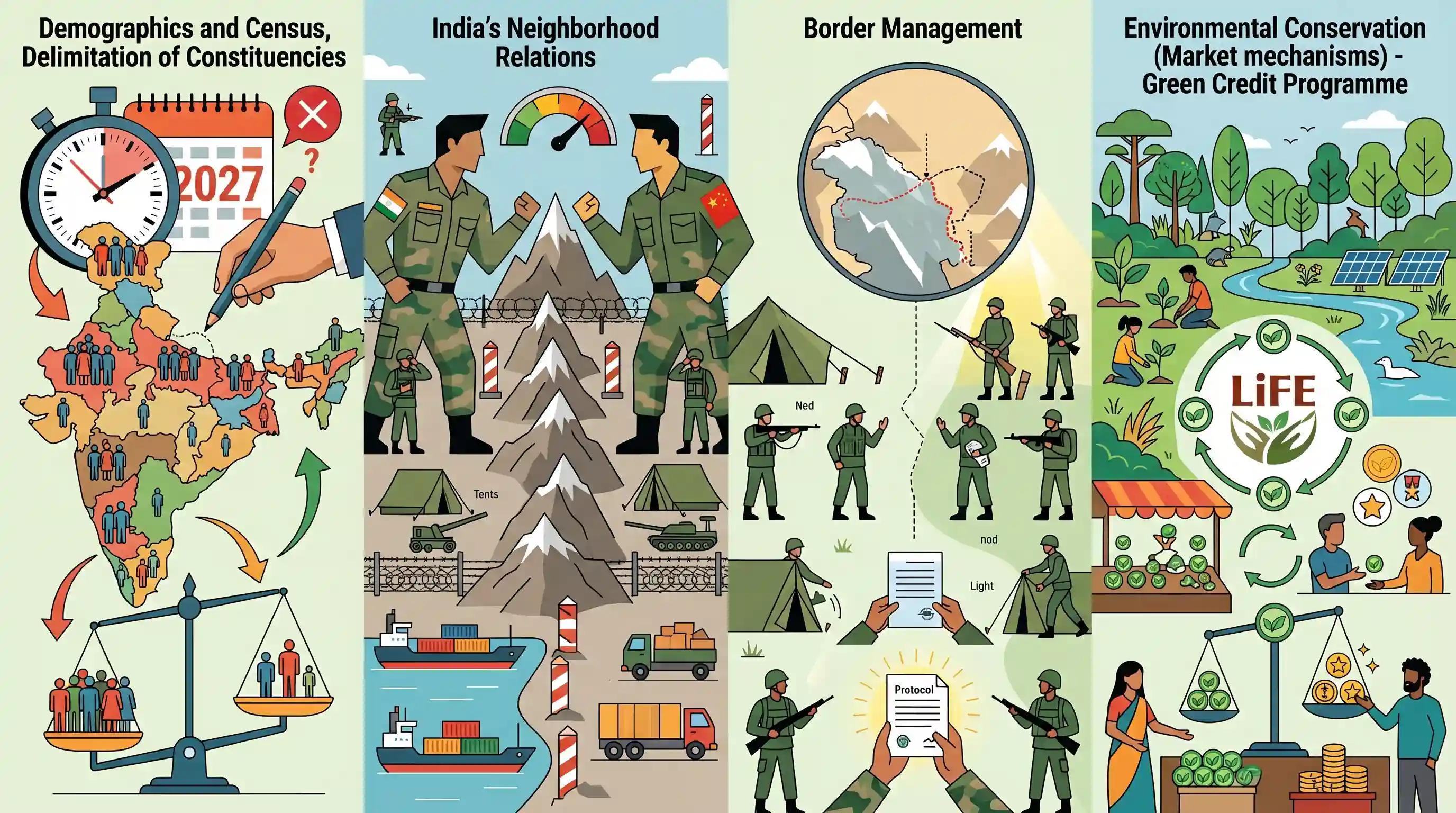
The article highlights three critical domains for UPSC preparation: the impending Census 2027, the Green Credit Programme, and India-China relations. It discusses the cascading effects of a delayed census on the delimitation of parliamentary constituencies, which poses challenges to federal representation. The piece explores the Green Credit Programme as a novel market mechanism under the LiFE movement to incentivize broader environmental conservation efforts beyond mere carbon emissions. Finally, it analyzes the geopolitical and security dynamics of India-China relations, emphasizing recent border disengagement protocols at the Line of Actual Control (LAC) and the broader challenge of managing trade ties amid border tensions.
Key Points
- The decadal Census, significantly delayed from its original 2021 schedule, is anticipated to be conducted around 2027, forming the statistical baseline for future governance.
- The upcoming census data will trigger the Delimitation exercise, raising critical debates about the political representation and federal balance between population-controlling Southern states and Northern states.
- The Green Credit Programme (GCP) introduces a market-based incentive mechanism to reward voluntary environmental actions like afforestation and water conservation, operating alongside traditional carbon markets.
- India and China are navigating complex bilateral relations with recent patrolling arrangements aimed at military disengagement along friction points like Depsang and Demchok on the LAC.
- Balancing trade dependencies with national security imperatives remains a primary challenge in India's strategic posture toward China.
Important Terms
Green Credit Programme (GCP)

An innovative market mechanism under India's LiFE movement that incentivizes voluntary environmental actions—like afforestation and water conservation—through tradable credits issued for positive environmental impacts.
UPSC context
GS3 (Environment); tests market-based conservation, LiFE movement initiatives, and India's climate mitigation strategies beyond carbon trading.
Delimitation Commission
A powerful, independent statutory body (appointed by the President) tasked with redrawing the boundaries of Lok Sabha and State Assembly constituencies based on the latest census data.
UPSC context
GS2 (Polity/Elections); tests understanding of fair representation, Article 82, and federal challenges posed by demographic shifts.
Delimitation Act
Legislation enacted by Parliament under Article 82 of the Constitution after each census to provide the legal framework for redrawing electoral constituency boundaries.
UPSC context
GS2 (Polity); relevant for questions on legislative authority and the constitutional process of constituency reallocation.
Paris Agreement
A legally binding international treaty on climate change adopted at COP21 (2015) aiming to limit global warming to well below 2°C through Nationally Determined Contributions (NDCs).
UPSC context
GS3 (Environment/IR); critical for global climate governance, equity principles (CBDR), and India's international climate commitments.
United Nations Framework Convention on Climate Change (UNFCCC)
The 1992 foundational international treaty establishing a framework for global intergovernmental efforts to address climate change and stabilize greenhouse gas concentrations in the atmosphere.
UPSC context
GS3 (Environment); tests knowledge of global climate architecture, annual COP meetings, and international environmental law.
Ministry of Environment, Forest and Climate Change (MoEFCC)
The nodal agency of the Government of India responsible for planning and implementing environmental, forest, and wildlife policies, including the Green Credit Programme.
UPSC context
GS2 (Governance); tests familiarity with executive bodies and their regulatory roles in environmental administration.
People's Liberation Army (PLA)
The unified military organization of the People's Republic of China, which is directly involved in border standoffs and disengagement protocols with India at the LAC.
UPSC context
GS2 (IR/Security); pertains to India-China relations, border management challenges, and regional security dynamics.
Prelims Trap
"The Green Credit Programme is exclusively designed to reduce carbon emissions and trade carbon credits."
GCP goes beyond carbon, rewarding eight specific voluntary environmental actions (like water conservation and afforestation) and functions independently of traditional carbon markets.
Static Concepts Connected
How does the Delimitation Commission operate under the Indian Constitution?
- Constitutional Mandate: Articles 82 and 170 mandate the readjustment of constituencies for Parliament and State legislatures respectively after every census.
- Current Freeze: The 84th Amendment (2001) froze the number of Lok Sabha seats based on the 1971 census until the first census taken after 2026.
- Binding Nature: The Commission's orders have the force of law and cannot be challenged in any court, preventing election delays.
What is the geographical alignment of key LAC friction points in Eastern Ladakh?
- Depsang Plains: Located in the far north (Sub-Sector North), providing critical access to the strategic Daulat Beg Oldie (DBO) airstrip and the Karakoram Pass.
- Galwan Valley: Situated south of Depsang, near the strategic confluence of the Galwan and Shyok rivers.
- Demchok: Located further south near the Indus river entry point, centering around the Charding Ninglung Nullah junction.
Cross-Topic Patterns
Demographics + Fiscal Federalism
The delayed Census and impending delimitation directly tie into the 16th Finance Commission's challenge of balancing tax devolution using 'Demographic Performance' to protect Southern states' interests.
Environment + Market Mechanisms
The Green Credit Programme pairs with the PAT scheme and Carbon Credit Trading Scheme (CCTS), marking India's broader shift from pure regulatory compliance to market-led ecological incentivization.
Geoeconomics vs Border Security
LAC military disengagement is paralleled by India's record trade deficit with China, exposing the tension between 'Atmanirbhar Bharat' and India's heavy reliance on Chinese industrial intermediates.

Expect a multi-statement Prelims question contrasting GCP's multi-sectoral credits with carbon markets, alongside North-South LAC mapping.
Linked PYQs · 5
Linked PYQs · 5
- 2024PrelimsGS1
How many Delimitation Commissions have been constituted by the Government of India till December 2023?
- 2024MainsGS3
India has a long and troubled border with China and Pakistan fraught with contentious issues. Examine the conflicting issues and security challenges along the border. Also give out the development being undertaken in these areas under the Border Area Development Programme (BADP) and Border Infrastructure and Management (BIM) Scheme.
- 2012MainsGS2
Do you think that China's emergence as one of the largest trading partners of India has adversely affected the settlement of the outstanding border problem?
- 2023PrelimsGS1
Consider the following statements: Statement-I: Carbon markets are likely to be one of the most widespread tools in the fight against climate change. Statement-II: Carbon markets transfer resources from the private sector to the State. Which one of the following is correct in respect of the above statements?
- 2025PrelimsGS1
Consider the following statements : Statement I: Article 6 of the Paris Agreement on climate change is frequently discussed in global discussions on sustainable development and climate change. Statement II: Article 6 of the Paris Agreement on climate change sets out the principles of carbon markets. Statement III : Article 6 of the Paris Agreement on climate change intends to promote inter-country non-market strategies to reach their climate targets. Which one of the following is correct in respect of the above statements?
