Core Economic and Environmental Issues for Civil Services
Source:Indian Express ↗
কেন এটি গুরুত্বপূর্ণ
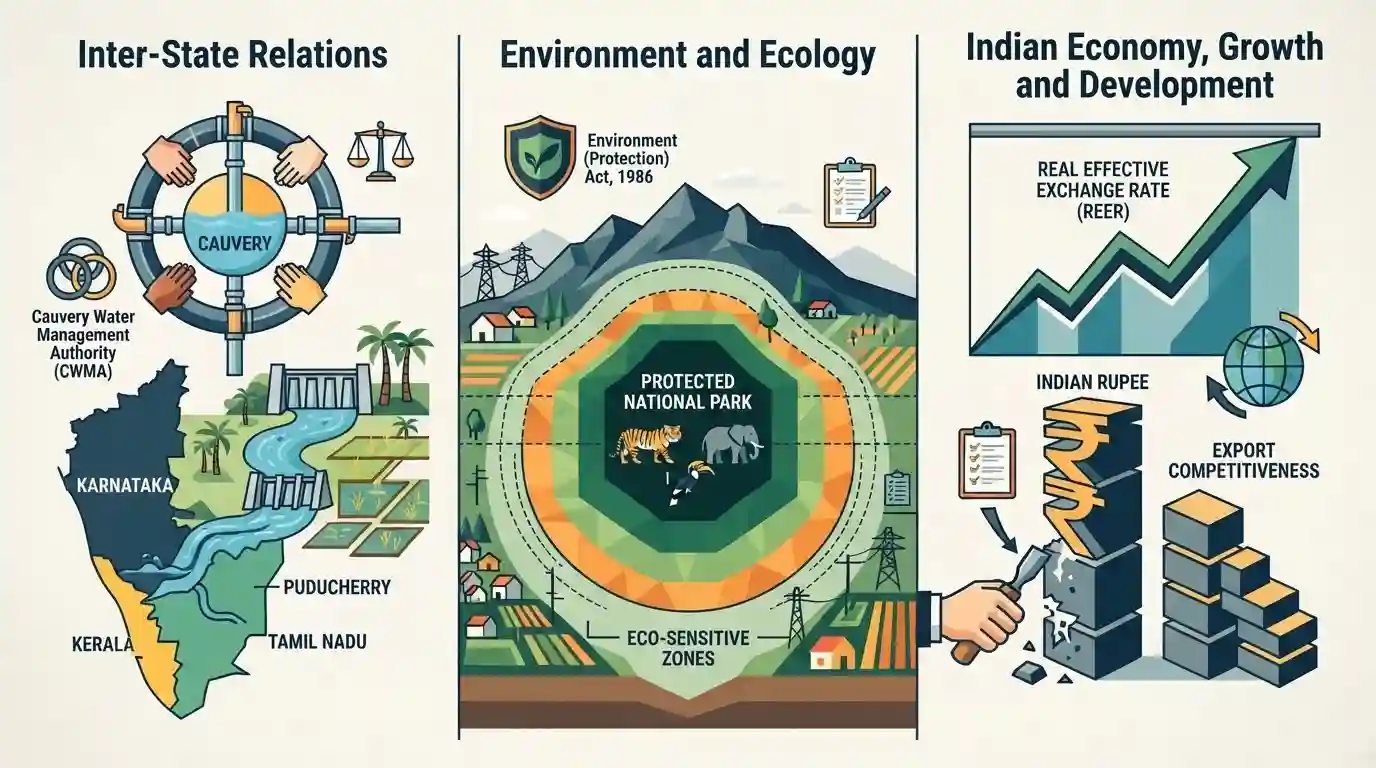
This article encapsulates three highly tested themes in UPSC: federal friction over natural resources (Polity), ecological conservation versus development in fragile ecosystems (Environment), and external sector macroeconomic indicators (Economy).
সারসংক্ষেপ
The article covers three distinct UPSC-relevant themes: the ongoing Cauvery water dispute involving Karnataka, Tamil Nadu, Kerala, and Puducherry, and the role of the Cauvery Water Management Authority (CWMA); the declaration and regulation of Eco-Sensitive Zones (ESZs) around protected areas under the Environment (Protection) Act, 1986, particularly in the context of the Western Ghats; and macroeconomic concerns surrounding the overvaluation of the Indian Rupee as indicated by the Real Effective Exchange Rate (REER), which impacts India's export competitiveness despite interventions by the RBI.
মূল বিষয়
- The Cauvery water dispute highlights the complexities of inter-state river water sharing, invoking constitutional mechanisms (Article 262) and statutory bodies like the CWMA.
- Eco-Sensitive Zones (ESZs) act as "shock absorbers" for protected areas, regulating rather than prohibiting human activities, though defining their extent remains contentious in regions like the Western Ghats.
- The Real Effective Exchange Rate (REER) indicates the Rupee's value against a basket of currencies adjusted for inflation; a high REER suggests the Rupee is overvalued, hurting export competitiveness.
- The RBI continuously monitors the Nominal Effective Exchange Rate (NEER) and REER, intervening in the forex market to stabilize the currency and manage imported inflation.
গুরুত্বপূর্ণ শব্দ
Environment (Protection) Act, 1986

An umbrella legislation empowering the Central Government to protect the environment, regulate pollution, and notify Eco-Sensitive Zones to safeguard areas around national parks and wildlife sanctuaries.
UPSC context
Crucial for GS Paper 3 (Environment). UPSC frequently tests its provisions, rules, and the legal basis of Eco-Sensitive Zones.
Inter-State River Water Disputes Act, 1956
A law providing the legal framework to resolve conflicts over shared inter-state rivers. It allows the Centre to establish binding Water Dispute Tribunals when negotiations fail.
UPSC context
Vital for GS Paper 2 (Polity). Tests dispute redressal mechanisms, federalism, and inter-state relations in India.
Article 262 of the Constitution
A constitutional provision enabling Parliament to adjudicate disputes regarding the use or distribution of inter-state river waters, explicitly allowing it to bar Supreme Court jurisdiction.
UPSC context
Key to GS Paper 2 (Polity). Tests the constitutional backing for resolving federal water disputes and the powers of Parliament.
Cauvery Water Management Authority (CWMA)
A statutory, quasi-judicial body created to ensure the equitable distribution and management of the Cauvery River's waters among Karnataka, Tamil Nadu, Kerala, and Puducherry.
UPSC context
Highly relevant for GS Paper 2 and GS Paper 1. Questions focus on river board functions, tribunal awards, and inter-state disputes.
Reserve Bank of India (RBI)
India's central bank and regulatory body responsible for managing the country's currency, money supply, and foreign exchange reserves, including interventions to stabilize the Rupee.
UPSC context
Essential for GS Paper 3 (Indian Economy). Tests monetary policy, currency valuation metrics like REER, and macroeconomic stability.
প্রিলিমস ফাঁদ
The Environment (Protection) Act, 1986 explicitly defines and contains the term 'Eco-Sensitive Zone' (ESZ).
The EPA, 1986 contains no mention of the term 'ESZ'. ESZs are notified under the executive powers granted by Section 3 of the Act.
সংযুক্ত স্থির ধারণা
How does Article 262 impact the Supreme Court's jurisdiction over water disputes?
- Exclusionary Power: Article 262 empowers Parliament to exclude the jurisdiction of all courts, including the Supreme Court, over inter-state water disputes.
- Statutory Execution: Section 11 of the Inter-State River Water Disputes Act, 1956, implements this exclusion, barring judicial interference.
- Judicial Bypass: The Supreme Court maintains indirect oversight under Article 136 (Special Leave Petitions), invoking the right to life and water under Article 21.
What is the difference between NEER and REER in trade competitiveness?
- NEER Mechanism: Weighted average of bilateral exchange rates of the rupee against a basket of major currencies without adjusting for inflation.
- REER Adjustment: NEER adjusted for relative price levels (inflation differentials) between India and its trading partners.
- Export Implications: A rising REER above 100 indicates real overvaluation, signaling that Indian goods are becoming pricier and less competitive internationally.
আন্তঃবিষয় প্যাটার্ন
Federalism + Eco-Sensitive Zones
Central notification of ESZs in the Western Ghats limits land-use planning, a state-list subject, sparking federal tensions over development.
REER + Agri-Export Competitiveness
An overvalued rupee (high REER) combines with minimum support prices to price Indian agricultural exports out of global commodity markets.

Conceptual questions comparing NEER and REER will likely test how domestic vs partner-country inflation drives Indian export competitiveness.
সংযুক্ত PYQ · 4
সংযুক্ত PYQ · 4
- 2014PrelimsGS1
With reference to 'Eco-Sensitive Zones', which of the following statements is/are correct? 1. Eco-Sensitive Zones are the areas that are declared under the Wildlife (Protection) Act, 1972. 2. The purpose of the declaration of Eco-Sensitive Zones is to prohibit all kinds of human activities in those zones except agriculture. Select the correct answer using the code given below.
- 2022PrelimsGS1
With reference to the Indian economy, consider the following statements: 1. An increase in Nominal Effective Exchange Rate (NEER) indicates the appreciation of rupee. 2. An increase in the Real Effective Exchange Rate (REER) indicates an improvement in trade competitiveness. 3. An increasing trend in domestic inflation relative to inflation in other countries is likely to cause an increasing divergence between NEER and REER. Which of the above statements are correct?
- 2022PrelimsGS1
With reference to the Indian economy, consider the following statements: 1. If the inflation is too high, Reserve Bank of India (RBI) is likely to buy government securities. 2. If the rupee is rapidly depreciating, RBI is likely to sell dollars in the market. 3. If interest rates in the USA or European Union were to fall, that is likely to induce RBI to buy dollars. Which of the statements given above are correct?
- 2019PrelimsGS1
Which one of the following is not the most likely measure the Government/RBI takes to stop the slide of Indian rupee?
