Core UPSC Themes on Caste Census IBC and Internal Security
Source:Indian Express ↗
Why It Matters
These are foundational topics across multiple GS papers. The caste census addresses social justice and structural inequalities (GS1/GS2), the IBC represents a major economic reform (GS3), and Maoism remains one of India's most significant internal security challenges (GS3).
Summary
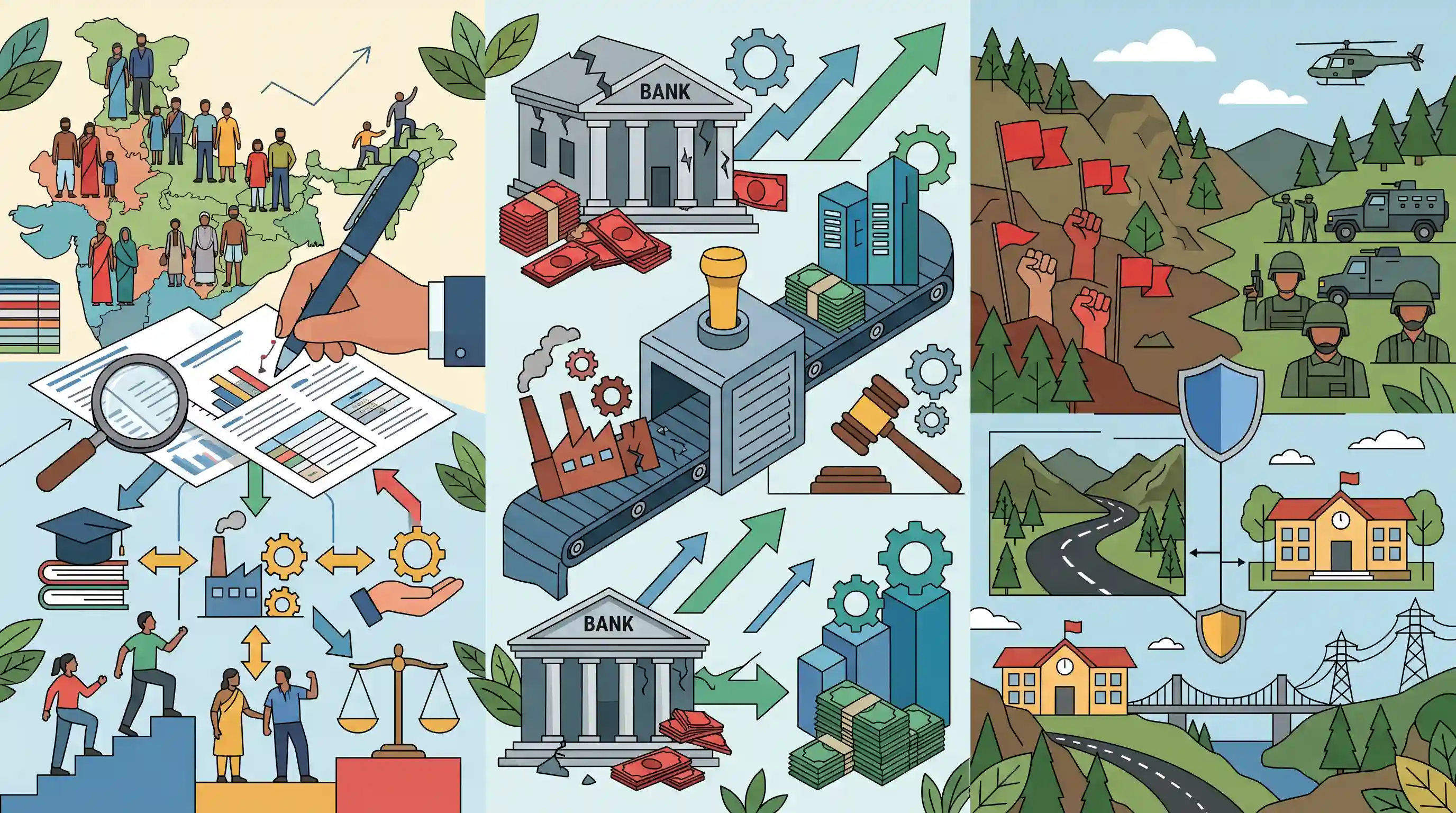
The article provides a comprehensive analysis of three critical issues highly relevant to the UPSC examination. It explores the ongoing debate surrounding a nationwide Caste Census, evaluating its potential socio-economic implications and policy relevance for affirmative action. Additionally, it examines the performance of the Insolvency and Bankruptcy Code (IBC) in streamlining the corporate resolution process and tackling non-performing assets (NPAs). Finally, it details the persistent internal security challenges posed by Maoism (Left-Wing Extremism) in India, highlighting the intersection of developmental deficits and the government's multi-layered counter-insurgency strategies.
Key Points
- **Caste Census Debate:** Evaluates the demand for a comprehensive caste enumeration to better target affirmative action, weighing its political, administrative, and social implications.
- **Insolvency and Bankruptcy Code (IBC):** Analyzes the efficacy of the IBC framework in accelerating the resolution of corporate defaults and mitigating the banking sector's Non-Performing Assets (NPA) burden.
- **Maoism/Left-Wing Extremism (LWE):** Assesses the internal security threat posed by Naxalism, examining root causes such as developmental deficits, land alienation, and tribal displacement.
- **State Response to LWE:** Details the government's multi-pronged approach involving security force operations, infrastructure development in affected areas, and rehabilitation policies.
Important Terms
Insolvency and Bankruptcy Code (IBC)

A 2016 law providing a unified, time-bound framework for resolving insolvency and bankruptcy of companies, individuals, and partnerships, aiming to maximize asset value and promote entrepreneurship.
UPSC context
GS Paper 3 (Economy); vital for understanding debt recovery, banking health, and Ease of Doing Business.
National Company Law Tribunal (NCLT)
A quasi-judicial body constituted under the Companies Act, 2013, that serves as the adjudicating authority for corporate insolvency resolution and liquidation processes under the IBC.
UPSC context
GS Paper 2 (Statutory Bodies) and GS Paper 3 (Economy); essential for corporate governance and dispute resolution.
Caste Census
The systematic collection of data on individuals' caste identities during a national census to provide socio-demographic insights for affirmative action and targeted welfare policy formulation.
UPSC context
GS Paper 1 (Social Issues) and GS Paper 2 (Social Justice); critical for debates on reservation and representation.
Left-Wing Extremism (LWE)
An armed insurgency, often called Naxalism, driven by Maoist ideology that seeks to overthrow the state through violent revolution, typically exploiting socio-economic grievances in tribal regions.
UPSC context
GS Paper 3 (Internal Security); focuses on the nexus between developmental deficits and security challenges.
Non-Performing Assets (NPAs)
Loans or advances where the principal or interest remains overdue for more than 90 days, causing the asset to stop generating income for the bank.
UPSC context
GS Paper 3 (Economy); a key indicator of banking sector stability and the effectiveness of resolution mechanisms.
Insolvency and Bankruptcy Board of India (IBBI)
A statutory regulator established under the IBC (2016) that oversees insolvency proceedings and regulates professionals like Insolvency Professionals, Agencies, and Information Utilities.
UPSC context
GS Paper 3 (Economy); important as the primary regulatory pillar of India's insolvency ecosystem.
Prelims Trap
The Socio-Economic Caste Census (SECC) is conducted under the Census Act of 1948, ensuring strict confidentiality of the socio-economic data collected.
False. The General Census is conducted under the Census Act, 1948 (confidential). The SECC is conducted by different ministries, and its data is deliberately shared with departments to identify welfare beneficiaries.
Static Concepts Connected
What is the institutional framework of the Insolvency and Bankruptcy Code (IBC), 2016?
- Regulator: Insolvency and Bankruptcy Board of India (IBBI) oversees insolvency professionals, agencies, and information utilities.
- Adjudicating Authorities: The National Company Law Tribunal (NCLT) adjudicates for companies/LLPs, while the Debt Recovery Tribunal (DRT) handles individuals and partnership firms.
- Committee of Creditors: Comprising financial creditors, this committee holds the supreme decision-making power to approve or reject corporate resolution plans.
How does the Constitution mandate the identification and welfare of Backward Classes?
- Article 340: Empowers the President to appoint a commission to investigate the conditions of socially and educationally backward classes (SEBCs) and recommend steps to improve their condition.
- Indra Sawhney (1992): Established that caste can be a primary, but not the sole, indicator of backwardness when targeting affirmative action and reservation policies.
- Articles 15(4) & 16(4): Provide the core constitutional basis for state intervention and reservation policies aimed at the advancement of SEBCs.
Cross-Topic Patterns
LWE, PESA, and Forest Rights Act
Left-Wing Extremism exploits perceived state failures in tribal land rights. UPSC links internal security deficits directly to the poor implementation of the Forest Rights Act (FRA) and PESA.
IBC and the Twin Balance Sheet Syndrome
IBC acts as a crucial structural reform to resolve the "Twin Balance Sheet" syndrome (over-leveraged corporates and bad-loan encumbered banks), a recurring theme in the Economic Survey.
Caste Enumeration & OBC Sub-categorization
Demands for accurate caste data strongly correlate with the Rohini Commission's ongoing mandate for sub-categorizing OBCs to ensure an equitable distribution of reservation benefits.

Expect a multi-statement Prelims question contrasting SECC vs. Census Act 1948, or a Mains question linking LWE mitigation to PESA.
Linked PYQs · 4
Linked PYQs · 4
- 2018MainsGS1
Caste system is assuming new identities and associational forms. Hence, caste system cannot be eradicated in India." Comment.
- 2022MainsGS3
Naxalism is a social, economic and developmental issue manifesting as a violent internal security threat. In this context, discuss the emerging issues and suggest a multilayered strategy to tackle the menace of Naxalism.
- 2018MainsGS3
Left Wing Extremism (LWE) is showing a downward trend, but still affects many parts of the country. Briefly explain the Government of India's approach to counter the challenges posed by LWE.
- 2015MainsGS3
The persisting drives of the Government for development of large industries in backward areas have resulted in isolating the tribal population and the farmers who face multiple displacements. With Malkangiri and Naxalbari foci, discuss the corrective strategies needed to win the Left Wing Extremism (LWE) doctrine affected citizens back into the mainstream of social and economic growth.
