Brain Eating Amoeba Animal Blood Bank and Sustainable Aviation Fuel
Source:Indian Express ↗
Why It Matters
These topics highlight the diverse syllabus of GS Paper 3, interconnecting emerging public health threats, critical infrastructure for the rural and livestock economy, and technological transitions required for sustainable energy and climate mitigation.
Summary
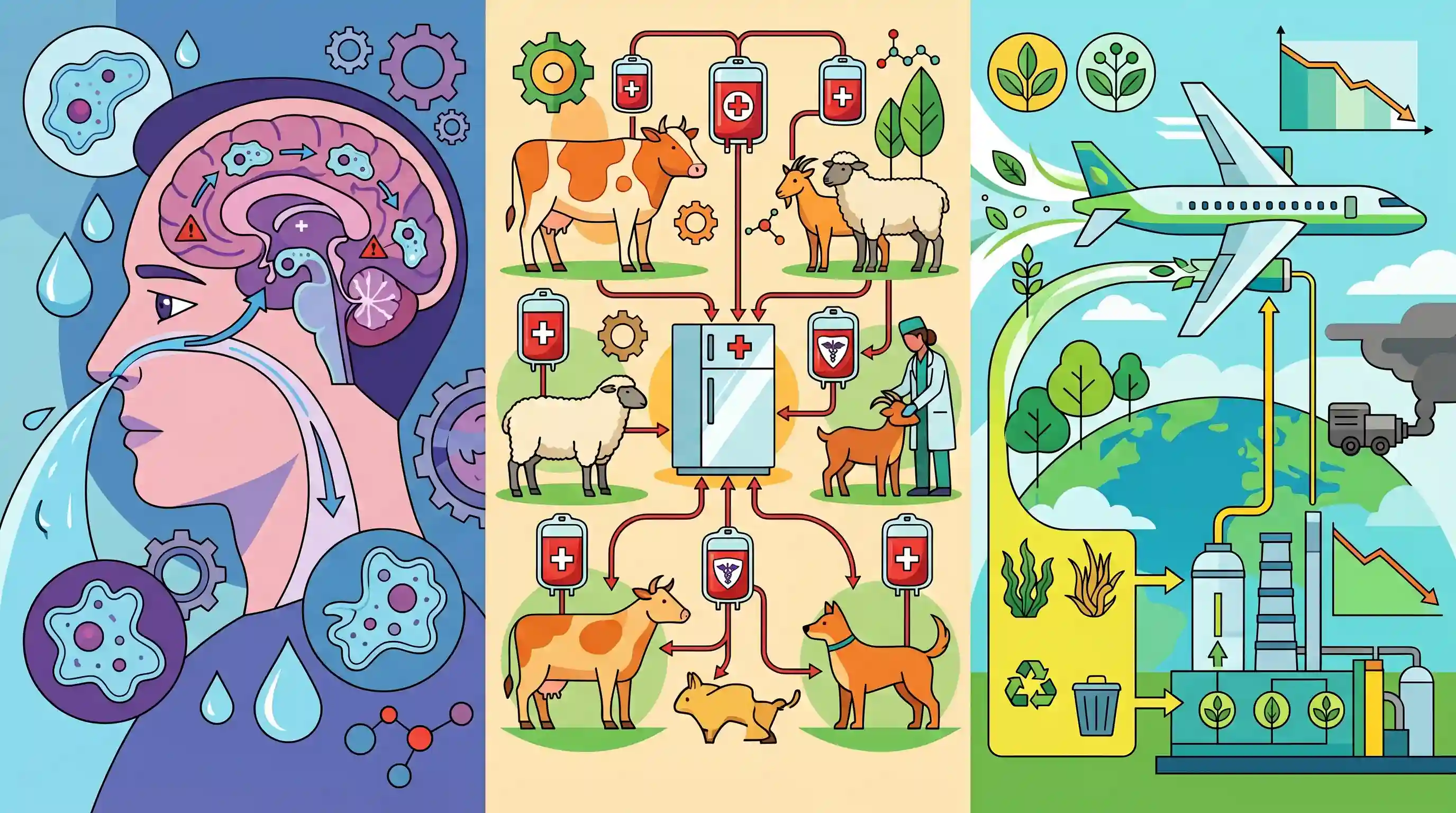
The article highlights three significant developments for UPSC aspirants across Science, Agriculture, and Environment. It discusses the health risks of the brain-eating amoeba (Naegleria fowleri), the strategic importance of building an Animal Blood Bank Network to strengthen veterinary healthcare and livestock management, and the role of Sustainable Aviation Fuel (SAF) in reducing greenhouse gas emissions in the aviation sector.
Key Points
- Naegleria fowleri, commonly known as the 'brain-eating amoeba', is a fatal pathogen found in warm freshwater that causes primary amoebic meningoencephalitis (PAM).
- The establishment of an Animal Blood Bank Network aims to improve veterinary healthcare, enhance survival rates of livestock and companion animals, and support the animal husbandry sector.
- Sustainable Aviation Fuel (SAF) is a cleaner alternative to conventional jet fuel, produced from sustainable feedstocks like agricultural waste, crucial for decarbonizing the aviation industry.
Important Terms
Sustainable Aviation Fuel (SAF)

A biofuel produced from renewable feedstocks (like agricultural waste or used cooking oil) that can reduce lifecycle greenhouse gas emissions by up to 80% compared to conventional jet fuel.
UPSC context
GS Paper 3: Environment/Energy. Tests knowledge of decarbonization strategies and India's 1% blending target by 2027.
Naegleria fowleri
Commonly known as the 'brain-eating amoeba,' this single-celled organism found in warm freshwater causes a rare, fatal brain infection when it enters through the nasal passage.
UPSC context
GS Paper 3: Science & Technology (Health). Tests awareness of emerging pathogens and non-communicable diseases frequently reported in news.
Primary Amoebic Meningoencephalitis (PAM)
A rare and near-fatal brain infection caused by Naegleria fowleri, resulting in rapid inflammation and tissue destruction after the amoeba migrates through the olfactory nerve.
UPSC context
GS Paper 2/3: Health issues and scientific developments. Relevant for understanding public health risks in specific geographic regions.
National Veterinary Blood Bank Network (N-VBBN)
An Indian government initiative to standardize animal blood transfusion protocols, create digital donor registries, and ensure availability of safe blood for livestock and pets.
UPSC context
GS Paper 3: Economics/Animal Husbandry. Tests understanding of veterinary infrastructure and government interventions to safeguard livestock assets.
Drop-in Fuel
Renewable fuels that are chemically identical to conventional petroleum-based fuels, allowing them to be used in existing engines and infrastructure without modifications.
UPSC context
GS Paper 3: S&T/Energy. Relevant for technical understanding of biofuel adoption and energy infrastructure compatibility.
One Health Approach
An integrated framework recognizing the interconnectedness of human, animal, and environmental health, essential for managing zoonotic risks and veterinary standards.
UPSC context
GS Paper 3: S&T/Environment. Tests holistic knowledge of disease management across multiple biological sectors.
Prelims Trap
Naegleria fowleri can be transmitted by drinking contaminated water or through person-to-person contact.
Infection strictly occurs when contaminated water enters through the nose (reaching the olfactory nerve). It does not spread person-to-person or via ingestion.
Static Concepts Connected
What constitutes a "drop-in" fuel like Sustainable Aviation Fuel (SAF)?
- Seamless Integration: Can be utilized in existing aircraft engines and fueling infrastructure without requiring any mechanical or structural modifications.
- Blending Capacity: SAF is chemically similar to conventional jet fuel (Jet A/A-1) and can typically be blended up to 50% with traditional fossil fuels.
- Feedstock Variety: Produced from non-petroleum sources like agricultural residues, used cooking oil, and municipal solid waste, promoting a circular economy.
What is the "One Health" approach in public health?
- Core Philosophy: An integrated, unifying approach recognizing that human health is inextricably linked to the health of animals and the shared environment.
- Zoonotic Focus: Crucial for monitoring and preventing disease spillovers (zoonoses), requiring robust veterinary infrastructure like standardized animal blood banks.
Cross-Topic Patterns
SAF + ICAO's CORSIA framework
SAF adoption is critical for meeting emission targets under the UN ICAO's Carbon Offsetting and Reduction Scheme for International Aviation (CORSIA), connecting domestic biofuel tech with international climate commitments.
Livestock health + Agricultural GVA
Veterinary infrastructure like the N-VBBN stabilizes the livestock sector, which is increasingly tested as a core pillar of the rural economy, contributing nearly 30% to India's agricultural GVA.

Expect a multi-statement question on SAF's 'drop-in' mechanics, blending limits, and its role in ICAO's CORSIA framework for 2026.
Linked PYQs · 4
Linked PYQs · 4
- 2024PrelimsGS1
Consider the following materials : 1. Agricultural residues 2. Corn grain 3. Wastewater treatment sludge 4. Wood mill waste Which of the above can be used as feedstock for producing Sustainable Aviation Fuel?
- 2025PrelimsGS1
With reference to 'Direct Air Capture', an emerging technology, which of the following statements is/are correct? I. It can be used as a way of carbon sequestration. II. It can be a valuable approach for plastic production and in food processing. III. In aviation, it can be a source of carbon for combining with hydrogen to create synthetic low-carbon fuel. Select the correct answer using the code given below.
- 2015MainsGS3
Livestock rearing has a big potential for providing non-farm employment and income in rural areas. Discuss suggesting suitable measures to promote this sector in India.
- 2023MainsGS3
Discuss several ways in which microorganisms can help in meeting the current fuel shortage.
