Defense exports renewable energy mandates and riverine ecology
Source:Indian Express ↗
Why It Matters
These topics bridge India's strategic defense goals with its renewable energy ambitions and environmental challenges. Understanding the mechanics of defense exports (like BrahMos) and policy tools for indigenization (like ALMM/DCR) is vital for GS3. Meanwhile, the ecological fallout of sand mining on riverine species like the Gharial is a recurring theme in Prelims Environment and GS1 Geography.
Summary
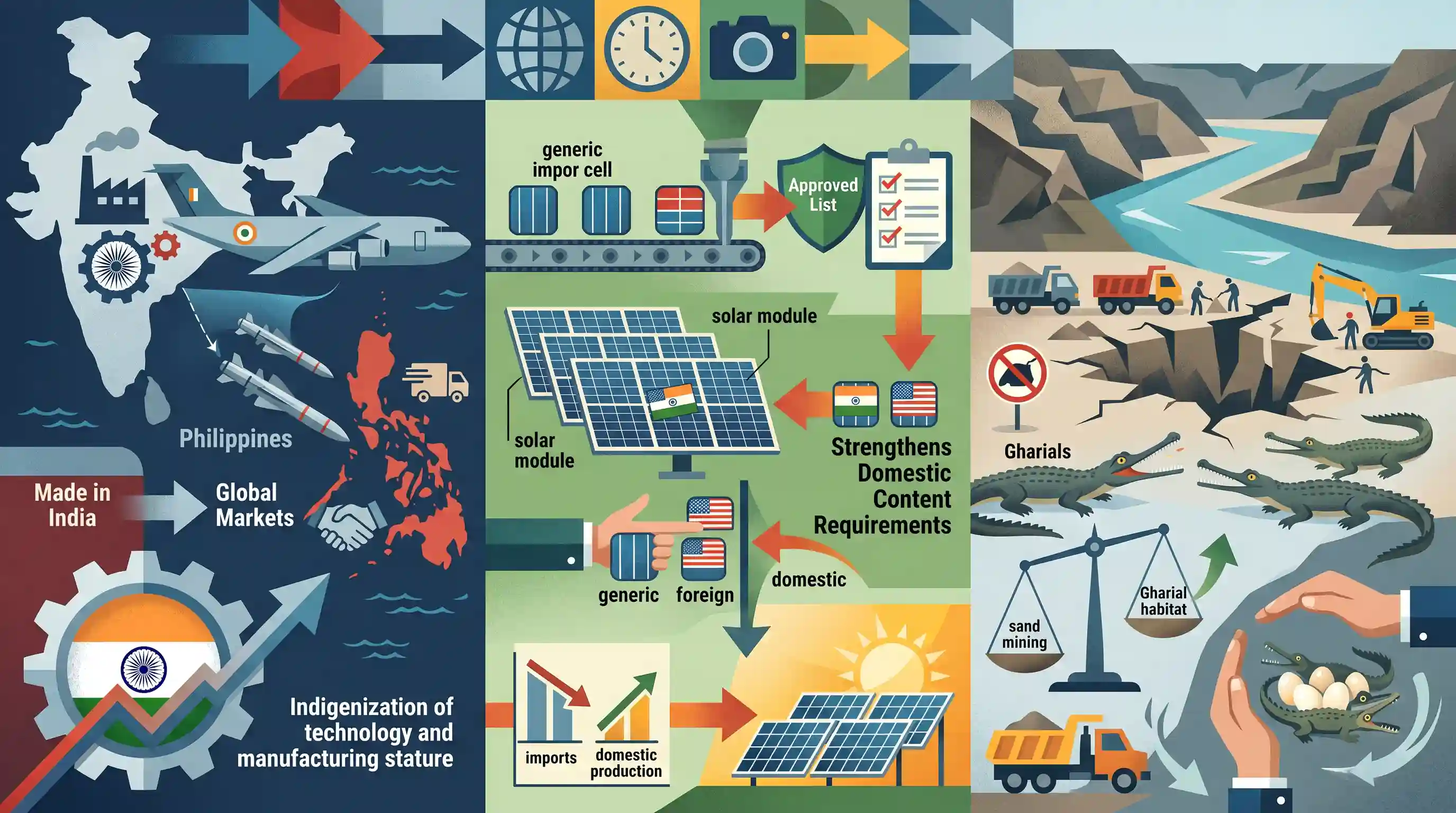
The article highlights three critical UPSC-relevant topics: defense exports, renewable energy policies, and environmental conservation. India's delivery of the BrahMos supersonic cruise missile to the Philippines underscores its growing stature in global defense manufacturing. In the renewable energy sector, the government's mandate extending the Approved List of Models and Manufacturers (ALMM) to solar cells aims to strengthen Domestic Content Requirements (DCR) and reduce import dependency. Additionally, the piece addresses the severe ecological impacts of illegal sand mining in the Chambal River, which severely threatens the habitat of the critically endangered Gharial.
Key Points
- India's delivery of the BrahMos supersonic cruise missile to the Philippines marks a significant achievement in its defense export strategy and technological indigenization.
- The MNRE has expanded the Approved List of Models and Manufacturers (ALMM) to include solar cells, enforcing stricter Domestic Content Requirements (DCR) to boost local manufacturing and curb imports.
- Rampant illegal sand mining in the Chambal River basin poses a severe ecological threat, particularly to the natural habitat of the critically endangered Gharial.
Important Terms
Approved List of Models and Manufacturers (ALMM)

A quality-and-reliability framework by the MNRE ensuring solar equipment meets domestic standards. Mandatory for government projects, it serves as a non-tariff barrier to protect local manufacturers from low-quality imports.
UPSC context
GS-III Infrastructure/Economy. Tests knowledge of non-tariff barriers, technology indigenization, and renewable energy self-reliance.
Domestic Content Requirement (DCR)
A policy mandating that a specific percentage of components in a project must be manufactured locally. In solar energy, it aims to reduce import dependence and has been a focal point of WTO disputes.
UPSC context
GS-III Economy/Environment. Tests 'Make in India' initiatives, trade policy, and WTO national treatment disputes.
Production Linked Incentive (PLI)
A government scheme providing financial incentives to manufacturers based on incremental sales of domestically produced goods. In the solar sector, it encourages large-scale manufacturing of high-efficiency PV modules.
UPSC context
GS-III Economic Development/Manufacturing. Tests industrial policy, import substitution, and scaling strategic domestic production.
BrahMos Aerospace
A joint venture between India's DRDO and Russia's NPO Mashinostroyeniya producing the world’s fastest supersonic cruise missile. It represents India's transition from an arms importer to a significant defense exporter.
UPSC context
GS-III Security/Science & Technology. Tests defense indigenization, supersonic technology, and India’s emerging defense export trajectory.
Ministry of New and Renewable Energy (MNRE)
The nodal ministry of the Government of India for all matters relating to new and renewable energy. It oversees major initiatives like the National Solar Mission and ALMM mandates.
UPSC context
GS-III Environment/Governance. Key for tracking national energy transition targets and international climate commitments.
DRDO
India's premier defense research agency under the Ministry of Defence. It develops indigenous technologies for the armed forces, focusing on self-reliance in missiles, aeronautics, and electronics.
UPSC context
GS-III Science & Technology/Security. Tests indigenization of technology, defense R&D, and 'Atmanirbhar Bharat' initiatives.
Prelims Trap
"The BrahMos delivered to the Philippines is a supersonic ballistic missile."
BrahMos is a cruise missile, meaning it is jet-propelled throughout its atmospheric flight, unlike ballistic missiles which follow a mostly unpowered, parabolic trajectory.
Static Concepts Connected
What is the conservation status and primary habitat of the Gharial?
- Conservation Status: It is listed as Critically Endangered (CR) on the IUCN Red List, Schedule I of the Wildlife Protection Act, 1972, and Appendix I of CITES.
- Primary Habitat: They thrive in clear freshwater river systems with deep pools and pristine sandbanks, which are essential for basking and nesting.
- Chambal Sanctuary: The National Chambal Sanctuary (tri-state area of MP, UP, Rajasthan) hosts the largest breeding subpopulation, heavily threatened by illegal sand mining.
How do Domestic Content Requirements (DCR) like ALMM function as non-tariff barriers?
- Mechanism: DCR mandates that a specific percentage of a product's components (like solar cells) be manufactured locally to qualify for government projects or subsidies.
- Non-Tariff Barrier: By restricting benefits to approved domestic manufacturers, ALMM limits import dependency without imposing direct import duties (tariffs).
- WTO Friction: Such requirements often face scrutiny under the WTO's National Treatment principle, which forbids discriminating against imported goods once they enter the market.
Cross-Topic Patterns
Defense exports and Act East Policy
Supplying BrahMos to the Philippines aligns with the Act East Policy, signaling India's transition from a major defense importer to a net security provider balancing China in the South China Sea.
Solar DCR vs. WTO trade rules
India's ALMM mandates mirror previous Domestic Content Requirement policies that faced WTO disputes. Balancing ambitious renewable energy transitions with global trade compliance remains a recurrent UPSC mains theme.

Expect a 2026 prelims question linking the Gharial's Critically Endangered status, Chambal geography, and sand mining ecological impacts.
Linked PYQs · 5
Linked PYQs · 5
- 2023PrelimsGS1
Consider the following statements: 1. Ballistic missiles are jet-propelled at subsonic speeds throughout their flights, while cruise missiles are rocket-powered only in the initial phase of flight. 2. Agni-V is a medium-range supersonic cruise missile, while BrahMos is a solid-fuelled intercontinental ballistic missile. Which of the statements given above is/are correct?
- 2017PrelimsGS1
The term 'Domestic Content Requirement' is sometimes seen in the news with reference to
- 2024PrelimsGS1
Consider the following: 1. Battery storage 2. Biomass generators 3. Fuel cells 4. Rooftop solar photovoltaic units How many of the above are considered "Distributed Energy Resources"?
- 2016PrelimsGS1
'Net metering' is sometimes seen in the news in the context of promoting the
- 2017PrelimsGS1
If you want to see gharials in their natural habitat, which one of the following is the best place to visit?
