Advanced battery technology and purchasing power parity metrics
Source:Indian Express ↗
Why It Matters
These topics represent core themes across the GS3 syllabus, intersecting technology (EVs and critical minerals), national security (border porosity and demographics), and economy (GDP metrics). Mastery of these diverse areas is essential for both Prelims and Mains.
Summary
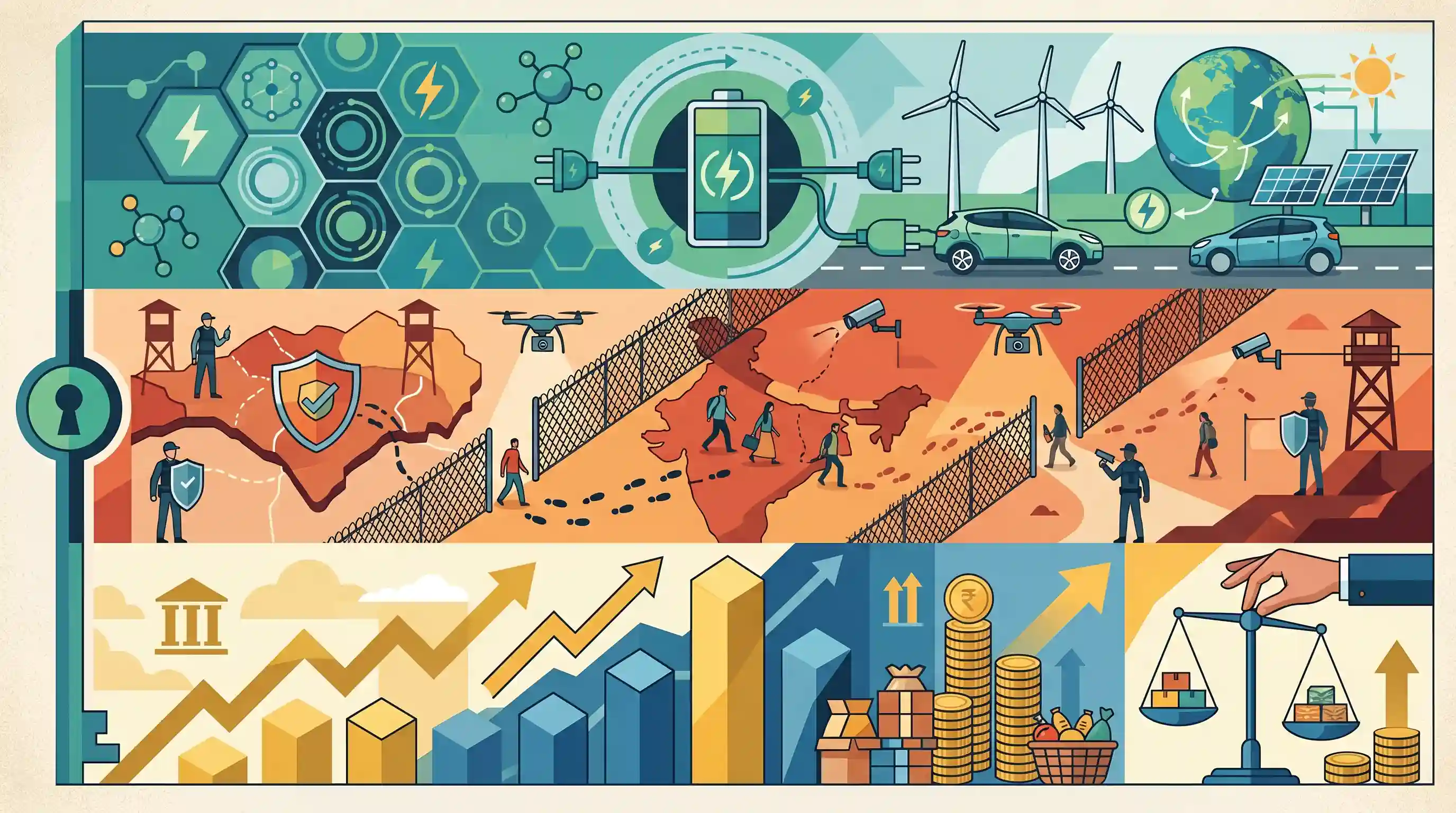
This edition of 'UPSC Key' highlights three distinct yet critical topics for civil services preparation: Battery Technology, Illegal Immigration, and Purchasing Power Parity (PPP). It details the transition towards advanced EV battery chemistries to ensure energy security and clean mobility. It also explores the multifaceted socio-economic and internal security challenges posed by illegal immigration and porous borders. Finally, it unpacks the concept of Purchasing Power Parity as a truer measure of economic output, highlighting India's position as the world's third-largest economy by this metric.
Key Points
- Advances in battery technology, including solid-state and alternative chemistries like sodium-ion, are pivotal for electric vehicle (EV) adoption and reducing dependence on critical minerals like lithium and cobalt.
- Illegal immigration poses significant internal security and demographic challenges for India, underscoring the need for comprehensive border management and intelligence sharing.
- Purchasing Power Parity (PPP) is a vital macroeconomic metric that compares currency values based on a standard basket of goods, offering a realistic view of living standards.
- In PPP terms, India ranks as the third-largest global economy, trailing only China and the United States, providing a different perspective compared to nominal GDP rankings.
Important Terms
Border Area Development Programme (BADP)

A Centrally Sponsored Scheme under the Ministry of Home Affairs aimed at the socio-economic development of residents in remote areas near international borders to ensure security and prevent migration.
UPSC context
GS Paper 3: Internal Security and Border Management; tests knowledge of developmental strategies for securing porous borders.
Border Infrastructure and Management (BIM) Scheme
A Central Sector Scheme focusing on physical infrastructure like fencing, floodlighting, and roads along India’s international borders to curb illegal infiltration, smuggling, and cross-border crimes.
UPSC context
GS Paper 3: Internal Security; relevant for questions on border management technology and infrastructure.
World Bank
The international financial institution that coordinates the International Comparison Program (ICP), which produces the Purchasing Power Parity (PPP) data used to compare global economic outputs.
UPSC context
GS Paper 3: Indian Economy; tests understanding of global indices and India's relative economic standing.
IMF
An international organization that uses PPP-adjusted GDP estimates in its World Economic Outlook to compare economic strength and living standards across its 190 member countries.
UPSC context
GS Paper 3: Macroeconomics; relevant for data-driven analysis of India’s global economic rank.
Reserve Bank of India
India’s central bank responsible for monetary policy, currency management, and maintaining financial stability, which is essential for sustaining the country’s high economic growth.
UPSC context
GS Paper 3: Indian Economy; fundamental for understanding monetary stability and economic growth drivers.
Prelims Trap
Solid-state EV batteries eliminate the need for lithium by replacing it with a solid sodium-ion electrolyte.
Solid-state refers to the electrolyte phase, not the metal. While sodium-ion is a lithium alternative, solid-state batteries often still use pure lithium-metal anodes for high energy density.
Static Concepts Connected
What distinguishes Solid-State Batteries from conventional Lithium-ion batteries?
- Electrolyte Phase: Solid-state uses solid ceramics or polymers, whereas conventional Li-ion uses flammable liquid or gel electrolytes.
- Anode Material: Solid-state can safely utilize pure lithium-metal anodes because the solid electrolyte prevents short-circuiting lithium dendrite growth.
- Safety Profile: Solid-state largely eliminates the risk of thermal runaway (battery fires) while providing significantly higher volumetric energy density.
How does Purchasing Power Parity (PPP) differ from Nominal Exchange Rates?
- Measurement Basis: PPP compares the cost of a standardized basket of goods and services between countries, thereby eliminating price-level differences.
- Nominal Rates: Nominal exchange rates are dictated by forex market forces (supply and demand) and do not accurately reflect domestic purchasing power or living standards.
- India's Standing: India ranks as the third-largest global economy in absolute PPP terms (behind China, US), but drops to fifth when measured by nominal GDP.
Cross-Topic Patterns
Battery Tech + Critical Minerals Geopolitics
Shifting to alternative battery chemistries like sodium-ion reduces import reliance on nations dominating the lithium and cobalt supply chains, directly complementing the Quad's critical mineral initiatives.
Riverine Borders + CIBMS Technology
Illegal immigration through riverine stretches of the 4,096 km Indo-Bangladesh border drives demographic shifts that frequently spark internal security crises, requiring tech-driven border solutions like CIBMS.

Expect a 2026 Prelims question mixing EV battery chemistries (Solid-state vs Li-ion) with the geopolitical sourcing of critical minerals.
Linked PYQs · 5
Linked PYQs · 5
- 2025PrelimsGS1
In the context of electric vehicle batteries, consider the following elements : I. Cobalt II. Graphite III. Lithium IV. Nickel How many of the above usually make up battery cathodes?
- 2025PrelimsGS1
Consider the following types of vehicles : I. Full battery electric vehicles II. Hydrogen fuel cell vehicles III. Fuel cell-electric hybrid vehicles How many of the above are considered as alternative powertrain vehicles?
- 2020MainsGS3
For effective border area management, discuss the steps required to be taken to deny local support to militants and also suggest ways to manage favourable perception among locals.
- 2024MainsGS3
India has a long and troubled border with China and Pakistan fraught with contentious issues. Examine the conflicting issues and security challenges along the border. Also give out the development being undertaken in these areas under the Border Area Development Programme (BADP) and Border Infrastructure and Management (BIM) Scheme.
- 2016MainsGS3
Border management is a complex task due to difficult terrain and hostile relations with some countries. Elucidate the challenges and strategies for effective border management.
