Ecological conservation and monsoon forecasting for aspirants
Source:Indian Express ↗
Why It Matters
Understanding bat conservation is critical for recognizing ecosystem services and zoonotic disease management. Monsoon forecasting directly links to India's macroeconomic stability, food security, and agricultural planning. The de-hyphenation policy is foundational to India's contemporary strategic autonomy in global diplomacy.
Summary
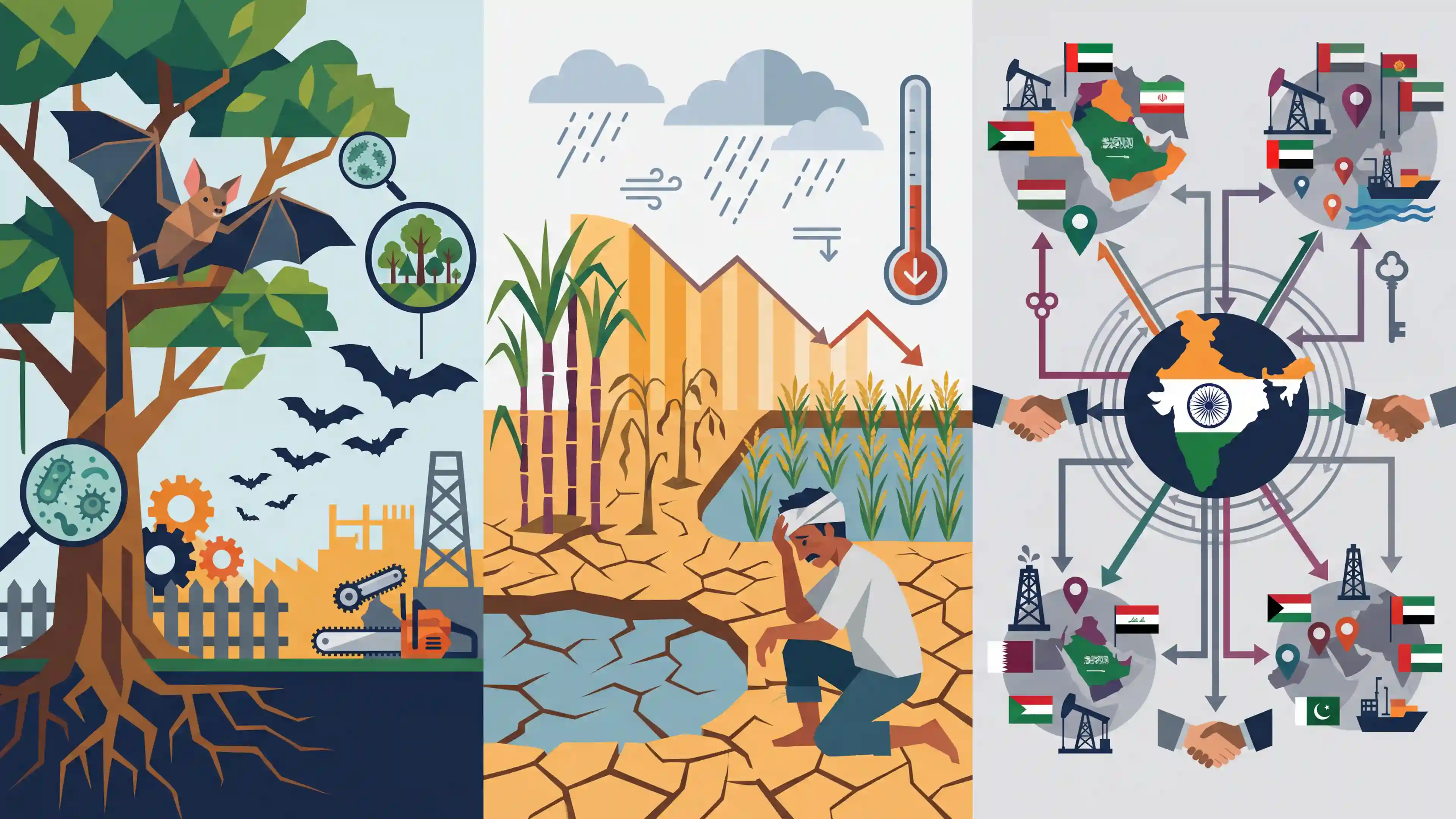
This edition of UPSC Key covers three distinct issues: the ecological imperative of bat conservation against the backdrop of habitat loss, the macroeconomic and agricultural threats posed by a projected below-normal monsoon, and the strategic importance of India's 'de-hyphenation' policy in navigating complex geopolitical relationships, particularly in the Middle East.
Key Points
- Bats are vital for ecosystem services like pollination, seed dispersal, and pest control, but are threatened by habitat destruction and negative perceptions related to zoonotic diseases.
- Forecasts of a below-normal monsoon, often influenced by the El Nino phenomenon, pose significant risks to India's agricultural output, rural economy, and food inflation.
- The 'de-hyphenation' policy highlights India's pragmatic foreign policy shift, allowing it to maintain independent, strong bilateral relations with historical rivals (e.g., Israel and Palestine) without linking them.
Important Terms
De-hyphenation Policy

A foreign policy strategy where India maintains independent, bilateral relations with adversarial nations (e.g., Israel and Palestine) without letting one relationship influence or restrict the other.
UPSC context
GS Paper II (International Relations); critical for understanding India's pragmatic shift in West Asian geopolitics and strategic autonomy.
Wildlife (Protection) Act, 1972
The primary legal framework for the protection of plants and animal species in India; it establishes schedules that provide varying degrees of protection and regulates hunting and trade.
UPSC context
GS Paper III (Environment); frequently tested regarding conservation legalities, protected areas, and recent amendments rationalizing species schedules.
Long Period Average (LPA)
The benchmark for 'normal' rainfall, calculated as the average rainfall recorded over a specific 50-year period; the current LPA for the southwest monsoon is 87 cm.
UPSC context
GS Paper I (Geography) & GS Paper III (Agriculture); essential technical term for monsoon forecasting and agricultural planning.
India Meteorological Department (IMD)
The principal government agency responsible for meteorological observations, weather forecasting, and seismology, operating under the Ministry of Earth Sciences.
UPSC context
GS Paper I & III; central to questions on monsoon mechanisms, disaster management, and climate change monitoring.
State of India’s Bats (SoIBats) 2024–25
The first-ever comprehensive national assessment of bat species in India, highlighting their ecological roles, data gaps, and conservation threats like habitat loss and negative public perception.
UPSC context
GS Paper III (Biodiversity); relevant for species-specific conservation issues and ecological indicators in environmental impact assessments.
Below Normal Monsoon
An IMD classification for the southwest monsoon when the realized rainfall is between 90% and 96% of the Long Period Average (LPA).
UPSC context
GS Paper III (Indian Economy & Agriculture); tests understanding of monsoon impact on Kharif crops and food inflation.
Ecosystem Services
The myriad benefits that humans freely gain from the natural environment and from properly-functioning ecosystems, such as pollination, pest control, and seed dispersal provided by bats.
UPSC context
GS Paper III (Environment); a fundamental concept for valuing biodiversity beyond charismatic megafauna in conservation discourse.
Prelims Trap
El Niño years always guarantee a drought and a failed monsoon in India.
El Niño increases the probability of a below-normal monsoon, but positive Indian Ocean Dipole (IOD) events or favorable Madden-Julian Oscillations can offset its impact.
Static Concepts Connected
How does El Niño suppress the Indian Southwest Monsoon?
- Ocean Warming: Abnormal warming of surface waters in the eastern and central Pacific Ocean alters global pressure gradients.
- Walker Cell Shift: The shifting of the Walker circulation causes descending air (high pressure) over the Indian subcontinent, suppressing rain-bearing clouds.
- IOD Mitigation: A positive Indian Ocean Dipole (IOD) can sometimes counteract El Niño's drying effect, meaning El Niño does not automatically equal drought.
What does the 'De-hyphenation' policy mean in Indian diplomacy?
- Independent Ties: Pursuing mutually exclusive, direct relationships with two historically rival nations without allowing ties with one to dictate ties with the other.
- Classic Example: India maintains deep defense and tech ties with Israel while simultaneously supporting the Palestinian two-state solution and Arab energy ties.
- Pragmatism over Ideology: It marks a definitive shift from Cold War-era ideological bloc politics to issue-based strategic autonomy and pragmatic foreign policy.
Cross-Topic Patterns
Monsoon deficits + RBI Monetary Policy
A below-normal monsoon drives up food inflation via lowered kharif yields, directly impacting the RBI's ability to lower interest rates under its inflation-targeting mandate.
Bat conservation + Zoonotic Disease spillover
Habitat fragmentation forces bat populations closer to human settlements, increasing the risk of zoonotic spillover (like Nipah), bridging biodiversity loss with public health epidemiology.

Expect a 2026 Prelims multi-statement question combining El Niño's monsoon disruption with the RBI's inflation targeting mandate.
Linked PYQs · 5
Linked PYQs · 5
- 2012PrelimsGS1
Consider the following kinds of organisms: 1. Bat 2. Bee 3. Bird Which of the above is/are pollinating agent/agents?
- 2017PrelimsGS1
With reference to 'Indian Ocean Dipole (IOD)' sometimes mentioned in the news while forecasting Indian monsoon, which of the following statements is/are correct? 1. IOD phenomenon is characterised by a difference in sea surface temperature between tropical Western Indian Ocean and tropical Eastern Pacific Ocean. 2. An IOD phenomenon can influence an El Nino's impact on the monsoon. Select the correct answer using the code given below:
- 2011PrelimsGS1
La Nina is suspected to have caused recent floods in Australia. How is La Nina different from El Nino? 1. La Nina is characterised by unusually cold ocean temperature in equatorial Indian Ocean whereas El Nino is characterised by unusually warm ocean temperature in the equatorial Pacific Ocean. 2. El Nino has adverse effect on south-west monsoon of India, but La Nina has no effect on monsoon climate. Which of the statements given above is/are correct?
- 2018MainsGS2
“India’s relations with Israel have, of late, acquired a depth and diversity, which cannot be rolled back.” Discuss.
- 2014MainsGS1
Most of the unusual climatic happenings are explained as an outcome of the El-Nino effect. Do you agree?
