Social Media Regulation and Care Economy in India
Source:Indian Express ↗
Why It Matters
The intersection of child safety in the digital sphere, the recognition of women's unpaid care work, and regional industrial policies (like SIRs) form the core of current socio-economic and governance debates, making them highly probable themes for GS1, GS2, and GS3 Mains questions.
Summary
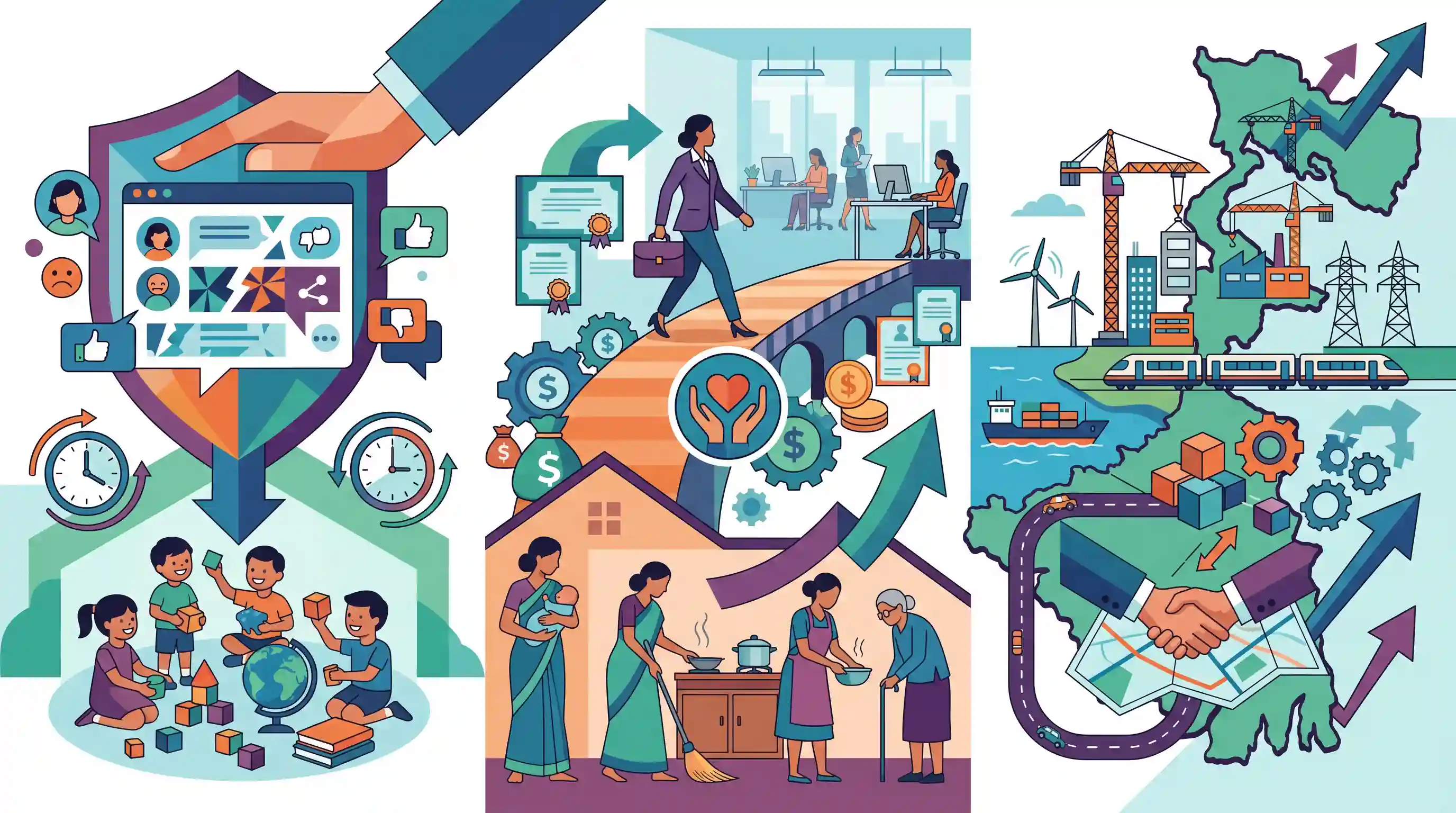
This UPSC Key edition highlights three critical themes: the growing debate around banning or regulating social media for children to protect their well-being in the digital age; the macroeconomic importance of the 'Care Economy' in addressing unpaid work and boosting women's workforce participation; and West Bengal's initiative to develop a Special Investment Region (SIR) to spur industrial and infrastructure growth. These topics intersect across child rights, gender-inclusive economic policies, and regional investment models.
Key Points
- Increasing global and national focus on regulating or banning social media access for minors to mitigate mental health issues, cyberbullying, and privacy violations.
- The 'Care Economy' encompasses the vast unpaid domestic and caregiving work predominantly performed by women, which limits female labour force participation (FLFP).
- Recognizing, reducing, and redistributing unpaid care work, alongside investing in paid care services, is essential for gender equality and inclusive economic growth.
- West Bengal's push to establish a Special Investment Region (SIR) aims to drive industrialization, infrastructure development, and attract large-scale investments, addressing past regional economic challenges.
- SIRs serve as integrated industrial corridors offering streamlined regulations, unlike traditional SEZs which have faced taxation and administrative hurdles.
Important Terms
Special Investment Region (SIR) Policy

Large-scale industrial zones designated to attract massive investment and regional growth through world-class infrastructure, policy incentives, and integrated industrial ecosystems beyond traditional SEZs.
UPSC context
Relevant for GS Paper 3: Infrastructure and Investment Models; tests understanding of regional development strategies and ease of doing business.
National Commission for Protection of Child Rights (NCPCR)
A statutory body established under the CPCR Act, 2005, mandated to ensure that all laws and policies in India align with child rights and the UN Convention.
UPSC context
GS Paper 2: Statutory Bodies and Issues relating to Children; tests knowledge of grievance redressal and child safety frameworks.
Care Economy
The sector encompassing both paid and unpaid labor involved in caregiving for children, the elderly, and the disabled, crucial for human capital development.
UPSC context
GS Paper 3: Inclusive Growth and GS Paper 1: Women Empowerment; tests the link between unpaid labor and female labor force participation.
Time Poverty
A condition where individuals lack sufficient time for personal growth, leisure, or paid employment because they are overburdened with unpaid domestic and caregiving duties.
UPSC context
GS Paper 1: Social Empowerment and GS Paper 3: Employment; tests analysis of gender-based disparities in the labor market.
Social Media Regulation for Children
Legal frameworks, such as the DPDP Act 2023, aimed at controlling online content, protecting data privacy, and mitigating digital addiction risks for minors.
UPSC context
GS Paper 2: Government Policies and Interventions; tests the balance between digital rights and the protection of vulnerable sections.
Prelims Trap
Unpaid domestic and care work is officially accounted for in India's Gross Domestic Product (GDP).
Unpaid care work is excluded from the UN System of National Accounts (SNA) boundary due to valuation complexities, meaning it is omitted from official GDP calculations.
Static Concepts Connected
Why is unpaid care work excluded from official GDP?
- SNA boundary: The UN System of National Accounts (SNA) excludes unpaid domestic services primarily due to the complexity of assigning accurate monetary values to such non-market activities.
- Alternative measurement: Instead of macroeconomic aggregates, India's NSO uses the Time Use Survey (TUS) to quantify time spent on unpaid care, capturing gender-disaggregated labor data.
How do Special Investment Regions (SIRs) differ from Special Economic Zones (SEZs)?
- Export vs Domestic: SEZs are treated as foreign territory strictly for export promotion. SIRs focus on broad-based domestic industrialisation and integrated regional development.
- Scale and scope: SIRs are massive, city-scale industrial corridors (e.g., Dholera SIR), whereas SEZs are typically smaller, fenced enclaves governed by specific national tax exemption acts.
Cross-Topic Patterns
DPDP Act + Fundamental Rights
Mandating 'verifiable parental consent' for minors under the DPDP Act 2023 bridges statutory data protection with Article 21 (Puttaswamy privacy) and international child cyber-safety interventions.
Care Economy + Demographic Dividend
Addressing the '3Rs' (Recognise, Reduce, Redistribute) of unpaid care is structurally linked to raising India's low Female Labour Force Participation (FLFP), an absolute prerequisite for reaping the demographic dividend.

Expect a GS-3 prelims statement testing the exact SNA boundary rules regarding unpaid care work alongside NSO's Time Use Survey.
Linked PYQs · 3
Linked PYQs · 3
- 2025MainsGS2
The National Commission for Protection of Child Rights has to address the challenges faced by children in the digital era. Examine the existing policies and suggest measures the Commission can initiate to tackle the issue.
- 2021MainsGS1
Examine the role of 'Gig Economy' in the process of empowerment of women in India.
- 2015MainsGS3
There is a clear acknowledgement that Special Economic Zones (SEZs) are a tool of industrial development, manufacturing and exports. Recognizing this potential, the whole instrumentality of SEZs requires augmentation. Discuss the issues plaguing the success of SEZs with respect to taxation, governing laws and administration.
