India UAE Relations and Strategic Security Partnership in West Asia
Source:Indian Express ↗
Why It Matters
The article highlights essential domains for UPSC aspirants: India's diplomatic outreach in the Middle East, transnational counter-terrorism strategies, and the physical geography/disaster vulnerability of neighboring regions like Afghanistan.
Summary
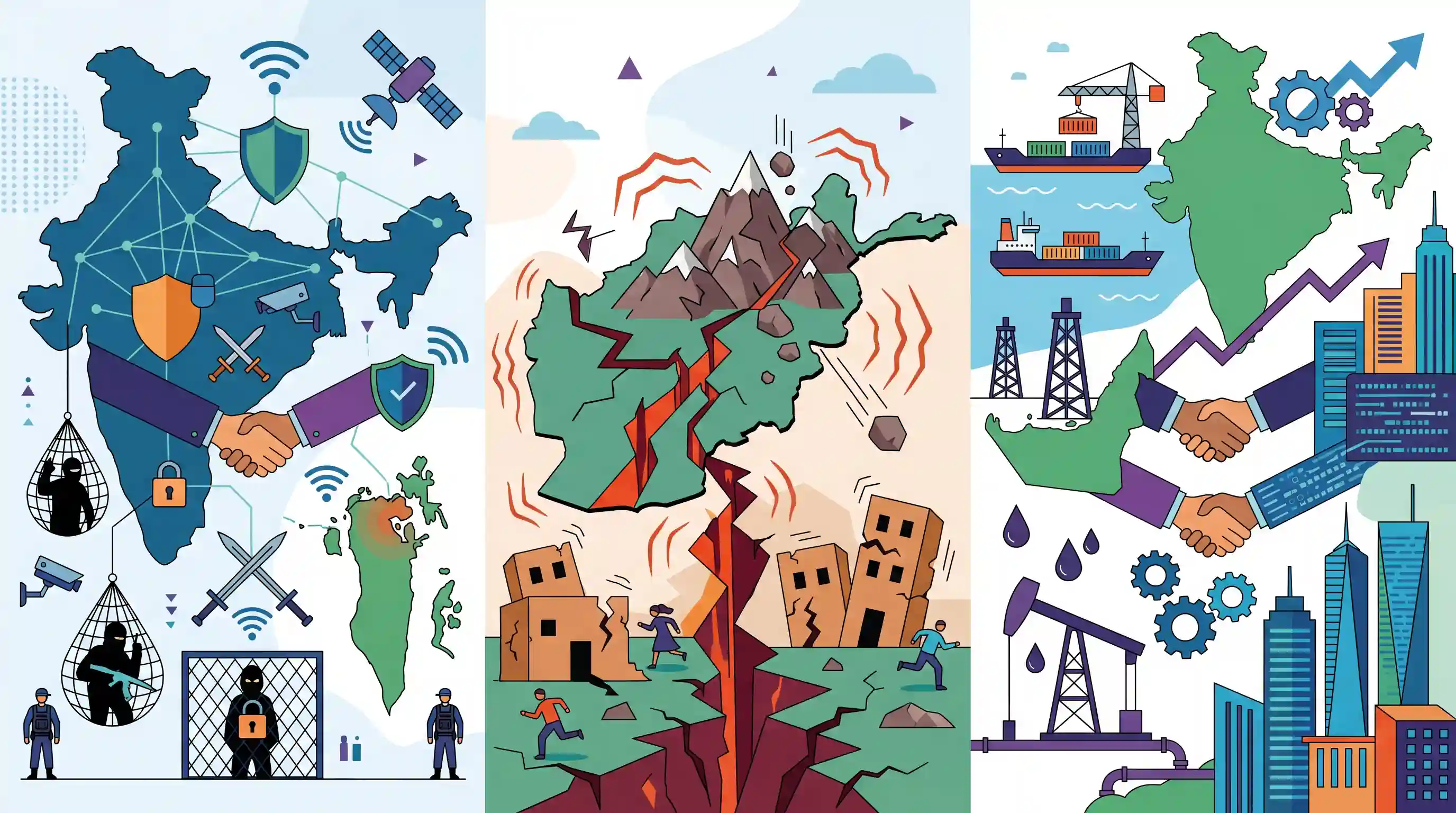
This article explores three distinct topics relevant to UPSC exam preparation: India's counter-terrorism cooperation with Bahrain, the significant seismic risks faced by Afghanistan, and the evolving dynamic of India-UAE bilateral relations. It highlights the strategic imperative for India to partner with Middle Eastern nations like Bahrain to tackle terrorism and radicalization. Furthermore, it touches upon the geological vulnerabilities of Afghanistan located in the earthquake-prone Hindu Kush region, compounding its existing geopolitical challenges. Lastly, it details the deepening strategic and economic cooperation between India and the UAE, underpinned by energy security and trade partnerships.
Key Points
- India and Bahrain emphasize strengthening bilateral counter-terrorism cooperation, focusing on information sharing and combating radicalization.
- Afghanistan's location along the highly active tectonic fault lines of the Hindu Kush region exposes it to persistent and severe seismic risks.
- The lack of robust disaster management and infrastructure in Afghanistan exacerbates its vulnerability to devastating earthquakes.
- India and the UAE are rapidly deepening their strategic ties, expanding bilateral relations into trade, energy, and multilateral frameworks.
Important Terms
Comprehensive Economic Partnership Agreement (CEPA)

A comprehensive trade pact covering goods, services, investment, and regulatory issues. It reduces tariffs and barriers to promote deeper economic integration between signatory nations.
UPSC context
GS Paper 2 & 3: Bilateral trade agreements and their impact on India’s economy and foreign policy.
Joint Working Group (JWG) on Counter-Terrorism
A bilateral institutional mechanism established to enhance cooperation in intelligence sharing, capacity building, and cyber security to combat terrorism, radicalization, and cross-border threats.
UPSC context
GS Paper 2 & 3: International security cooperation and challenges from external state/non-state actors.
Hindu Kush Mountain Range
An 800km-long mountain range in Central and South Asia. It is geologically young and highly seismically active due to the collision of Indian and Eurasian tectonic plates.
UPSC context
GS Paper 1: Physical Geography and geological phenomena (earthquakes) in India’s neighborhood.
Comprehensive Strategic Partnership
The highest level of bilateral relationship involving multi-sectoral cooperation in defense, energy, technology, and regional security, anchored in mutual trust and long-term geopolitical convergence.
UPSC context
GS Paper 2: Bilateral, regional, and global groupings and agreements involving India.
Alpide Belt
The second most seismically active region globally, extending from the Atlantic to the Himalayas. It was formed by the collision of the African, Arabian, and Indian plates with the Eurasian plate.
UPSC context
GS Paper 1: World physical geography and tectonic activity.
Energy Security
Ensuring the uninterrupted availability of energy sources at an affordable price. For India, it involves diversifying suppliers and long-term contracts for crude oil and LNG.
UPSC context
GS Paper 3: Infrastructure and energy needs; GS Paper 2: International relations and resource diplomacy.
Prelims Trap
"Foreign national oil companies are prohibited from participating or storing oil in India's Strategic Petroleum Reserves."
Aspirants often mistakenly assume strategic reserves are 100% closed to foreign entities for national security reasons. The UAE's ADNOC actually stores crude in India's SPR.
Static Concepts Connected
What is the framework for India's Strategic Petroleum Reserves (SPR)?
- Locations: Phase 1 includes underground rock caverns at Visakhapatnam (AP), Mangaluru (Karnataka), and Padur (Karnataka). Phase 2 proposes commercial-cum-strategic facilities at Chandikhol (Odisha) and Padur.
- Management: Maintained by Indian Strategic Petroleum Reserves Limited (ISPRL), a wholly owned subsidiary of OIDB under the Ministry of Petroleum and Natural Gas.
- Foreign Leasing: Foreign national oil companies can lease space to store oil, but the Government of India retains the first right of refusal during supply emergencies.
What tectonic mechanism drives the high seismicity in the Hindu Kush region?
- Plate Collision: The region sits on a highly active convergent plate boundary resulting from the ongoing collision and underthrusting of the Indian Plate beneath the Eurasian Plate.
- Focal Depth: While famous for deep-focus earthquakes due to subducted slabs, periodic shallow-focus events cause immense surface destruction, worsened by non-engineered mud-brick housing.
Cross-Topic Patterns
Middle East ties: From Oil to Strategy
India’s bilateral relations in the Gulf have transcended simple buyer-seller oil dynamics to include joint counter-terrorism, CEPA frameworks, and integration into critical domestic energy infrastructure.
Geological hazards + Institutional vacuum
Like the 2015 Nepal earthquake, Afghanistan’s tectonic vulnerability is severely amplified by a lack of disaster preparedness, highlighting how governance deficits fatally compound natural disasters in the Himalayas/Hindu Kush.

Expect a 2026 Prelims question combining India's Strategic Petroleum Reserves (locations) with permissible foreign participation rules.
Linked PYQs · 4
Linked PYQs · 4
- 2021MainsGS3
Analyse the complexity and intensity of terrorism, its causes, linkages and obnoxious nexus. Also suggest measures required to be taken to eradicate the menace of terrorism.
- 2017MainsGS2
The question of India's Energy Security constitutes the most important part of India's economic progress. Analyze India's energy policy cooperation with West Asian countries.
- 2019MainsGS3
Vulnerability is an essential element for defining disaster impacts and its threat to people. How and in what ways can vulnerability to disasters be characterized? Discuss different types of vulnerability with reference to disasters.
- 2013MainsGS3
How important are vulnerability and risk assessment for pre-disaster management ? As an administrator, what are key areas that you would focus on in a Disaster Management System.
