Analyzing Anti-Defection Law and Linguistic Reorganization of States
Source:Indian Express ↗
Why It Matters
These topics represent core UPSC themes across GS1, GS2, and GS3. The Anti-Defection Law is vital for understanding legislative functioning, linguistic state reorganization forms the bedrock of post-independence history, and the Myanmar crisis is essential for evaluating border management and regional geopolitics.
Summary
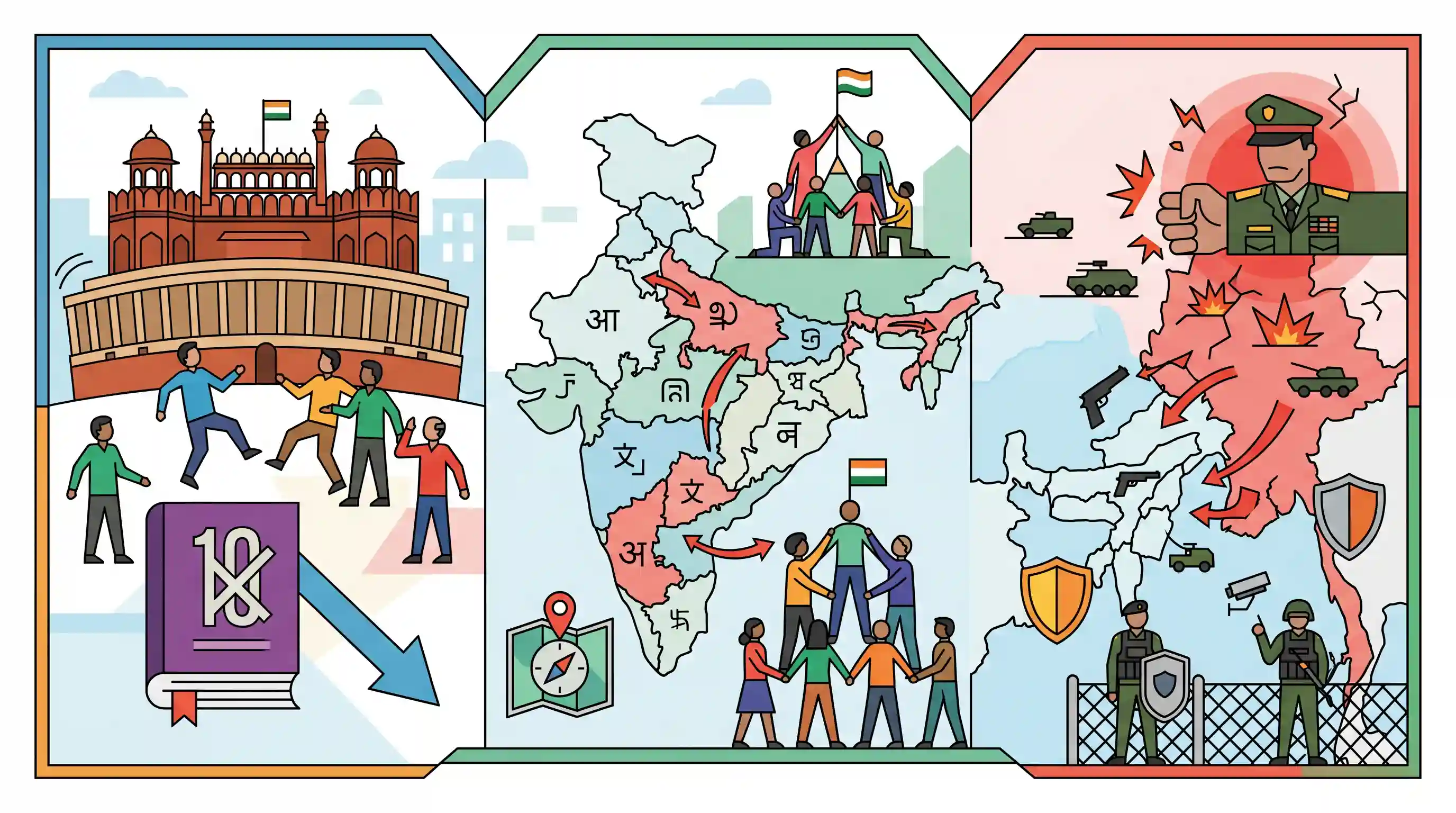
This edition of UPSC Key covers three major topics: the constitutional provisions and challenges surrounding the Anti-Defection Law (Tenth Schedule), the historical context of the linguistic reorganization of Indian states post-independence, and the geopolitical implications of the military junta's rule in Myanmar. It details how defection impacts parliamentary democracy, traces the role of the States Reorganisation Commission in nation-building, and analyzes the internal security threats facing India's North-East due to the instability in Myanmar.
Key Points
- The Anti-Defection Law (Tenth Schedule) is designed to ensure political stability by preventing legislators from changing parties, highlighting the critical adjudicatory role of the Speaker in disqualification cases.
- The linguistic division of states was a pivotal part of India's post-independence consolidation, guided by bodies like the States Reorganisation Commission to balance linguistic identity with national unity.
- The ongoing military junta rule in Myanmar poses significant geopolitical and internal security challenges for India, notably through cross-border insurgencies, illegal migration, and transnational crimes along the porous North-East border.
Important Terms
Tenth Schedule

The section of the Indian Constitution detailing the Anti-Defection Law, introduced to disqualify legislators who switch political parties for personal or political gain.
UPSC context
GS Paper 2: Indian Constitution/Polity. Tests knowledge of political stability, legislative disqualification, and the Speaker's powers.
Anti-Defection Law
The legal framework (within the Tenth Schedule) that prevents elected members from defecting, aimed at curbing unprincipled floor-crossing and ensuring government stability.
UPSC context
GS Paper 2: Governance/Political System. Crucial for understanding party discipline and judicial review (Kihoto Hollohan case).
52nd Constitutional Amendment Act
The 1985 constitutional amendment that legally established the Anti-Defection Law and inserted the Tenth Schedule into the Indian Constitution.
UPSC context
GS Paper 2: Constitution. Essential factual knowledge regarding the legal origins of defection-related disqualifications.
States Reorganisation Commission (SRC)
A 1953 body (Fazal Ali Commission) that recommended redrawing India's internal boundaries based on linguistic, administrative, and national unity factors.
UPSC context
GS Paper 1: Post-Independence Consolidation. Core topic for understanding the evolution of the Indian federation.
Tatmadaw
Myanmar's military forces, which seized power in a 2021 coup, creating instability and refugee crises impacting India’s North-Eastern internal security.
UPSC context
GS Paper 2: International Relations; GS Paper 3: Internal Security. Tests awareness of regional geopolitics and border management.
States Reorganisation Act
The 1956 legislation resulting from SRC recommendations that reorganized Indian states into 14 states and 6 union territories along linguistic lines.
UPSC context
GS Paper 1: History. Focuses on the formal legal creation of linguistic states post-independence.
Prelims Trap
"Disqualification under the Anti-Defection Law is decided by the President on the binding advice of the Election Commission."
Under the 10th Schedule, the Presiding Officer (Speaker/Chairman) decides defection cases. The President (via EC advice) decides ordinary disqualifications under Article 102(1) / RPA 1951.
Static Concepts Connected
Who adjudicates the different types of MP/MLA disqualifications?
- 10th Schedule (Defection): The Presiding Officer (Speaker/Chairman) decides, acting as a tribunal subject to judicial review.
- Article 102/191 & RPA 1951: The President/Governor decides, based on the binding advice of the Election Commission.
What were the key commissions for the linguistic reorganization of states?
- Dhar Commission (1948): Rejected language as a basis, favoring administrative convenience and historical continuity.
- JVP Committee (1948): Formally rejected language as the sole basis for reorganization, prioritizing security and economic stability.
- Fazl Ali Commission (1953): Broadly accepted language as a basis but firmly rejected the "one language, one state" theory.
Cross-Topic Patterns
Myanmar Junta + FMR Suspension
The security vacuum in Myanmar links directly to India's recent move to scrap the Free Movement Regime (FMR) and fence the Indo-Myanmar border to curb narco-terrorism and insurgent sanctuaries.
Anti-Defection + Quasi-Judicial Role
The Speaker acts as a tribunal under the 10th Schedule. UPSC tests this quasi-judicial role against the doctrine of separation of powers and judicial review limits (Kihoto Hollohan case).

Expect a mixed 2026 Prelims question testing the Speaker's quasi-judicial powers under the 10th Schedule against RPA 1951 provisions.
Linked PYQs · 5
Linked PYQs · 5
- 2025PrelimsGS1
Consider the following statements : I. If any question arises as to whether a Member of the House of the People has become subject to disqualification under the 10th Schedule, the President's decision in accordance with the opinion of the Council of Union Ministers shall be final. II. There is no mention of the word 'political party' in the Constitution of India. Which of the statements given above is/are correct?
- 2014PrelimsGS1
Which one of the following Schedules of the Constitution of India contains provisions regarding anti-defection?
- 2025MainsGS1
Trace India's consolidation process during early phase of independence in terms of polity, economy, education and international relations.
- 2017MainsGS1
In the context of the diversity of India, can it be said that the regions form cultural units rather than the States ? Give reasons with examples for your viewpoint.
- 2019MainsGS3
Cross-border movement of insurgents is only one of the several security challenges facing the policing of the border in North-East India. Examine the various challenges currently emanating across the India-Myanmar border. Also, discuss the steps to counter the challenges.
