Air pollution regulations and internal security threats from toxins
Source:Indian Express ↗
Why It Matters
The topics represent high-yield areas for UPSC GS-3, frequently appearing in both Prelims and Mains. Air pollution and carbon emissions are central to environmental policy and international climate negotiations. Understanding toxins like ricin bridges the gap between basic science and internal security threats (WMDs). Meanwhile, QCOs highlight contemporary trade policy shifts toward import substitution and quality standardization under the 'Atmanirbhar Bharat' vision.
Summary
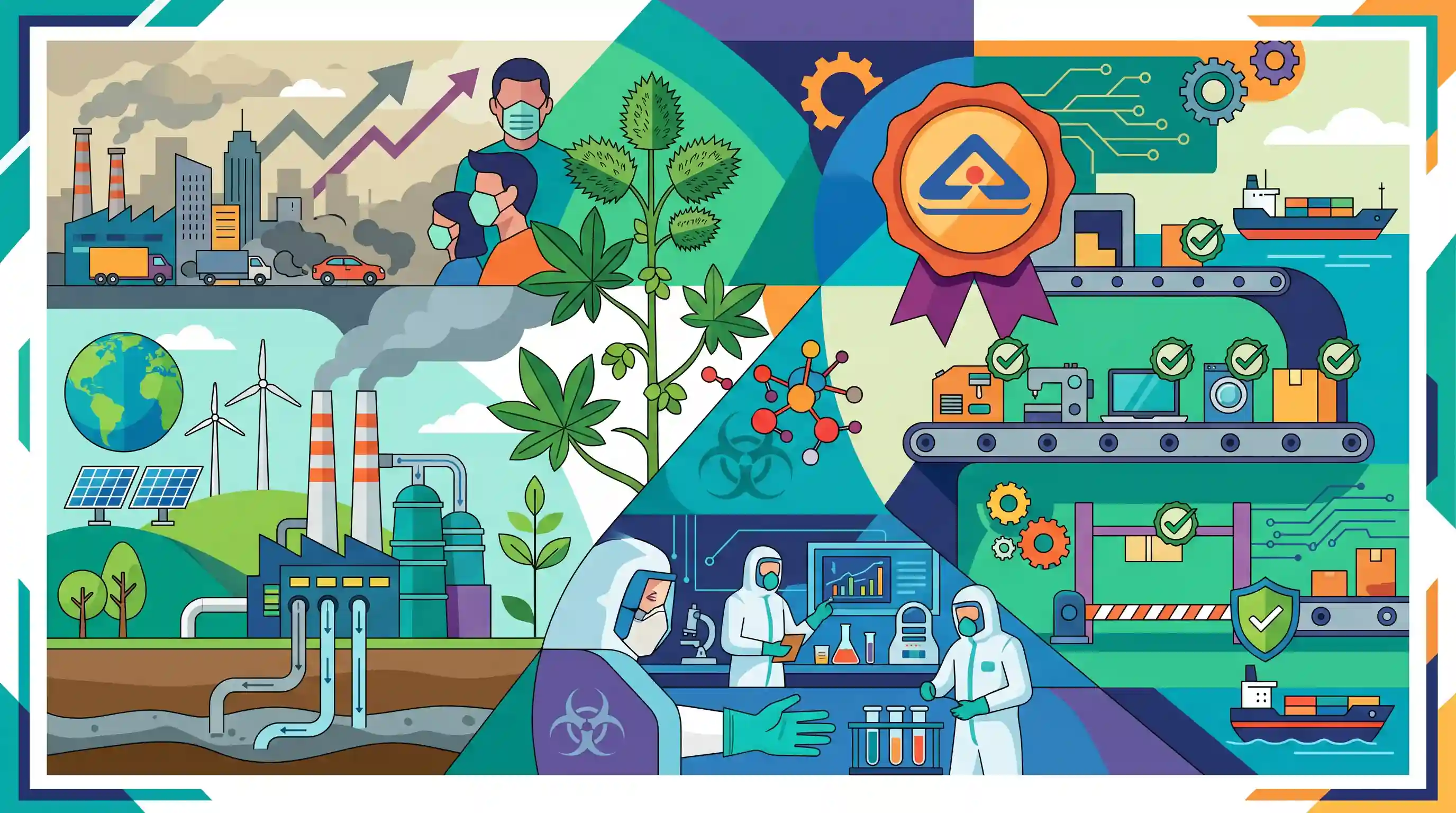
This comprehensive current affairs compilation addresses critical topics across the UPSC syllabus. It covers the persistent challenge of air pollution and the regulatory frameworks needed to align with WHO guidelines. It highlights the science and security implications of the ricin toxin, a lethal biological agent derived from castor beans. The article also examines India's strategies for curbing carbon emissions to meet UNFCCC climate targets through emerging technologies like CCUS. Finally, it outlines the economic and strategic importance of Quality Control Orders (QCOs) enforced by the Bureau of Indian Standards (BIS), which serve to ensure product safety, protect domestic manufacturing, and restrict sub-standard imports.
Key Points
- Air pollution continues to be a severe environmental and public health crisis in India, requiring strict enforcement of the National Clean Air Programme (NCAP) and Graded Response Action Plan (GRAP) to meet WHO Air Quality Guidelines for PM2.5 and PM10.
- Ricin is a highly potent, naturally occurring toxin derived from castor beans (Ricinus communis). By inhibiting protein synthesis in cells, it is lethal in tiny doses and poses significant internal security risks due to its potential use as a bioterrorism agent.
- Mitigating carbon emissions is central to India's climate commitments (including the 'Panchamrit' goals and Net Zero by 2070), necessitating the scale-up of renewable energy, EV adoption, and Carbon Capture, Utilization, and Storage (CCUS) technologies.
- Quality Control Orders (QCOs) are regulatory instruments used by the government to mandate Bureau of Indian Standards (BIS) certification for products. They aim to protect consumers, ensure environmental and safety standards, and act as a strategic non-tariff barrier to curb the import of sub-standard goods.
Important Terms
National Clean Air Programme (NCAP)

Launched in 2019, this long-term strategy targets a 40% reduction in particulate matter (PM10 and PM2.5) concentrations by 2026 across 131 Indian 'non-attainment' cities.
UPSC context
GS Paper III (Environment). Tests pollution control frameworks, target-setting, and collaborative federalism in environmental governance.
Quality Control Orders (QCOs)
Mandatory regulatory directives issued under the BIS Act, 2016, requiring products to meet specific Indian standards before being manufactured, imported, or sold in India.
UPSC context
GS Paper III (Economy/Industrial Policy). Relevant for trade barriers, domestic manufacturing protection, and consumer safety.
Graded Response Action Plan (GRAP)
An emergency response framework for Delhi-NCR that mandates stage-wise restrictive actions based on real-time Air Quality Index (AQI) thresholds to prevent pollution spikes.
UPSC context
GS Paper III (Environment). Tests emergency policy interventions, air quality management, and the role of the CAQM.
Ricin Toxin
A highly potent protein toxin derived from castor bean waste that inhibits cellular protein synthesis; it is internationally regulated as a potential bioterrorism agent.
UPSC context
GS Paper III (Internal Security/Science & Tech). Relevant for biological threats, bioterrorism, and international weapon conventions.
Bureau of Indian Standards (BIS)
The National Standards Body of India, functioning under the Ministry of Consumer Affairs, responsible for standardization, quality certification, and enforcing mandatory quality orders.
UPSC context
GS Paper III (Economy/Regulatory Bodies). Crucial for institutional quality assurance and non-tariff trade measures.
Department for Promotion of Industry and Internal Trade (DPIIT)
A nodal department under the Ministry of Commerce and Industry responsible for industrial policy, FDI, startups, and coordinating manufacturing standards across sectors.
UPSC context
GS Paper III (Economy). Tests knowledge of industrial growth, Ease of Doing Business, and manufacturing regulations.
Prelims Trap
"Quality Control Orders (QCOs) inherently violate WTO rules as they act as non-tariff barriers."
QCOs are WTO-compliant under the Technical Barriers to Trade (TBT) Agreement when applied to protect human health, safety, or environment, provided they treat domestic and imported goods equally.
Static Concepts Connected
What are the primary targets and parameters under the National Clean Air Programme (NCAP)?
- Base Year: 2017 is the designated base year used to compare pollution reduction across target cities.
- Pollutant Targets: Aims for a 40% reduction in PM10 and PM2.5 concentrations by 2026. It focuses on particulates, not directly targeting gaseous pollutants like SO2 in the headline metric.
- City Coverage: It focuses on 131 'non-attainment' cities that consistently failed to meet National Ambient Air Quality Standards (NAAQS) for five consecutive years.
What is the statutory and administrative basis for Quality Control Orders (QCOs)?
- Statutory Backing: Issued under the regulatory framework of the Bureau of Indian Standards (BIS) Act, 2016.
- Issuing Authority: QCOs are issued by the relevant line Ministries or Departments (e.g., DPIIT, Ministry of Textiles), rather than by BIS itself.
- Universal Applicability: To maintain WTO parity, a QCO mandates that both domestically manufactured and imported goods must bear the BIS Standard Mark.
Cross-Topic Patterns
Bioterrorism & CWC Schedule 1
Ricin’s classification as a natural toxin and a Schedule 1 substance under the CWC perfectly merges Internal Security (bioterrorism) with International Relations (disarmament treaties).
QCOs as Strategic Non-Tariff Barriers
Using BIS standards for trade policy highlights how India leverages technical regulations (QCOs) to shield domestic manufacturing while navigating WTO’s Technical Barriers to Trade (TBT) agreements.

Expect a 2026 multi-statement Prelims question merging WTO's TBT agreement, India's QCOs, and BIS Act applicability to imports.
Linked PYQs · 5
Linked PYQs · 5
- 2022PrelimsGS1
In the context of WHO Air Quality Guidelines, consider the following statements: 1. The 24-hour mean of PM2.5 should not exceed 15 µg/m³ and annual mean of PM2.5 should not exceed 5 µg/m³. 2. In a year, the highest levels of ozone pollution occur during the periods of inclement weather. 3. PM10 can penetrate the lung barrier and enter the bloodstream. 4. Excessive ozone in the air can trigger asthma. Which of the statements given above are correct?
- 2021MainsGS3
Describe the key points of the revised Global Air Quality Guidelines (AQGs) recently released by the World Health Organisation (WHO). How are these different from its last update in 2005? What changes in India's National Clean Air Programme are required to achieve these revised standards?
- 2017PrelimsGS1
Consider the following statements: 1. The Standard Mark of Bureau of Indian Standards (BIS) is mandatory for automotive tyres and tubes. 2. AGMARK is a quality Certification Mark issued by the Food and Agriculture Organisation (FAO). Which of the statements given above is/are correct?
- 2010PrelimsGS1
As regards the use of international food safety standards as reference point for the dispute settlements, which one of the following does WTO collaborate with?
- 2025MainsGS3
What is Carbon Capture, Utilization and Storage (CCUS)? What is the potential role of CCUS in tackling climate change?
