AI Governance Refurbished Medical Devices and Maternity Act
Source:Indian Express ↗
Why It Matters
These topics intersect multiple UPSC syllabus areas: global tech governance (GS2/GS3), healthcare accessibility and social welfare schemes (GS2), and women's workforce participation (GS1/GS2). The direct overlap with previous questions on AI applications, healthcare affordability, and maternity laws makes this highly relevant for both Prelims and Mains.
Summary
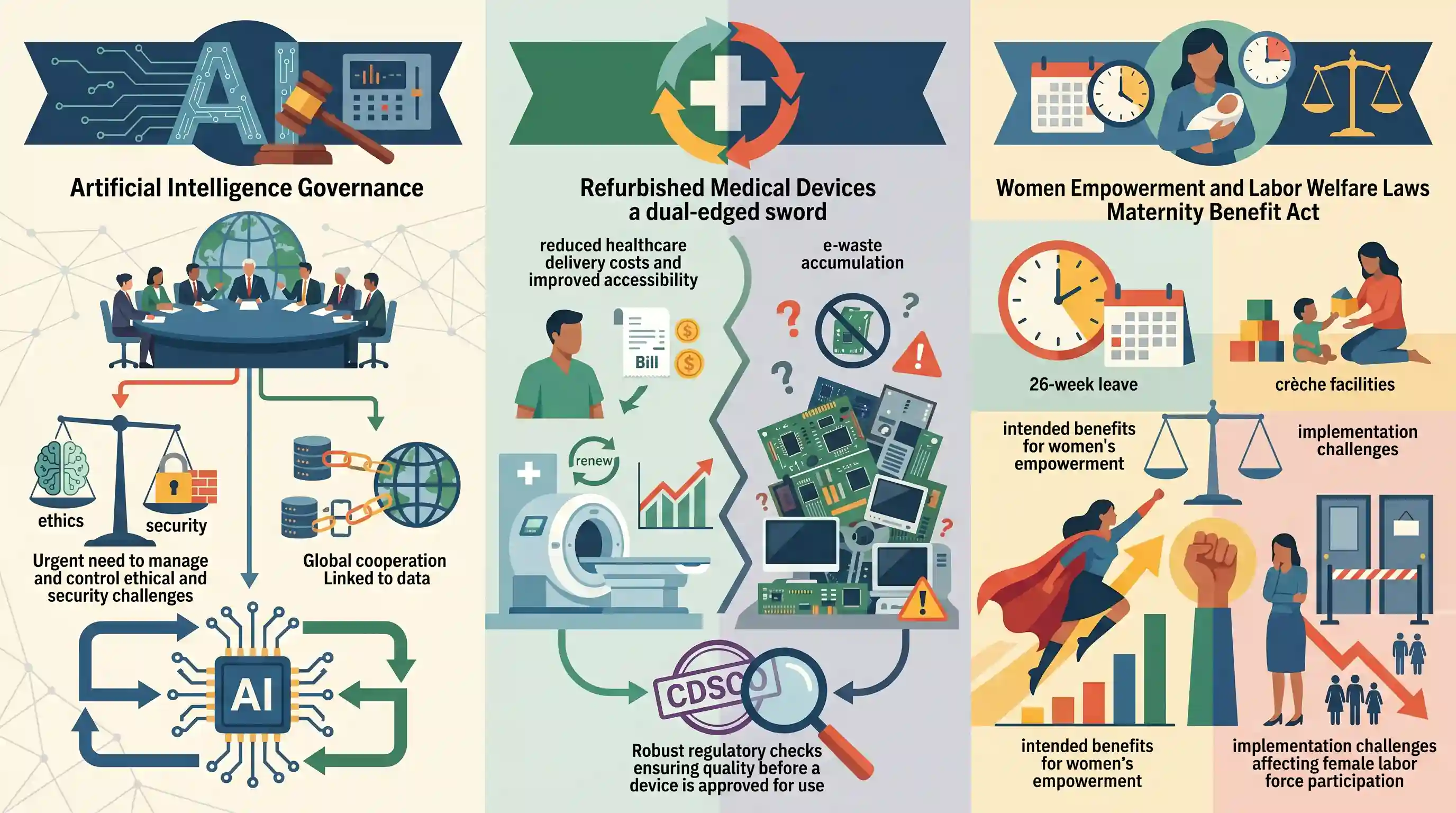
This UPSC Key edition explores three crucial developments. The AI Summit focuses on the urgent need for global governance frameworks to manage the ethical and security challenges of Artificial Intelligence. The policy regarding refurbished medical devices is analyzed as a dual-edged sword: while it reduces healthcare delivery costs and improves accessibility, it requires robust regulatory checks by CDSCO to guarantee quality and avoid e-waste accumulation. Lastly, the article assesses the Maternity Benefit Act's provisions, particularly the 26-week leave and crèche facilities, weighing its intended benefits for women's empowerment against implementation challenges affecting female labor force participation.
Key Points
- The AI Summit highlights the need for international collaboration to establish ethical guidelines, governance frameworks, and regulations addressing algorithmic bias and deepfakes.
- Allowing the import and use of refurbished medical devices can significantly lower capital expenditure for healthcare providers, enhancing healthcare affordability in tier-2 and tier-3 cities.
- Stringent regulatory oversight by bodies like the CDSCO is required for refurbished medical devices to ensure patient safety and prevent India from becoming a dumping ground for electronic waste.
- Discussions around the Maternity Benefit Act emphasize the need for better compliance with 26-week paid maternity leave and crèche mandates, while addressing the unintended consequence of reduced female hiring in certain sectors.
Important Terms
Global Partnership on Artificial Intelligence (GPAI)

A multi-stakeholder international initiative hosted by the OECD that promotes responsible, human-centric Artificial Intelligence development. India is a founding member and served as the Lead Chair in 2024.
UPSC context
GS Paper 2 (International Relations) & GS Paper 3 (S&T); tests global governance of emerging technologies and India's leadership roles.
CDSCO
India's national regulatory authority for pharmaceuticals and medical devices. It operates under the Ministry of Health and Family Welfare and is responsible for licensing, standards, and import quality control.
UPSC context
GS Paper 2 (Statutory, regulatory and various quasi-judicial bodies); essential for governance and public health infrastructure questions.
Maternity Benefit (Amendment) Act, 2017
Legislation that increased paid maternity leave from 12 to 26 weeks and mandated crèche facilities for establishments with 50+ employees to improve female labor force participation.
UPSC context
GS Paper 2 (Social Justice/Welfare schemes) & GS Paper 1 (Society); tests understanding of gender-based labor reforms and socio-economic empowerment.
Medical Devices Rules, 2017
The primary regulatory framework under the Drugs and Cosmetics Act, 1940, governing the manufacture, import, and sale of medical devices in India, including recent debates on refurbished equipment.
UPSC context
GS Paper 2 (Governance/Health) & GS Paper 3 (Economy); relevant for industrial policy and healthcare accessibility challenges.
Ministry of Health and Family Welfare (MoHFW)
The apex executive body in India responsible for health policy, overseeing the CDSCO, and managing the implementation of medical standards and public health programs.
UPSC context
GS Paper 2 (Government policies and interventions); foundational for answering questions on health sector administration and social infrastructure.
Prelims Trap
"The 2017 Act provides 26 weeks of paid maternity leave for all pregnancies."
The 26-week leave is restricted to the first two surviving children. For the third child onwards, the paid leave entitlement drops to 12 weeks.
Static Concepts Connected
What is the statutory backing and mandate of CDSCO?
- Nodal Ministry: Functions under the Directorate General of Health Services, Ministry of Health and Family Welfare.
- Statutory Basis: Derives its regulatory powers primarily from the Drugs and Cosmetics Act, 1940.
- Core Mandate: Regulates the import of drugs and medical devices, approves new drugs, and oversees clinical trials in India.
What are the core mandates of the Maternity Benefit (Amendment) Act, 2017?
- Enhanced Leave: Increased paid maternity leave from 12 weeks to 26 weeks for the first two children.
- Crèche Facility: Provision of a crèche is mandatory for every establishment employing 50 or more employees.
- Adoptive Mothers: Grants 12 weeks of paid maternity leave to commissioning and adopting mothers.
Cross-Topic Patterns
Health access vs E-waste rules
Importing refurbished medical devices lowers tier-2 healthcare capital costs but risks violating E-Waste Management Rules, pitting health access directly against environmental regulations.
Social welfare vs FLFP paradox
Well-intentioned mandates like 26-week employer-paid leave create financial disincentives for private firms, ironically suppressing formal female labor force participation (FLFP).

Expect a 2026 Prelims multi-statement question linking Maternity Benefit Act clauses to the paradox of falling female formal hiring.
Linked PYQs · 4
Linked PYQs · 4
- 2023MainsGS3
Introduce the concept of Artificial Intelligence (AI). How does Al help clinical diagnosis? Do you perceive any threat to privacy of the individual in the use of Al in healthcare?
- 2019PrelimsGS1
Which of the following statements is/are correct regarding the Maternity Benefit (Amendment) Act, 2017? 1. Pregnant women are entitled for three months pre-delivery and three months post-delivery paid leave. 2. Enterprises with crèches must allow the mother minimum six crèche visits daily. 3. Women with two children get reduced entitlements. Select the correct answer using the code given below.
- 2024MainsGS2
In a crucial domain like the public healthcare system the Indian State should play a vital role to contain the adverse impact of marketisation of the system. Suggest some measures through which the State can enhance the reach of public healthcare at the grassroots level.
- 2025MainsGS2
Women's social capital complements in advancing empowerment and gender equity. Explain.
