UPSC Core Governance Themes on AI and Electoral Reform
Source:Indian Express ↗
Why It Matters
This compilation covers essential aspects of statutory regulatory bodies, judicial intervention in clean governance, and environmental emergency action plans, which are evergreen areas for GS Paper 2 (Polity & Governance) and GS Paper 3 (S&T and Environment).
Summary
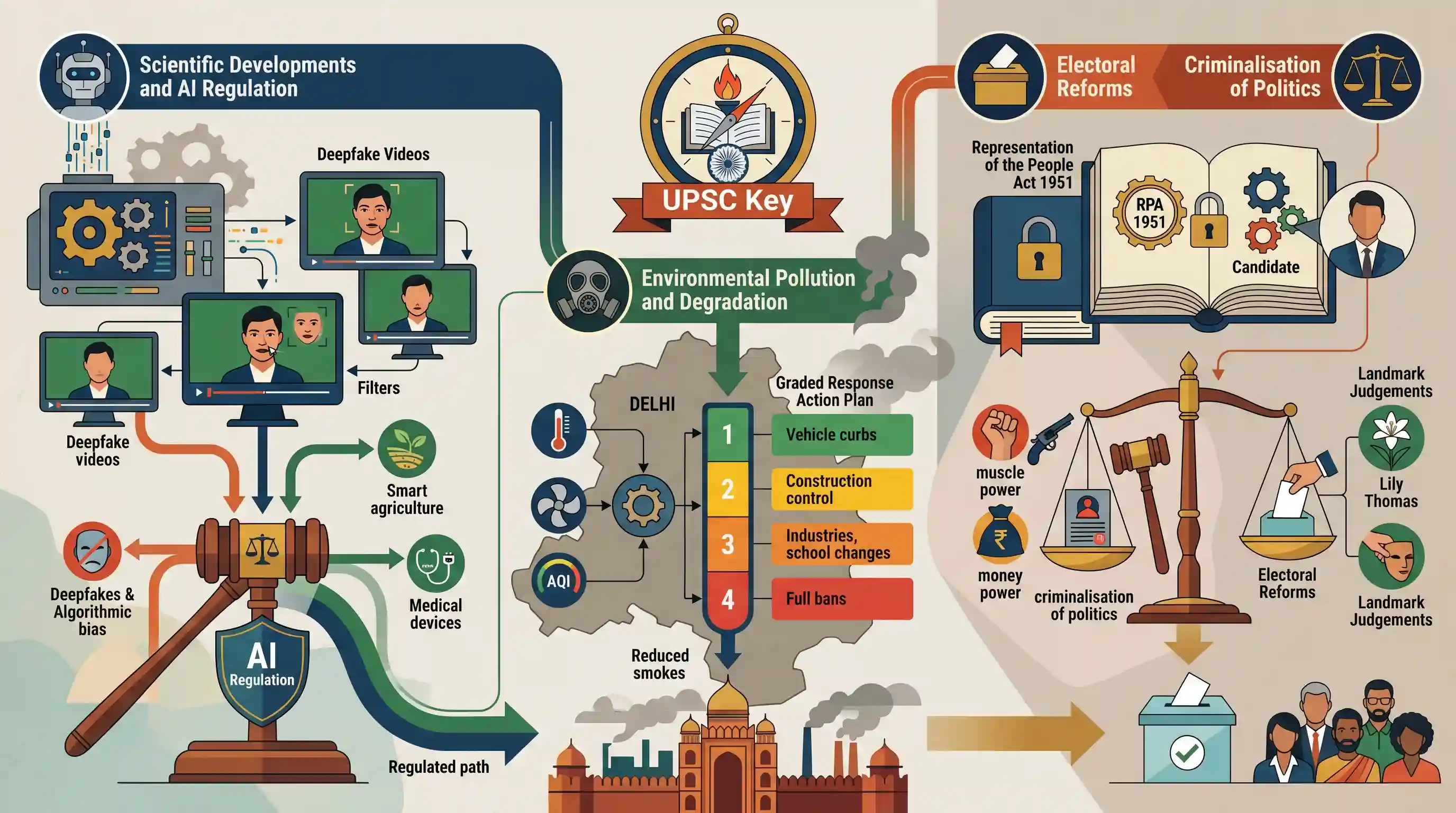
The Indian Express 'UPSC Key' discusses three central themes crucial for the UPSC syllabus: the evolving regulation of Artificial Intelligence (AI) to combat deepfakes and algorithmic bias, the multi-stage Graded Response Action Plan (GRAP) for mitigating winter air pollution in Delhi-NCR, and the persistent challenge of criminalisation of politics in India, along with related legislative frameworks and landmark Supreme Court rulings.
Key Points
- AI Regulation: Explores risk-based frameworks globally (e.g., EU AI Act, US Executive Order) and India's ongoing efforts to update the IT Act, 2000 through the proposed Digital India Act and targeted MEITY advisories to tackle deepfakes and algorithm bias.
- Graded Response Action Plan (GRAP): Features a structured 4-stage response system managed by the Commission for Air Quality Management (CAQM) triggered by distinct Air Quality Index (AQI) levels in Delhi-NCR (Stage I 'Poor' to Stage IV 'Severe+').
- Criminalisation of Politics: Explores the prevalence of lawmakers with pending criminal cases, outlining key statutory provisions (Section 8 of the Representation of the People Act, 1951) and judicial checks on political parties.
- Judicial Landmark Rulings: Highlights critical Supreme Court judgements such as Lily Thomas (2013) striking down Section 8(4) of the RPA, Association for Democratic Reforms (2002) mandates, and Rambabu Singh (2020) requirements for publishing candidate credentials.
Important Terms
Representation of the People Act 1951

A foundational Indian law regulating the conduct of elections, specifying qualifications and disqualifications for MPs and MLAs, combatting corrupt practices, and establishing mechanisms to resolve electoral disputes.
UPSC context
GS Paper II (Polity & Governance): Essential for understanding electoral reforms, candidate qualifications, and democratic representation.
Graded Response Action Plan
An emergency framework in the Delhi-NCR region that triggers progressively stricter pollution-control measures based on the prevailing Air Quality Index (AQI) to prevent severe winter smog.
UPSC context
GS Paper III (Environment & Ecology): Crucial for analyzing urban pollution management, environmental governance, and short-term emergency responses.
Commission for Air Quality Management
A statutory body established in 2021 to coordinate, research, and enforce measures for the prevention and control of air pollution in the National Capital Region and adjoining states.
UPSC context
GS Paper II & III (Statutory Bodies / Environment): Key to discussing centralized governance, federal coordination, and environmental enforcement.
EU AI Act
The world's first comprehensive legal framework for artificial intelligence, utilizing a risk-based approach to categorize and regulate AI applications according to their potential societal harm.
UPSC context
GS Paper III (Science & Technology): Critical for exploring global tech governance benchmarks, ethical AI development, and digital regulation frameworks.
Digital India Act
A proposed legislation meant to replace the IT Act 2000, aiming to secure an open internet, address online safety, and govern modern tech like AI and blockchain.
UPSC context
GS Paper II & III (Governance / S&T): Vital for discussing modern digital laws, cybersecurity, and the regulation of emerging technologies.
Association for Democratic Reforms
An Indian non-governmental organization established in 1999 that advocates for political and electoral reforms, transparency in party financing, and the decriminalization of politics.
UPSC context
GS Paper II (Polity / Civil Society): Important for analyzing non-state actors, electoral transparency, and judicial interventions in political systems.
Prelims Trap
A sitting legislator convicted and sentenced to two or more years of imprisonment enjoys a three-month buffer period to file an appeal.
The Supreme Court in Lily Thomas (2013) struck down Section 8(4) of the RPA, which previously gave sitting legislators a 3-month grace period to appeal. Disqualification is now immediate upon conviction.
Static Concepts Connected
What are the disqualification rules under Section 8 of the Representation of the People Act, 1951?
- Section 8(1) & (2): Deals with disqualifications on conviction for specific offenses like promoting enmity, bribery, dowry, or violating preventive detention laws.
- Section 8(3): Mandates that any conviction leading to a prison sentence of two or more years results in disqualification for the sentence duration plus an additional six years.
- Section 8(4): Struck down in Lily Thomas (2013); it previously shielded sitting MPs/MLAs from immediate disqualification for three months to allow for appeals.
How is the statutory Commission for Air Quality Management (CAQM) structured to enforce GRAP?
- Statutory Origin: Established under the CAQM in National Capital Region and Adjoining Areas Act, 2021, superseding the Environment Pollution (Prevention and Control) Authority.
- Jurisdictional Reach: Holds overriding powers over state pollution control boards of Delhi, Haryana, Punjab, Rajasthan, and Uttar Pradesh in air quality matters.
- GRAP Mandate: Implements four progressive emergency stages based strictly on real-time AQI values ranging from 'Poor' (Stage I) to 'Severe+' (Stage IV).
Cross-Topic Patterns
AI deepfakes vs. Electoral Integrity
Deepfakes and digital manipulation complicate candidate disclosure norms (ADR case), challenging the Election Commission's ability to ensure a level playing field under Article 19(1)(a).
Centralized environmental governance via CAQM
CAQM's statutory authority to enforce GRAP over Delhi-NCR states represents a shift toward centralized federal intervention to manage interstate airshed pollution.

Mains 2026: SC guidelines on candidate credentials could merge with generative AI risks in elections under representation debates.
Linked PYQs · 5
Linked PYQs · 5
- 2023MainsGS3
Introduce the concept of Artificial Intelligence (AI). How does Al help clinical diagnosis? Do you perceive any threat to privacy of the individual in the use of Al in healthcare?
- 2020MainsGS2
There is a need for simplification of procedure for disqualification of persons found guilty of corrupt practices under the Representation of Peoples Act". Comment.
- 2019MainsGS2
On what grounds a people's representative can be disqualified under the Representation of Peoples Act, 1951? Also mention the remedies available to such person against his disqualification.
- 2020PrelimsGS1
Consider the following statements: 1. According to the Constitution of India, a person who is eligible to vote can be made a minister in a State for six months even if he/she is not a member of the Legislature of that State. 2. According to the Representation of People Act, 1951, a person convicted of a criminal offence and sentenced to imprisonment for five years is permanently disqualified from contesting an election even after his release from prison. Which of the statements given above is/are correct?
- 2016PrelimsGS1
In the cities of our country, which among the following atmospheric gases are normally considered in calculating the value of Air Quality Index? 1. Carbon dioxide 2. Carbon monoxide 3. Nitrogen dioxide 4. Sulfur dioxide 5. Methane Select the correct answer using the code given below.
