Emerging Challenges in Artificial Intelligence and Energy Security
Source:Indian Express ↗
Why It Matters
The article brings together diverse but highly testable topics for the UPSC examination, spanning emerging technologies (AI), new-age internal security threats (cyber frauds like digital arrest), and traditional geopolitical economics (OPEC's impact on energy security).
Summary
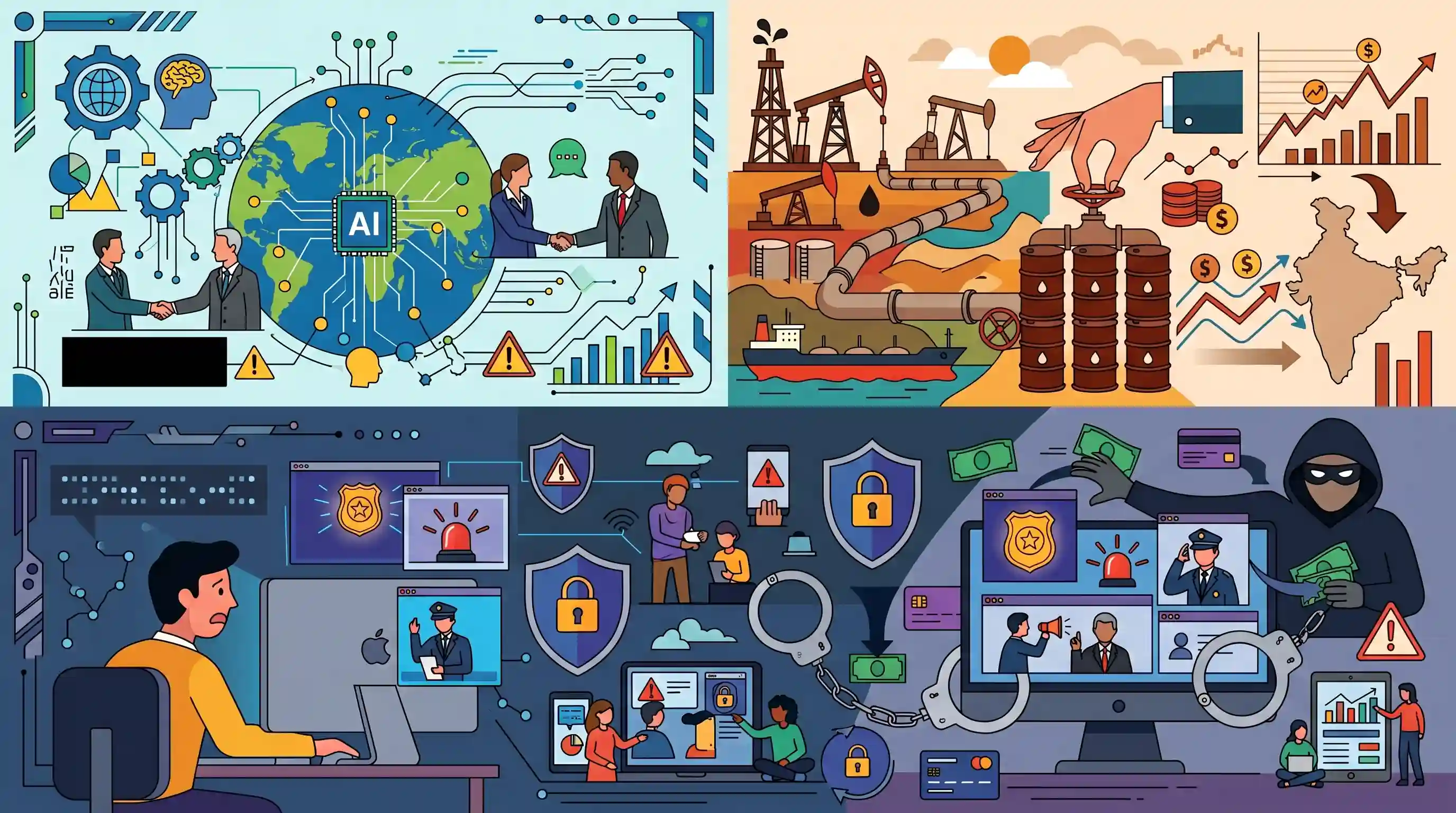
The article highlights three significant contemporary issues: the integration of Artificial Intelligence (AI) in diplomacy, the role of OPEC in global oil economics, and the rising threat of "digital arrest" cybercrimes. AI is increasingly used in foreign policy for data analysis and strategic forecasting, although it poses risks of bias and data security. OPEC continues to influence global energy security by regulating crude oil supply and prices, heavily impacting India due to its reliance on oil imports. Meanwhile, "digital arrest" is a growing cyber fraud tactic where criminals impersonate law enforcement agencies to extort money, highlighting the urgent need for robust cybersecurity measures and public awareness.
Key Points
- Artificial Intelligence is increasingly being integrated into diplomatic practices for predictive analysis, translation, and strategic forecasting, raising both opportunities and concerns about data security and algorithmic bias.
- OPEC's influence over global crude oil supply and pricing remains a critical factor in global energy security, directly affecting India's import-dependent economy and macroeconomic stability.
- "Digital arrest" has emerged as a sophisticated cyber fraud tactic where criminals impersonate law enforcement officials via video calls to extort money from unsuspecting victims.
- Addressing these challenges requires a comprehensive approach, including global AI governance frameworks, energy diversification strategies, and enhanced national cybersecurity awareness.
Important Terms
OPEC (Organization of the Petroleum Exporting Countries)

Permanent intergovernmental organization of 12 oil-exporting nations established in 1960 to coordinate petroleum policies and ensure stable global oil prices.
UPSC context
GS II (International Relations) and GS III (Economy); tests knowledge of global groupings and their impact on India's energy import bill.
Indian Cyber Crime Coordination Centre (I4C)
Nodal agency under the Ministry of Home Affairs (MHA) established to provide a framework for law enforcement agencies to deal with cybercrime in a coordinated manner.
UPSC context
GS III (Internal Security/Cyber Security); tests institutional mechanisms to counter emerging internal security threats.
Digital Arrest
Form of cybercrime where fraudsters impersonate law enforcement officials (e.g., CBI, ED) via video calls to extort money by falsely claiming the victim faces arrest.
UPSC context
GS III (Cyber Security); focuses on emerging cybercrime trends, modus operandi, and public awareness initiatives like 'CyberDost'.
AI Diplomacy
The use and governance of Artificial Intelligence in international relations, involving negotiations on ethical standards, norms-setting, and using AI tools for strategic forecasting.
UPSC context
GS II (International Relations) and GS III (Science & Tech); examines the intersection of emerging technology and foreign policy.
Energy Security
A nation's ability to maintain a secure, reliable, and affordable supply of energy, balancing availability, affordability, and sustainability.
UPSC context
GS III (Indian Economy/Energy Sector); critical for India due to high dependence (80%+) on crude oil imports.
OPEC+
Coalition of OPEC members and 10 non-OPEC oil-producing nations (including Russia) that collaborate to regulate global oil supply and stabilize market prices.
UPSC context
GS II (Bilateral/Global Groupings); tests understanding of expanded energy cartels and their geopolitical influence on global supply chains.
Prelims Trap
Digital arrest is a statutory provision under the IT Act allowing police to interrogate cybercrime suspects via video conferencing.
It is entirely a cyber fraud tactic. Indian criminal jurisprudence does not recognize "digital arrest" or authorize remote police custody via video calls.
Static Concepts Connected
How do OPEC production cuts impact India's macroeconomic indicators?
- Current Account Deficit: Higher global crude prices inflate India's import bill, directly widening the trade deficit and the Current Account Deficit (CAD).
- Imported Inflation: Expensive crude raises domestic transport, logistics, and production costs, leading to cost-push retail inflation (CPI).
- Currency Depreciation: Increased demand for US dollars to pay for costlier oil imports puts downward pressure on the Indian Rupee, causing depreciation.
What is the mandate of the Indian Cyber Crime Coordination Centre (I4C)?
- Nodal Coordination: Acts under the Ministry of Home Affairs to coordinate cybercrime investigations across different state police forces and law enforcement agencies.
- Reporting Infrastructure: Manages the National Cybercrime Reporting Portal (cybercrime.gov.in) and the 1930 helpline for centralized citizen complaints regarding financial fraud.
- Threat Analytics: Operates the National Cybercrime Threat Analytics Unit to produce early warnings and actionable cyber threat intelligence for law enforcement.
Cross-Topic Patterns
AI Governance + Multilateralism
As AI shapes foreign policy forecasting, global frameworks like the Bletchley Declaration and UN AI Advisory Body become critical for regulating algorithmic biases in international diplomacy.
Cyber Extortion + Transnational Money Laundering
Funds extorted via "digital arrests" are often routed through mule bank accounts and cryptocurrency, linking domestic cyber fraud directly to transnational money laundering networks and PMLA enforcement.
OPEC Dependency + India's Energy Transition
India's vulnerability to OPEC crude oil price shocks accelerates its strategic policy shift towards green hydrogen and renewables, linking traditional energy security vulnerabilities to the Panchamrit climate commitments.

Expect a 2026 prelims question distinguishing the statutory mandates of I4C, CERT-In, and NCIIPC in the context of emerging cyber frauds.
Linked PYQs · 5
Linked PYQs · 5
- 2023MainsGS3
Introduce the concept of Artificial Intelligence (AI). How does Al help clinical diagnosis? Do you perceive any threat to privacy of the individual in the use of Al in healthcare?
- 2020MainsGS3
Discuss different types of cyber crimes and measures required to be taken to fight the menace.
- 2017MainsGS3
Discuss the potential threats of Cyber attack and the security framework to prevent it.
- 2025MainsGS2
"Energy security constitutes the dominant kingpin of India's foreign policy, and is linked with India's overarching influence in Middle Eastern countries.” How would you integrate energy security with India's foreign policy trajectories in the coming years?
- 2017MainsGS2
The question of India's Energy Security constitutes the most important part of India's economic progress. Analyze India's energy policy cooperation with West Asian countries.
