Commemoration of Twenty Five Years of Three New States
Source:Indian Express ↗
Why It Matters
Understanding the constitutional basis for state creation, the balance of power in the tribunalization of justice, and advancements in domestic biotechnology are critical for both Prelims and Mains examinations across GS2 and GS3.
Summary
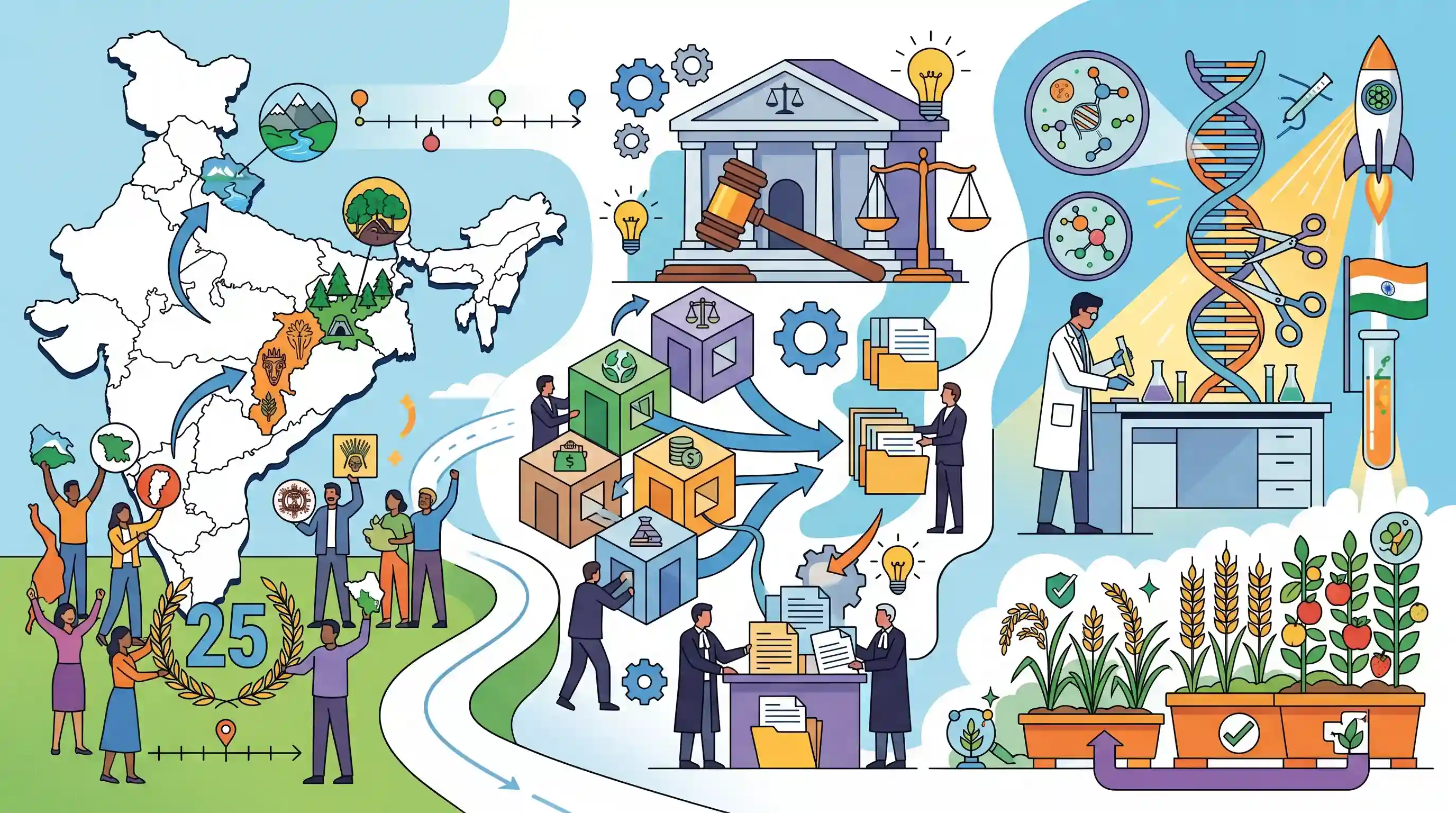
The article highlights three distinct UPSC-relevant themes: the 25th anniversary of the creation of Uttarakhand, Jharkhand, and Chhattisgarh (focusing on federalism and state reorganization); the ongoing implications of the Tribunals Reforms Act, 2021, on India's quasi-judicial framework; and the development of indigenous gene-editing technologies to advance India's biotechnology sector without relying on foreign patents.
Key Points
- The year marks the 25th anniversary of the formation of Uttarakhand, Jharkhand, and Chhattisgarh, bringing attention to the constitutional mechanisms of state reorganization under Article 3.
- The Tribunals Reforms Act, 2021, which abolished several appellate tribunals and transferred their powers to high courts, continues to be a subject of debate regarding judicial independence and the efficiency of quasi-judicial bodies.
- India's pursuit of indigenous ('desi') gene-editing technology aims to reduce reliance on international patents like CRISPR-Cas9, fostering self-reliance in agricultural and healthcare biotechnology.
Important Terms
Tribunals Reforms Act, 2021

Enacted to abolish several appellate tribunals (e.g., Intellectual Property Appellate Board) and transfer their functions to High Courts. It standardizes service conditions, including a controversial four-year tenure and a 50-year minimum age for members.
UPSC context
GS Paper II (Polity); focuses on judicial independence, the doctrine of separation of powers, and the rationalization of quasi-judicial infrastructure.
Quasi-judicial bodies
Non-judicial entities (like commissions or tribunals) vested with court-like powers to adjudicate specific disputes. They follow principles of natural justice, are less formal than courts, and their decisions are subject to judicial review.
UPSC context
GS Paper II (Polity/Governance); tests understanding of specialized adjudicatory forums and their role in reducing judicial pendency.
Central Administrative Tribunal (CAT)
A statutory body established under Article 323A (via the Administrative Tribunals Act, 1985) to adjudicate disputes regarding recruitment and service conditions of persons in central public services.
UPSC context
GS Paper II (Polity); essential for topics on administrative law and grievances of public servants.
Reorganisation of States (2000)
The Madhya Pradesh, Uttar Pradesh, and Bihar Reorganisation Acts of 2000, which carved out Chhattisgarh, Uttarakhand, and Jharkhand respectively, exercising Parliament's power under Article 3 to address long-standing regional aspirations.
UPSC context
GS Paper I (History/Geography) & II (Federalism); relevant for regionalism, statehood demands, and constitutional provisions like Article 3.
SDN-1 and SDN-2
Specific categories of gene editing (Site-Directed Nuclease) that modify an organism's own DNA without adding foreign genetic material. In 2022, India exempted these from stringent GMO regulations applied to transgenics.
UPSC context
GS Paper III (Science & Tech); crucial for biotechnology regulations and distinguishing gene-edited crops from Genetically Modified Organisms (GMOs).
TnpB-based Technology
An indigenous gene-editing system developed by ICAR-CRRI using Transposon-associated proteins. It serves as a compact, IP-free, and cost-effective alternative to globally patented CRISPR-Cas systems for crop improvement.
UPSC context
GS Paper III (Science & Tech); highlights indigenization of technology, intellectual property rights (IPR), and food security.
Prelims Trap
Formation of a new state requires the mandatory concurrence of the affected State Legislature under Article 3.
The President must refer the reorganization bill to the state legislature for its views, but Parliament is strictly not bound to accept them.
Static Concepts Connected
How does Article 3 empower Parliament to reorganize states?
- Prior Recommendation: Introduction of a state reorganization bill in Parliament requires the prior recommendation of the President.
- State Legislature Views: The President refers the bill to the state legislature for its views, but Parliament is not bound to accept them.
- Simple Majority: The bill requires only a simple majority in Parliament and is strictly not considered a Constitutional Amendment under Article 368.
What is the constitutional basis for Tribunals in India?
- 42nd Amendment 1976: Added Part XIV-A to the Constitution, introducing the concept of tribunals to reduce the burden on traditional courts.
- Article 323A: Empowers Parliament to exclusively establish administrative tribunals for resolving disputes related to public services (e.g., CAT).
- Article 323B: Allows Parliament and state legislatures to set up tribunals for other matters like taxation, foreign exchange, and land reforms.
Cross-Topic Patterns
Gene-editing meets IPR regimes
The shift towards indigenous TnpB tech addresses the bottleneck of foreign CRISPR patents, linking S&T advancements directly with the GS3 Intellectual Property Rights (IPR) syllabus.
Tribunal abolition vs Judicial pendency
Transferring appellate jurisdiction from abolished bodies (like IPAB and FCAT) back to High Courts heavily impacts the GS2 debate on judicial backlog and the efficacy of tribunalisation.

Expect a 2026 Prelims statement comparing the compact size and patent-free nature of indigenous TnpB against CRISPR-Cas9 gene editing.
Linked PYQs · 5
Linked PYQs · 5
- 2025MainsGS2
Comment on the need of administrative tribunals as compared to the court system. Assess the impact of the recent tribunal reforms through rationalization of tribunals made in 2021.
- 2019MainsGS2
“The Central Administrative Tribunal which was established for redressal of grievances and complaints by or against central government employees, nowadays is exercising its powers as an independent judicial authority.” Explain.
- 2024MainsGS2
What changes has the Union Government recently introduced in the domain of Centre-State relations ? Suggest measures to be adopted to build the trust between the Centre and the States and for strengthening federalism.
- 2019PrelimsGS1
What is Cas9 protein that is often mentioned in news?
- 2018PrelimsGS1
Consider the following pairs: Terms sometimes seen in news Context/Topic 1. Belle II experiment Artificial Intelligence 2. Blockchain technology Digital/Cryptocurrency 3. CRISPR-Cas9 Particle Physics Which of the pairs given above is/are correctly matched?
