West Asia Crisis and India's Threefold Macroeconomic Vulnerability
Source:Indian Express ↗
Why It Matters
The article provides a holistic framework (the 3Fs) connecting geopolitics (GS2) to macroeconomic stability, energy policy, and agriculture (GS3). It is highly relevant for Mains questions evaluating India's strategic autonomy, energy vulnerability, and agricultural sustainability.
Summary
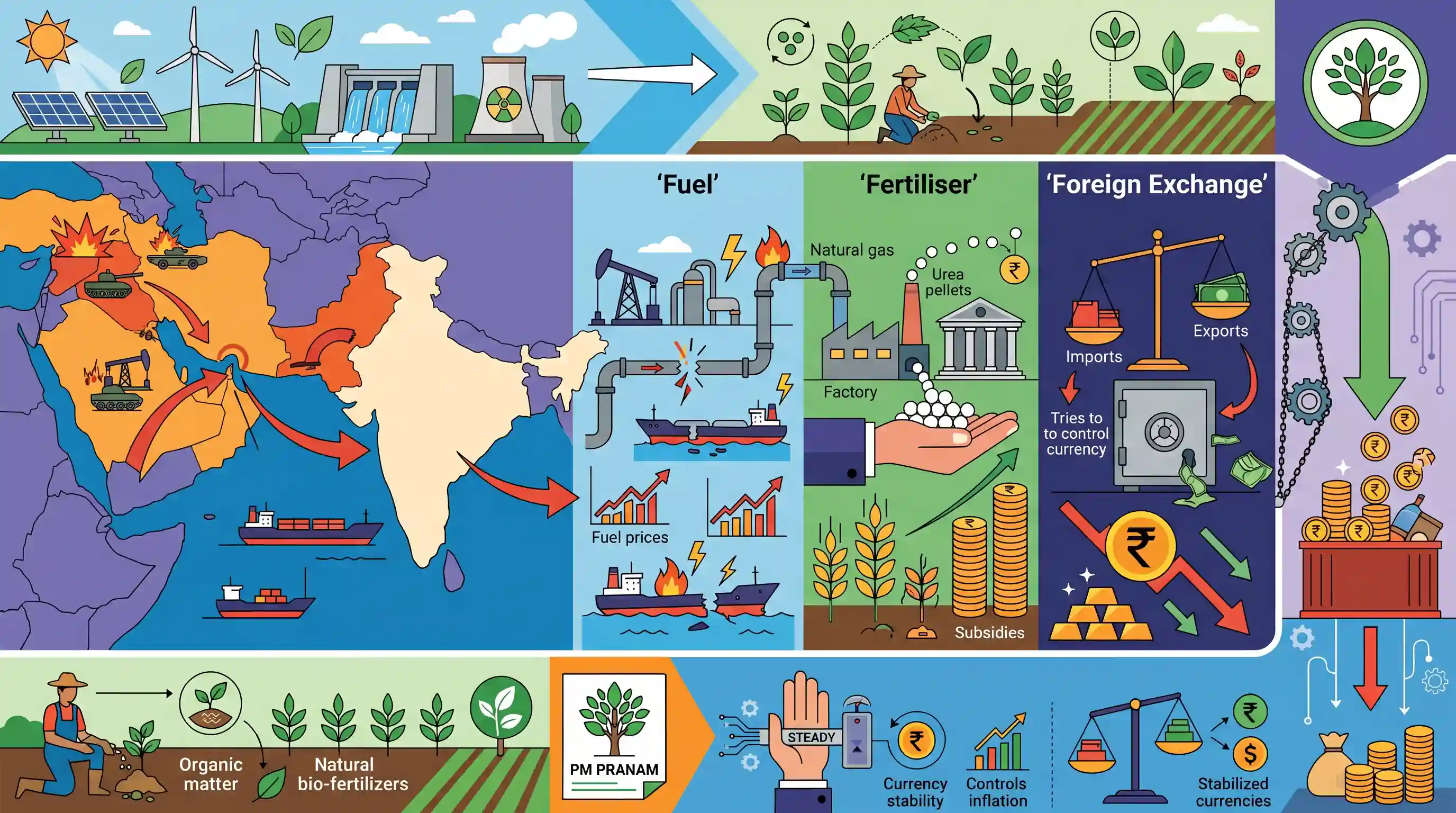
The article analyzes India's vulnerability to geopolitical conflicts in West Asia through the lens of the '3F Challenge': Fuel, Fertiliser, and Foreign Exchange. Any disruption in strategic chokepoints like the Strait of Hormuz severely impacts India's energy security, given its high import dependence on crude oil and LNG. This energy shock cascades into the agriculture sector, where natural gas is vital for urea production, thereby ballooning the fertiliser subsidy bill. The combined burden of inflated import bills and high gold demand drains foreign exchange reserves, widens the Current Account Deficit, and weakens the Indian Rupee. To mitigate these risks, India needs a multi-pronged approach encompassing energy diversification, promotion of alternative fertilisers (like biostimulants via PM PRANAM), and robust macroeconomic management by the RBI.
Key Points
- India faces a '3F Challenge'—Fuel, Fertiliser, and Foreign Exchange—aggravated by geopolitical tensions in West Asia (Iran-Israel-US conflict).
- Fuel dependency: Disruption in the Strait of Hormuz could cause crude oil and LNG prices to spike. India imports ~85% of its crude oil and 50% of its natural gas.
- Fertiliser burden: Natural gas is a key input for manufacturing urea. High LNG prices directly inflate India's massive fertiliser subsidy bill and raise agricultural input costs.
- Alternatives to chemical fertilisers, such as biostimulants and organic fertilisers promoted under schemes like PM PRANAM and Gobardhan, are critical to reducing urea import reliance.
- Foreign Exchange strain: Increased import bills for energy and fertilisers, compounded by a surge in gold imports due to global uncertainty, widen the Current Account Deficit and exert depreciating pressure on the Rupee, prompting RBI intervention.
Important Terms
Strait of Hormuz

A strategic maritime chokepoint between Iran and Oman connecting the Persian Gulf to the Gulf of Oman. It handles ~20% of global oil trade, crucial for India's energy imports.
UPSC context
GS Paper I & II; tests maritime geography and India's strategic energy security vulnerabilities in West Asia.
PM PRANAM
The 'PM Programme for Restoration, Awareness, Nourishment and Amelioration of Mother Earth' incentivizes states to reduce chemical fertilizer usage by sharing 50% of the resulting subsidy savings as grants.
UPSC context
GS Paper III (Agriculture & Economy); evaluates sustainable farming initiatives and fiscal management of the fertilizer subsidy bill.
Current Account Deficit (CAD)
Occurs when a country's total value of imported goods and services exceeds its exports. For India, high crude oil and gold imports are major drivers of this deficit.
UPSC context
GS Paper III (Economy); core concept for Balance of Payments, rupee stability, and external sector resilience.
GOBARdhan Scheme
'Galvanizing Organic Bio-Agro Resources Dhan' is a Swachh Bharat Mission (Gramin) initiative that converts cattle dung and solid waste into biogas, bio-CNG, and organic manure.
UPSC context
GS Paper III (Environment & Energy); tests waste-to-wealth models, circular economy, and rural energy diversification.
Fertiliser Subsidy
Government expenditure to provide fertilizers (like Urea and DAP) to farmers at below-market prices. It is a major component of India’s non-planned fiscal expenditure.
UPSC context
GS Paper III (Agriculture & Budget); critical for understanding fiscal deficit, cropping patterns, and soil health.
Energy Security
The assured, affordable, and sustainable availability of energy. India pursues this via strategic petroleum reserves, energy diversification, and securing maritime supply lines like the Strait of Hormuz.
UPSC context
GS Paper III (Infrastructure & Energy); essential for assessing India's strategic autonomy and resilience against global geopolitical shocks.
Prelims Trap
PM-PRANAM scheme provides direct financial subsidies to farmers to purchase organic and bio-fertilisers.
PM-PRANAM does not directly subsidize farmers. It incentivizes States/UTs to promote alternative fertilisers by granting them 50% of the subsidy savings generated.
Static Concepts Connected
How do imported fuel and gold affect the Current Account Deficit (CAD)?
- Trade Deficit: High prices of inelastic imports (crude oil, LNG) and safe-haven gold widen the merchandise trade deficit, which is the largest component of India's CAD.
- Currency Depreciation: A widening CAD increases the demand for foreign exchange (USD) to pay for imports, putting downward, depreciating pressure on the Rupee.
- Forex Drain: The RBI may intervene by selling Forex reserves to absorb excess rupee liquidity and curb extreme volatility in the exchange rate.
What is the role of Natural Gas in India's Urea production?
- Crucial Feedstock: Natural gas is primarily used as a raw material to synthesize ammonia, which is then reacted with carbon dioxide to produce urea.
- Import Dependency: With domestic gas production insufficient, India imports ~50% of its natural gas (as LNG), directly exposing domestic fertiliser costs to global price shocks.
- Coal Gasification Route: Alternative technologies utilizing syngas derived from coal are being promoted in India to produce ammonia, bypassing the need for imported LNG.
Cross-Topic Patterns
Maritime Chokepoints and Macroeconomics
Geopolitical conflicts in West Asia frequently test map-based knowledge of maritime chokepoints (Hormuz, Bab-el-Mandeb) alongside their direct macroeconomic impact on India's energy security and inflation.
Fiscal Subsidy Savings & Soil Health
Link the fiscal burden of chemical urea subsidies to ecological degradation. PM-PRANAM connects macroeconomic subsidy savings with micro-level soil health, organic farming, and water conservation initiatives.

Expect a multi-statement question in Prelims 2026 linking LNG import dependency, Urea feedstock, and the fiscal mechanics of PM-PRANAM.
Linked PYQs · 5
Linked PYQs · 5
- 2017MainsGS2
The question of India's Energy Security constitutes the most important part of India's economic progress. Analyze India's energy policy cooperation with West Asian countries.
- 2025MainsGS2
"Energy security constitutes the dominant kingpin of India's foreign policy, and is linked with India's overarching influence in Middle Eastern countries.” How would you integrate energy security with India's foreign policy trajectories in the coming years?
- 2020PrelimsGS1
With reference to chemical fertilizers in India, consider the following statements : 1. At present, the retail price of chemical fertilizers is market-driven and not administered by the Government. 2. Ammonia, which is an input of urea, is produced from natural gas. 3. Sulphur, which is a raw material for phosphoric acid fertilizer, is a by-product of oil refineries. Which of the statements given above is/are correct?
- 2016PrelimsGS1
Why does the Government of India promote the use of 'Neem-coated Urea' in agriculture?
- 2022PrelimsGS1
With reference to the Indian economy, consider the following statements: 1. If the inflation is too high, Reserve Bank of India (RBI) is likely to buy government securities. 2. If the rupee is rapidly depreciating, RBI is likely to sell dollars in the market. 3. If interest rates in the USA or European Union were to fall, that is likely to induce RBI to buy dollars. Which of the statements given above are correct?
