India US Interim Trade Deal Strategic and Economic Context
Source:Indian Express ↗
Why It Matters
The US is India's largest trading partner. A formalized trade agreement not only mitigates ongoing tariff wars but also firmly aligns India's economic integration with its growing strategic and defense priorities in the Indo-Pacific region.
Summary
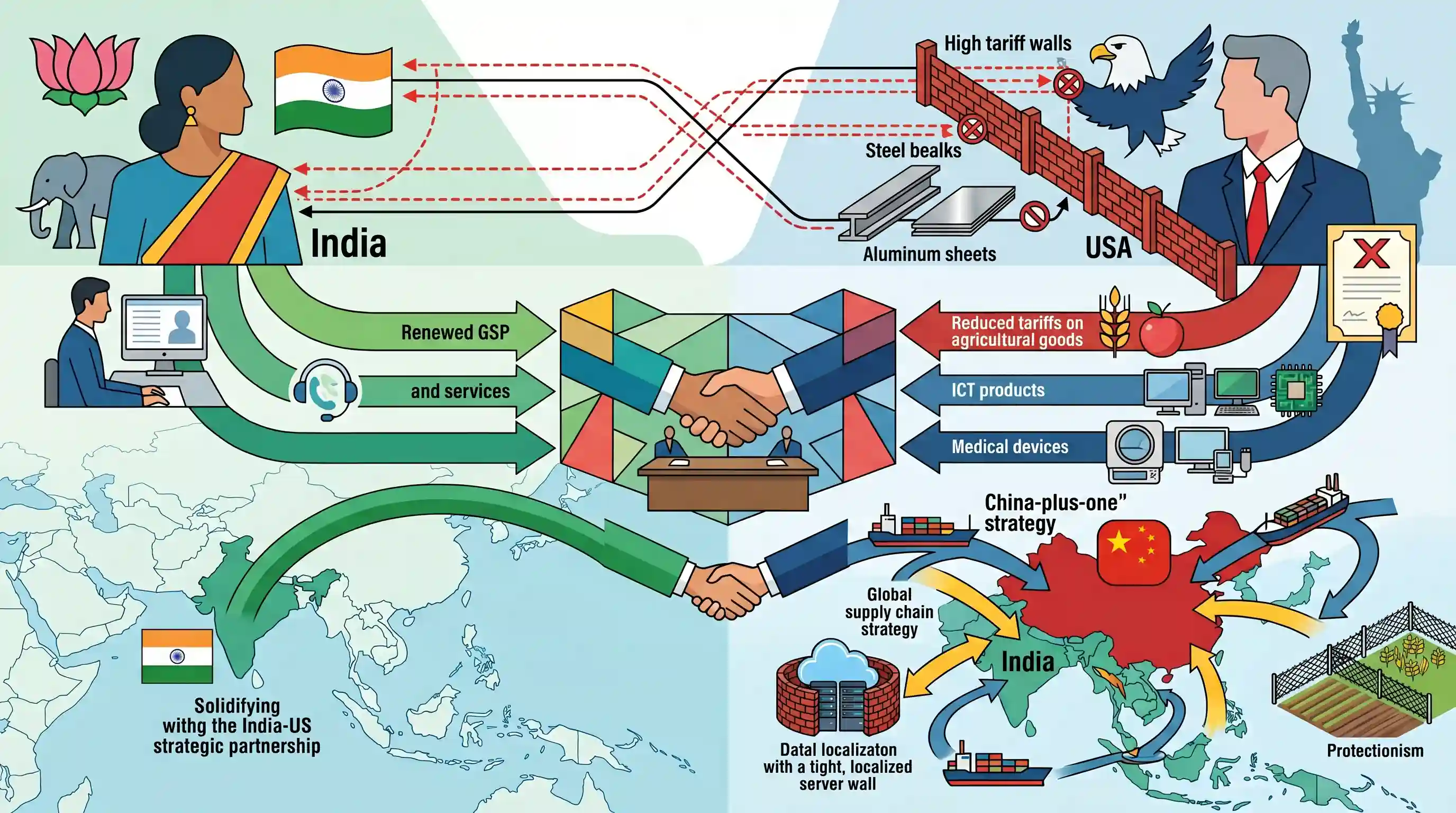
The article examines the backdrop, highlights, and geopolitical implications of the proposed India-US interim trade deal. Originating from bilateral trade frictions—such as the US revoking India's Generalized System of Preferences (GSP) status and imposing tariffs on steel and aluminum—the 'mini trade deal' attempts to find a middle ground. While India seeks reinstated GSP benefits and service-sector access, the US demands reduced tariffs on agricultural goods, ICT products, and medical devices. Beyond economic gains, the deal is strategically vital for diversifying supply chains away from China (China-plus-one) and solidifying the Indo-Pacific partnership, though issues like data localization and agricultural protectionism remain significant hurdles.
Key Points
- An interim or 'mini' trade deal between India and the US aims to resolve persistent tariff frictions and act as a precursor to a broader Free Trade Agreement (FTA).
- India's primary goals include the restoration of its Generalized System of Preferences (GSP) status, relief from US Section 232 tariffs on steel and aluminum, and relaxed H-1B visa norms for IT professionals.
- The US seeks market access for its agricultural, dairy, and ICT products, along with the removal of price caps on medical devices in India.
- The deal has strategic importance, aligning with the 'China Plus One' supply chain diversification strategy and reinforcing the Quad and Indo-Pacific geopolitical framework.
- Key concerns hindering progress include India's data localization laws, intellectual property rights (IPR) enforcement, and agricultural protectionism aimed at protecting rural livelihoods.
Important Terms
Generalized System of Preferences (GSP)

A trade program where developed nations provide preferential, duty-free, or reduced-tariff access to products from developing countries without requiring reciprocal benefits.
UPSC context
GS Paper II/III: Tests understanding of trade frictions, MFN exemptions, and impact on India’s labor-intensive export sectors.
Indo-Pacific Economic Framework (IPEF)
A US-led 14-nation economic initiative launched in 2022 focused on four pillars: trade, supply chain resilience, clean economy, and fair economy.
UPSC context
GS Paper II: Tests knowledge of regional economic architectures and India’s strategic shifts away from traditional trade blocs.
Free Trade Agreement (FTA)
A bilateral or multilateral treaty to reduce or eliminate trade barriers like tariffs and quotas on goods and services between member countries.
UPSC context
GS Paper III: Evaluates analysis of trade deficits, market access, and the protection of domestic MSMEs and farmers.
WTO (World Trade Organization)
The global international organization dealing with trade rules between nations, overseeing agreements, and resolving disputes to ensure smooth and predictable trade.
UPSC context
GS Paper III: Tests knowledge of global trade governance, dispute resolution, and rules affecting agricultural subsidies and IP rights.
Quad (Quadrilateral Security Dialogue)
An informal strategic forum of India, US, Japan, and Australia promoting a 'free and open Indo-Pacific' through security, technology, and economic cooperation.
UPSC context
GS Paper II: Tests comprehension of geopolitical balancing and the transition from security to economic-centric regional partnerships.
US Trade Representative (USTR)
The US government agency responsible for recommending trade policy and conducting negotiations, serving as the lead interlocutor in the India-US Trade Policy Forum.
UPSC context
GS Paper II: Tests awareness of institutional mechanisms in bilateral diplomacy and the role of specialized agencies in trade negotiations.
Prelims Trap
"GSP is a reciprocal trade agreement negotiated under the WTO framework to lower bilateral tariffs."
Aspirants often confuse GSP with mutual FTAs. GSP is a unilateral, non-reciprocal concession by developed nations, not a negotiated mutual agreement.
Static Concepts Connected
What is an Early Harvest Scheme (EHS) in trade negotiations?
- Stepping Stone: A precursor to a full Free Trade Agreement where partners reduce tariffs on a limited, agreed-upon set of goods/services.
- Primary Objective: To build trust and political momentum while the broader, more complex Comprehensive Agreement is negotiated.
- WTO Compliance: Often scrutinized under WTO's Article XXIV, which generally requires trade agreements to cover "substantially all trade" to avoid distorting global markets.
What is the Generalized System of Preferences (GSP)?
- Unilateral Preference: A preferential tariff system extending reduced or zero tariffs by developed countries to specific exports from developing ones.
- Non-Reciprocal: Beneficiary countries (like India) do not have to lower their own tariffs for the donor country (like the US) in return.
- WTO Exemption: It is authorized under the UNCTAD-backed "Enabling Clause," creating a legal exception to the WTO's strict Most-Favored-Nation (MFN) principle.
Cross-Topic Patterns
Data Localization vs. Digital Trade
Cross-border data flows are the new FTA battleground. India's digital localization mandates directly conflict with US tech lobbying, blending Economy (trade agreements) with Governance (privacy laws).
The Quad's Economic Pivot
Security partnerships are evolving into supply chain agreements. Bilateral deals and the IPEF act as the economic teeth of the Quad's China-Plus-One strategy, shifting from maritime security to critical supply chains.
IPR Enforcement vs. Public Health
US demands to remove price caps on medical devices collide with India's DPCO (Drug Price Control Order) mandate to ensure affordable healthcare, linking international trade directly to social justice schemes.

Expect a multi-statement Prelims question contrasting Early Harvest Schemes, GSP's non-reciprocity, and WTO's MFN principle in 2026.
Linked PYQs · 3
Linked PYQs · 3
- 2025MainsGS3
What are the challenges before the Indian economy when the world is moving away from free trade and multilateralism to protectionism and bilateralism? How can these challenges be met?
- 2018MainsGS2
What are the key areas of reform if the WTO has to survive in the present context of "Trade War', especially keeping in mind the interest of India?
- 2020MainsGS2
What is the significance of Indo-US defence deals over Indo-Russian defence deals? Discuss with reference to stability in the Indo-Pacific region.
