India US Interim Trade Agreement Key Highlights and Concerns
Source:Indian Express ↗
Why It Matters
Trade agreements and bilateral economic relations are central to the GS2 (International Relations) and GS3 (Economy) syllabi. Understanding the nuances of early harvest schemes, trade barriers, and geopolitical realignments helps candidates address questions on the trajectory of Indo-US ties and India's broader global economic strategy.
Summary
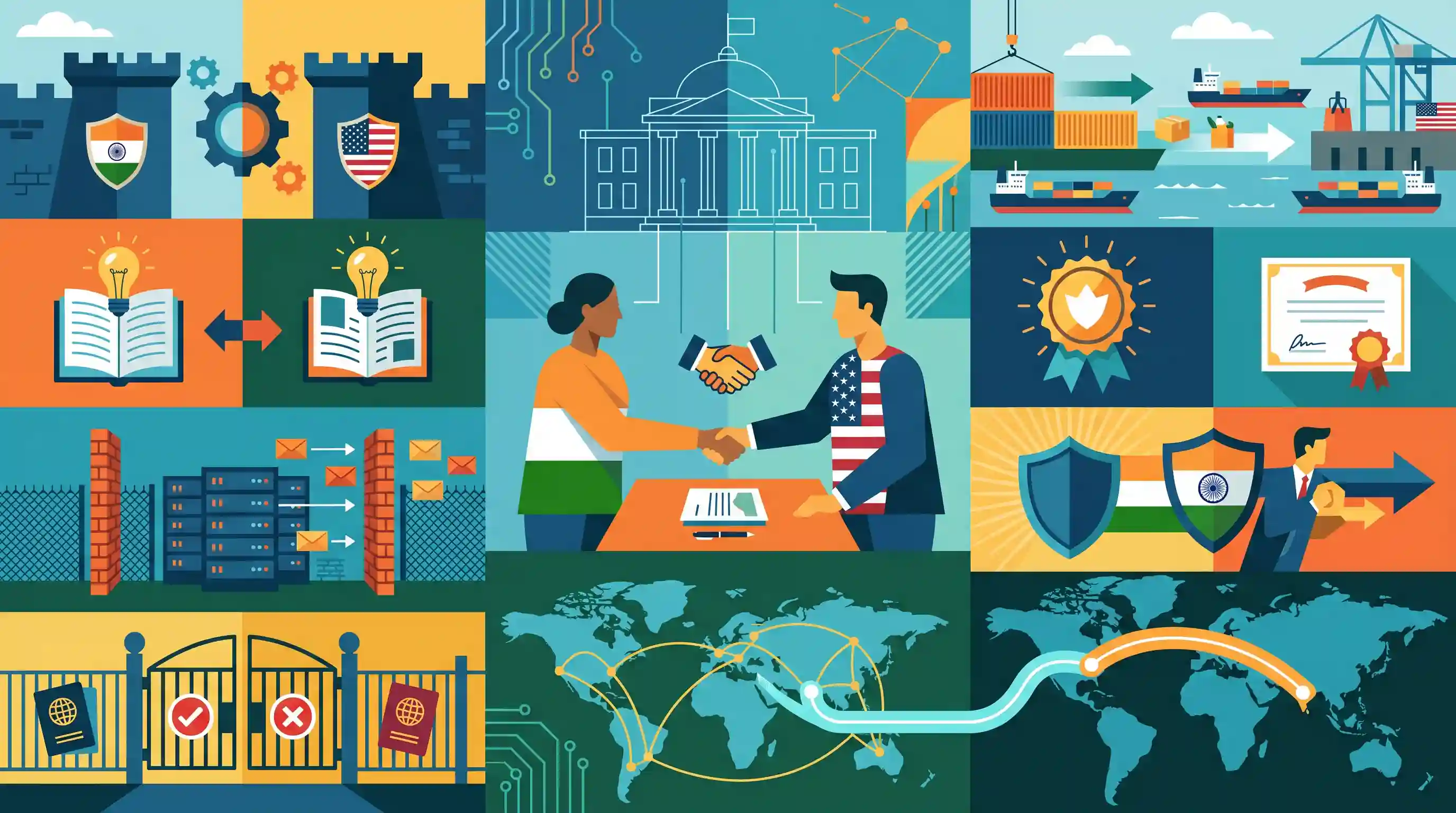
The article examines the proposed India-US interim trade deal, commonly referred to as a "mini trade deal" or "early harvest scheme." Such an agreement aims to swiftly resolve immediate trade irritants by reducing tariffs on select goods and settling ongoing WTO disputes, laying the groundwork for a broader Free Trade Agreement. For India, potential benefits include increased export market access, the restoration of GSP status, and enhanced strategic alignment to counter China's economic influence. However, significant challenges persist, including structural protectionism in both economies, differences over intellectual property rights, data localization mandates, and visa policies. Addressing these concerns is crucial for deepening the bilateral economic partnership.
Key Points
- An India-US interim trade deal (or early harvest scheme) aims to resolve specific, long-standing trade frictions before negotiating a comprehensive Free Trade Agreement.
- Key highlights typically include the reduction of tariffs on select goods (like agriculture and medical devices), mutual resolution of pending WTO disputes, and potentially the restoration of Generalized System of Preferences (GSP) benefits for India.
- The deal offers benefits such as a boost to Indian exports, strengthening the Indo-US strategic partnership, and aiding supply chain diversification (China-plus-one strategy).
- Concerns remain regarding both nations' protectionist tendencies, intellectual property rights (IPR) enforcement, digital trade/data localization rules, and non-tariff barriers.
Important Terms
Generalized System of Preferences (GSP)

A trade program where developed countries grant non-reciprocal, preferential tariff treatment (lower/zero duties) to goods from developing nations to support economic growth and market access.
UPSC context
GS Paper III (Economy); tests knowledge of preferential trade regimes and impacts on Indian exports like textiles and agriculture.
India-US Interim Trade Deal
A temporary trade agreement designed to resolve immediate frictions and provide limited market access before finalizing a comprehensive Bilateral Trade Agreement (BTA).
UPSC context
GS Paper II (International Relations); tests understanding of bilateral economic diplomacy and strategic de-escalation of trade tensions.
Early Harvest Scheme
A precursor to a full Free Trade Agreement (FTA) where partners liberalize tariffs on select 'low-hanging' products to build confidence and momentum.
UPSC context
GS Paper III (Economy/Trade); focuses on trade integration stages and compliance challenges under WTO legal frameworks.
World Trade Organization (WTO)
The global intergovernmental body regulating international trade, enforcing non-discrimination rules (like MFN), and providing a structured mechanism for resolving trade disputes.
UPSC context
GS Paper II (International Relations); tests role of multilateral institutions in governing global trade and legality of bilateral pacts.
United States Trade Representative (USTR)
The US government agency responsible for developing trade policy, leading negotiations, and monitoring foreign trade barriers like intellectual property rights (IPR) violations.
UPSC context
GS Paper II (International Relations); key for understanding US trade enforcement and reports (Special 301) affecting India.
Prelims Trap
"The Generalized System of Preferences (GSP) is a mutually negotiated, reciprocal trade framework under the WTO."
GSP is a non-reciprocal, unilateral tariff exemption granted by developed countries to developing nations, not a negotiated reciprocal treaty. The US revoked it unilaterally in 2019.
Static Concepts Connected
What distinguishes an Early Harvest Scheme from an FTA or CEPA?
- Early Harvest Scheme: A precursor pact where countries mutually reduce tariffs on a limited, specific list of goods to build trust before deeper negotiations.
- Free Trade Agreement: A broader, reciprocal pact eliminating tariffs on the majority of traded goods, and often expanding into the services sector.
- CECA / CEPA: Comprehensive economic partnerships that go beyond goods/services to include cross-border investment, IPR, competition, and regulatory harmonization.
Why does the US place India on the Special 301 Priority Watch List?
- Special 301 Report: An annual USTR review identifying foreign countries that deny adequate and effective Intellectual Property Rights (IPR) protection to US companies.
- Section 3(d) friction: India's Patent Act prevents 'evergreening' of patents by denying extensions for mere structural variants of existing drugs, frustrating US pharma companies.
- Compulsory Licensing: The US frequently objects to India's legal provisions allowing the generic manufacturing of patented drugs (compulsory licenses) during public health emergencies.
Cross-Topic Patterns
Data Localization vs. Trade Agreements
Trade deals increasingly stall over digital sovereignty. India's strict RBI data localization mandates directly clash with US tech demands for unrestricted cross-border data flows in e-commerce chapters.
EHS + China-Plus-One Strategy
Mini-trade deals act as geopolitical tools. Rapid agreements like the US-India EHS are stepping stones to restructure global supply chains away from Chinese dependencies alongside IPEF.

Expect a multi-statement Prelims question comparing Early Harvest Schemes to CECA/CEPA, alongside the non-reciprocal nature of GSP.
Linked PYQs · 4
Linked PYQs · 4
- 2019MainsGS2
‘What introduces friction into the ties between India and the United States is that Washington is still unable to find for India a position in its global strategy, which would satisfy India's national self-esteem and ambitions.’ Explain with suitable examples.
- 2025MainsGS3
What are the challenges before the Indian economy when the world is moving away from free trade and multilateralism to protectionism and bilateralism? How can these challenges be met?
- 2018PrelimsGS1
Consider the following countries: 1. Australia 2. Canada 3. China 4. India 5. Japan 6. USA Which of the above are among the 'free-trade partners' of ASEAN?
- 2016PrelimsGS1
The term 'Regional Comprehensive Economic Partnership' often appears in the news in the context of the affairs of a group of countries known as
