Chola Dynasty Architecture and Rajendra First Naval Expeditions
Source:Indian Express ↗
Why It Matters
The Chola administration, temple architecture (Dravidian style), and naval conquests are recurring themes in both Prelims and Mains. Rajendra I's overseas expeditions hold historical significance for India's geopolitical and maritime heritage.
Summary
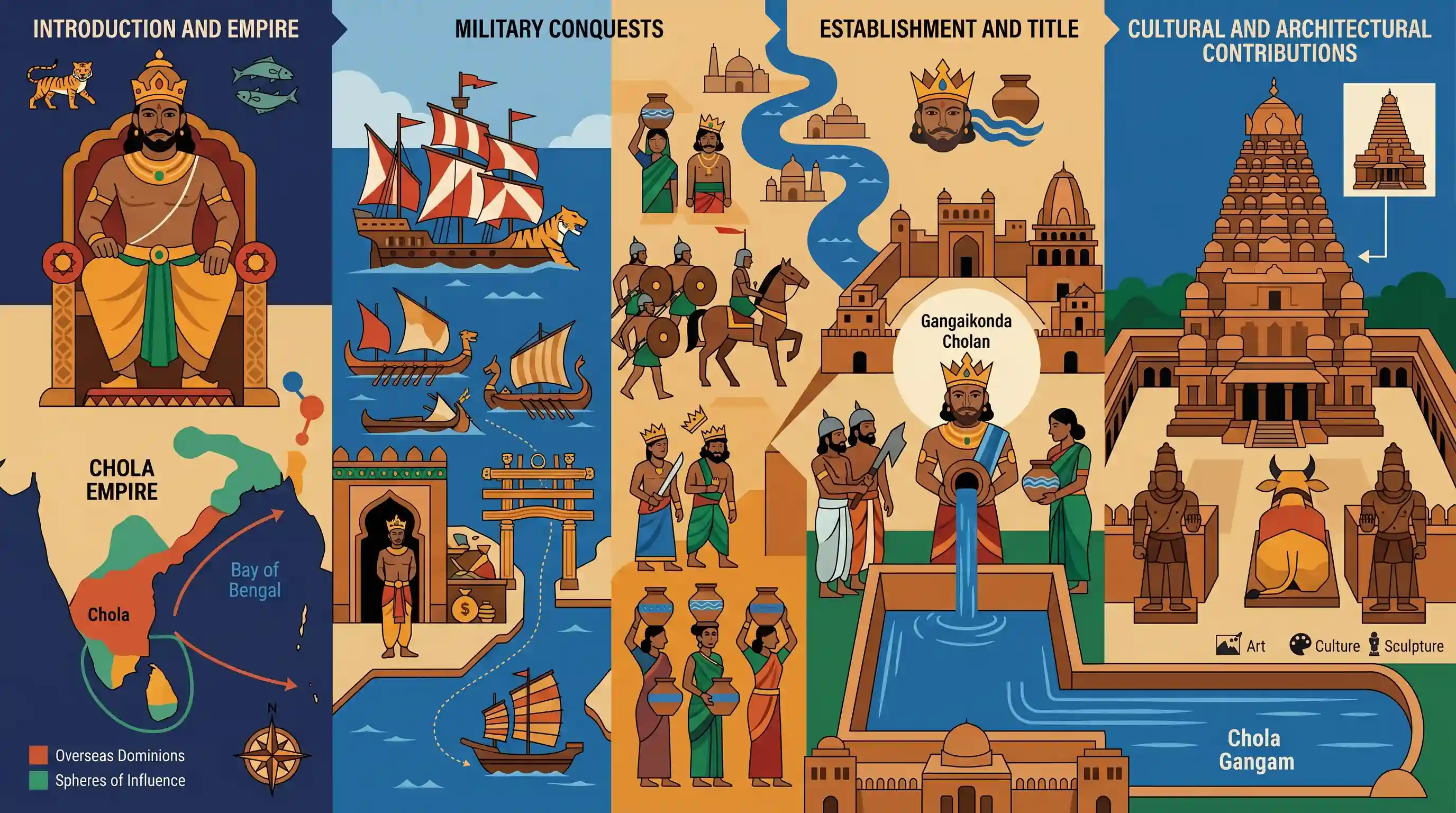
An overview of the Chola Dynasty focusing on the achievements of Rajendra I. It highlights his significant military conquests, notably the naval expedition to the Srivijaya empire to protect trade routes, and his march to the Ganges resulting in the title 'Gangaikonda'. The article also emphasizes his cultural and architectural contributions, particularly the establishment of Gangaikonda Cholapuram and its magnificent Shiva temple reflecting the pinnacle of Dravidian architecture.
Key Points
- Rajendra I expanded the Chola empire significantly, earning the title 'Gangaikonda Chola' after defeating the Pala ruler Mahipala.
- He established a new capital, Gangaikonda Cholapuram, and constructed a magnificent Shiva temple showcasing the zenith of Dravidian architecture.
- He led a successful naval expedition against the Srivijaya empire (Southeast Asia) to secure vital maritime trade routes and assert Chola dominance.
- The Chola period is highly significant in Indian history for its decentralized local administration, maritime prowess, and architectural brilliance.
Prelims Trap
Rajendra I built the famous Brihadeshwara Temple at Thanjavur to commemorate his victory over the Pala ruler Mahipala.
Rajaraja I built the original Brihadeshwara Temple at Thanjavur. Rajendra I built a distinct, slightly smaller replica at his new capital, Gangaikonda Cholapuram, after his northern campaign.
Static Concepts Connected
What were the three main types of village assemblies in Chola administration?
- Ur: The general assembly of the village comprising ordinary tax-paying residents and agricultural classes.
- Sabha (or Mahasabha): An exclusive administrative assembly of Brahmin landowners found specifically in Brahmadeya (tax-free land granted to Brahmins) villages.
- Nagaram: A specialized assembly composed of traders, artisans, and merchants, typically governing commercial centers and trade hubs.
What characterizes the zenith of Chola temple architecture?
- Towering Vimanas: Unlike later architectural styles that prioritized massive Gopurams (gateways), Chola temples feature colossal, soaring stepped-pyramid Vimanas directly over the main shrine.
- Monolithic Dvarapalas: Immense, fiercely guarding monolith statues (door-keepers) placed at the entrances of the sanctum or mandapas.
- Lost-Wax Bronzes: Bronze sculpture reached unprecedented heights under Chola patronage, most notably the iconic, standardized depictions of Nataraja (Shiva as the Lord of Dance).
Cross-Topic Patterns
Chola Maritime & Indo-Pacific Strategy
Rajendra I's expedition to the Malacca Strait to secure China trade routes mirrors modern strategic imperatives in India's Indo-Pacific vision and Act East policy.
Uttaramerur Inscriptions & Democratic Roots
The Chola committee (variyam) election system detailed in Parantaka I's Uttaramerur inscription frequently serves as historical precedent in GS2 questions on grassroots democracy and Panchayati Raj.

Expect a multi-statement question in 2026 contrasting the specific overseas conquests and architectural patronage of Rajaraja I vs Rajendra I.
Linked PYQs · 4
Linked PYQs · 4
- 2013MainsGS1
Chola architecture represents a high watermark in the evolution of temple architecture. Discuss.
- 2022MainsGS1
Discuss the main contributions of Gupta period and Chola period to Indian heritage and culture.
- 2025PrelimsGS1
Who among the following led a successful military campaign against the kingdom of Srivijaya, the powerful maritime State, which ruled the Malay Peninsula, Sumatra, Java and the neighbouring islands?
- 2023PrelimsGS1
With reference to ancient South India, Korkai, Poompuhar and Muchiri were well known as
