Ethics Case Study on Public Health Crises and Corporate Governance
Source:Indian Express ↗
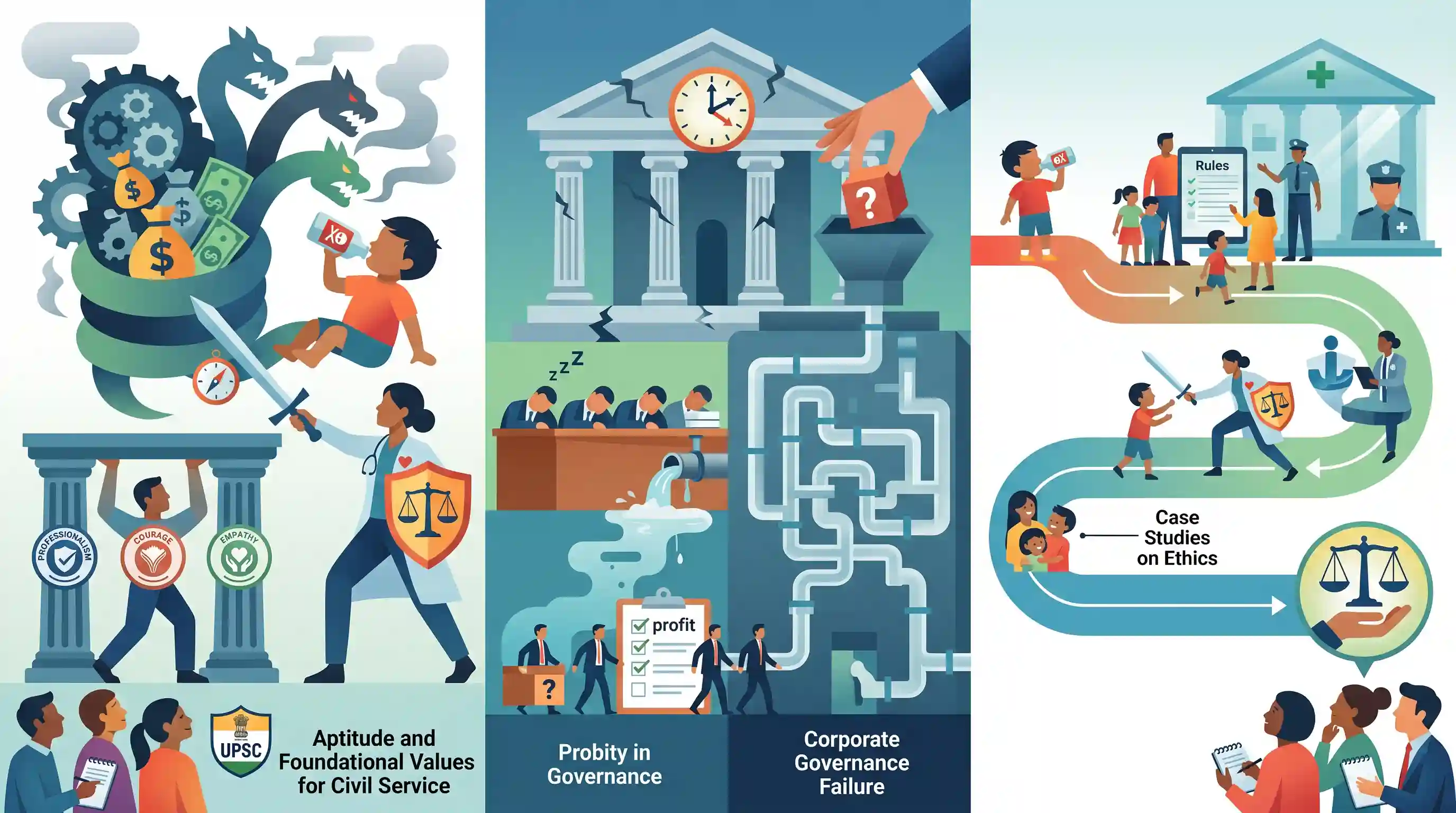
Why It Matters
Public health crises caused by negligence or corporate greed are highly relevant for GS4 case studies. Understanding a doctor's ethical stance helps aspirants cultivate the necessary moral framework to address regulatory failures and uphold public welfare as civil servants.
Summary
This case study explores the ethical dimensions of a tragic incident involving contaminated cough syrup, focusing on a doctor's response to the crisis. It serves as an essential lesson for future public servants by highlighting foundational values such as professional integrity, courage of conviction, and empathy. Furthermore, it sheds light on the grave consequences of corporate governance failures within the pharmaceutical industry and the lapse of regulatory accountability. For UPSC aspirants, the narrative provides vital insights into ethical decision-making, systemic accountability, and public health governance.
Key Points
- The article analyzes a cough syrup tragedy as a case study for future public servants to understand the ethical dimensions of a public health crisis.
- It emphasizes a doctor's role in demonstrating professional integrity, compassion, and courage of conviction when dealing with such tragedies.
- Highlights the stark ethical failure in corporate governance among pharmaceutical companies that compromise drug safety for profit.
- Underscores the accountability of regulatory bodies in enforcing strict compliance to prevent the circulation of toxic medicines.
- Provides lessons for civil servants on proactive governance, transparency, and upholding the spirit of service in safeguarding public health.
Important Terms
Central Drugs Standard Control Organisation (CDSCO)

India's national regulatory body under the Ministry of Health and Family Welfare. It oversees drug approvals, clinical trials, and quality standards for pharmaceuticals, cosmetics, and medical devices.
UPSC context
GS Paper II (Regulatory Bodies) and GS Paper IV (Regulatory Accountability and Case Studies).
Drugs and Cosmetics Act, 1940
The primary legislation regulating the import, manufacture, distribution, and sale of drugs and cosmetics in India to ensure their safety, efficacy, and quality.
UPSC context
GS Paper II (Statutory Frameworks) and GS Paper IV (Legal-Ethical interface in governance).
Professional Integrity
The practice of conducting professional duties with honesty and consistency, adhering to ethical codes and public interest regardless of external pressures or personal gain.
UPSC context
GS Paper IV (Foundational Values for Civil Service); tested via theory and case studies.
Corporate Governance
The system of rules and processes by which companies are directed and controlled, balancing stakeholder interests and ensuring ethical, transparent, and accountable business operations.
UPSC context
GS Paper IV (Ethical Issues in Corporate Governance); relevant for business ethics and accountability.
Courage of Conviction
The moral strength to stand by one's ethical beliefs and decisions, especially when facing adversity, political pressure, or significant professional repercussions.
UPSC context
GS Paper IV (Public Service Values); critical for decision-making under pressure.
Drug Regulatory Authority (DRA)
Statutory agencies (like CDSCO and State Drug Controllers) responsible for monitoring, licensing, and enforcing safety standards in the pharmaceutical industry to protect public health.
UPSC context
GS Paper II (Governance and Health) and GS Paper IV (Regulatory Ethics).
Prelims Trap
"A Code of Conduct provides a broader, more philosophical framework for public servants than a Code of Ethics."
It is the exact opposite. A Code of Ethics defines broad moral principles, while a Code of Conduct dictates specific, enforceable rules of behavior.
Static Concepts Connected
How does a Code of Ethics differ from a Code of Conduct?
- Nature and Scope: Ethics provides broad, principle-based moral guidelines (e.g., integrity, empathy). Conduct provides specific, compliance-based rules (e.g., working hours, anti-bribery rules).
- Focus Area: Ethics focuses on decision-making and values. Conduct focuses on regulating specific actions and behaviors in the workplace.
- Enforceability: Violations of a Code of Conduct invite strict legal or administrative penalties. Code of Ethics violations indicate moral failure but may not have direct statutory penalties.
What is the regulatory framework for drug safety in India?
- Central Authority: The Central Drugs Standard Control Organisation (CDSCO) under the Ministry of Health and Family Welfare is responsible for new drug approvals and clinical trials.
- State Regulators: State Drug Regulatory Authorities (SDRAs) are responsible for issuing licenses for the manufacturing, sale, and distribution of drugs.
- Governing Law: The entire regulatory architecture derives its powers from the Drugs and Cosmetics Act, 1940, and the rules framed thereunder.
Cross-Topic Patterns
Soft power vs. regulatory ethics
Lax domestic drug regulation undermines India's "Pharmacy of the World" image, directly linking GS2 international relations and health diplomacy with GS4 corporate governance.
Profit maximization vs. Public Safety
The tension between the pharmaceutical industry's export-driven economic targets (GS3) and the ethical mandate for strict quality control and human life preservation (GS4).

Expect a GS4 case study in 2026 blending corporate profit motives, regulatory negligence, and the courage of conviction of a whistleblower.
Linked PYQs · 4
Linked PYQs · 4
- 2017MainsGS4
Examine the relevance of the following in the context of civil service: Transparency, Accountability, Fairness and justice, Courage of conviction, Spirit of service.
- 2021MainsGS4
Identify ten essential values that are needed to be an effective public servant. Describe the ways and means to prevent non-ethical behaviour in the public servants.
- 2024MainsGS4
“Ethics encompasses several key dimensions that are crucial in guiding individuals and organizations towards morally responsible behaviour.” Explain the key dimensions of ethics that influence human actions. Discuss how these dimensions shape ethical decision-making in the professional context.
- 2024MainsGS4
“The 'Code of Conduct' and 'Code of Ethics' are the sources of guidance in public administration. There is code of conduct already in operation, whereas code of ethics is not yet put in place. Suggest a suitable model for code of ethics to maintain integrity, probity and transparency in governance.”
