India Israel Agricultural Cooperation and Pax Silica Initiative
Source:Indian Express ↗
Why It Matters
Understanding these topics is crucial for Mains GS2 (International Relations) and GS3 (Agriculture & Technology). They illustrate how bilateral partnerships address domestic challenges (like agriculture and water scarcity) and how India is navigating the global strategic shift towards critical technologies like semiconductors.
Summary
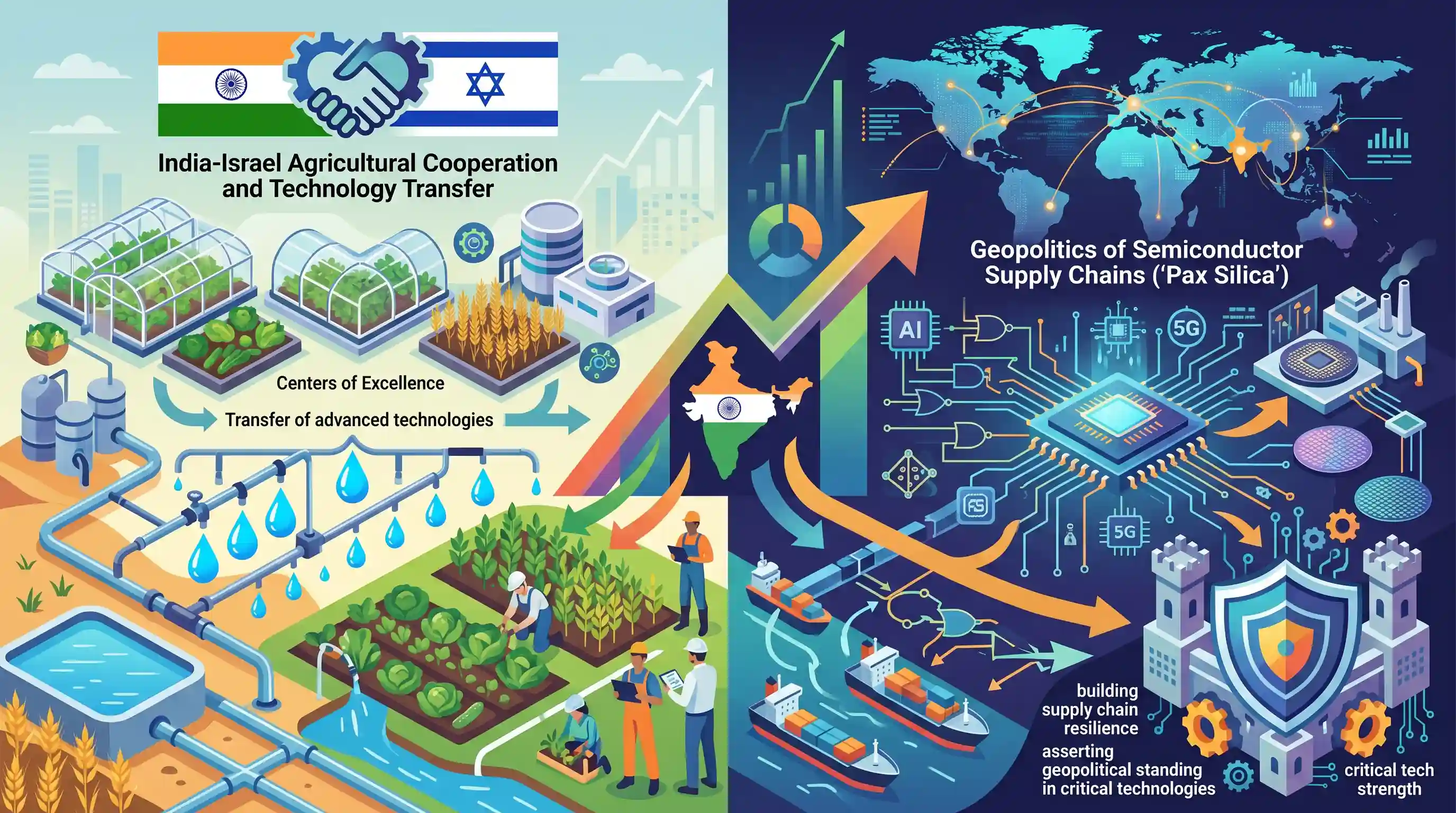
This Mains Answer Practice focuses on two critical aspects of India's strategic engagements. The first highlights the deep agricultural cooperation between India and Israel, emphasizing the transfer of advanced technologies in micro-irrigation and water management through Centers of Excellence under the INDO-ISRAEL Agricultural Project. The second addresses the concept of 'Pax Silica'—a new geopolitical paradigm driven by semiconductor supply chains. It examines the significance of India securing a position within the global semiconductor ecosystem to build supply chain resilience and assert its geopolitical standing in the realm of critical technologies.
Key Points
- India and Israel collaborate extensively in agriculture, leveraging Israel's expertise in dryland farming, micro-irrigation, and water management.
- The INDO-ISRAEL Agricultural Project (IIAP) and various Centers of Excellence (CoEs) help transfer advanced agricultural technologies to Indian farmers.
- 'Pax Silica' refers to the emerging geopolitical order where global power and economic security are heavily dependent on the control of semiconductor manufacturing and supply chains.
- India's participation in semiconductor initiatives aims to secure its domestic supply chain, reduce import dependencies, and position the country as a trusted node in global critical technology networks.
Important Terms
INDO-ISRAEL Agricultural Project (IIAP)

A bilateral government-to-government partnership since 2006 that implements Israeli agricultural technologies, such as micro-irrigation and fertigation, through a network of 'Centers of Excellence' to enhance Indian crop productivity and water-use efficiency.
UPSC context
GS2 (Bilateral Relations) and GS3 (Agriculture). Tests knowledge of technology transfer mechanisms and international cooperation in resource-constrained farming.
Pax Silica
A geopolitical framework focused on securing global semiconductor and AI supply chains. It emphasizes 'friend-shoring' and trusted digital ecosystems among allied nations to reduce dependency on monopolistic or adversarial sources for critical technology.
UPSC context
GS2 (International Relations) and GS3 (Science & Tech). Analyzes shifting power dynamics where semiconductor dominance replaces traditional oil-based (Pax Petrolia) geopolitics.
India Semiconductor Mission (ISM)
A specialized business division within the Digital India Corporation that serves as the nodal agency for building a sustainable semiconductor and display manufacturing ecosystem in India through fiscal support and strategic partnerships.
UPSC context
GS3 (Economy; Science & Tech). Evaluates India’s industrial policy, strategic self-reliance (Atmanirbhar Bharat), and integration into global high-tech value chains.
Prelims Trap
Pax Silica is a WTO-led global framework ensuring equitable access to semiconductor technology.
Pax Silica is a US-led geopolitical coalition focused on 'friend-shoring' critical supply chains, not a neutral multilateral UN or WTO trade agreement.
Static Concepts Connected
What is 'Friend-shoring' in the context of global supply chains?
- Geopolitical Re-routing: Shifting manufacturing and supply chains to countries with shared geopolitical values to reduce reliance on potentially hostile or coercive actors (e.g., China).
- Contrast with Offshoring: Unlike traditional offshoring, which prioritizes pure cost-efficiency and cheap labor, friend-shoring prioritizes supply chain security, resilience, and strategic autonomy.
How do micro-irrigation technologies enhance dryland agriculture?
- Water Use Efficiency: Techniques like drip irrigation deliver water directly to the plant's root zone, significantly reducing evaporation and deep percolation losses in arid regions.
- Fertigation Synergy: The integration of water and fertilizers prevents nutrient leaching and ensures optimal uptake, which is critical for poorer dryland soils.
- Salinity Management: Continuous, localized moisture application helps push harmful salts away from the root zone, managing the soil salinity often found in drylands.
Cross-Topic Patterns
Pax Silica + Mineral Security Partnership
Both initiatives represent the US-led shift toward 'friend-shoring' critical tech inputs, moving global trade from WTO-style open globalization to strategic, geopolitical blocs.
I2U2 Framework + Israeli Agri-tech
The bilateral Indo-Israel agricultural model (IIAP) scales multilaterally within the I2U2 grouping, which focuses on integrating Israeli water tech and UAE capital into Indian food parks.

Expect a paired GS-2/GS-3 question linking the 'Pax Silica' coalition and friend-shoring to India's Semiconductor Mission and strategic autonomy.
Linked PYQs · 4
Linked PYQs · 4
- 2018MainsGS2
“India’s relations with Israel have, of late, acquired a depth and diversity, which cannot be rolled back.” Discuss.
- 2025MainsGS3
India aims to become a semiconductor manufacturing hub. What are the challenges faced by the semiconductor industry in India? Mention the salient features of the India Semiconductor Mission.
- 2024MainsGS3
What are the major challenges faced by Indian irrigation system in recent times? State the measures taken by the government for efficient irrigation management.
- 2020MainsGS3
Suggest measures to improve water storage and irrigation system to make its judicious use under depleting scenario.
