Electronics Manufacturing and Asset Monetization Policy in India
Source:Indian Express ↗
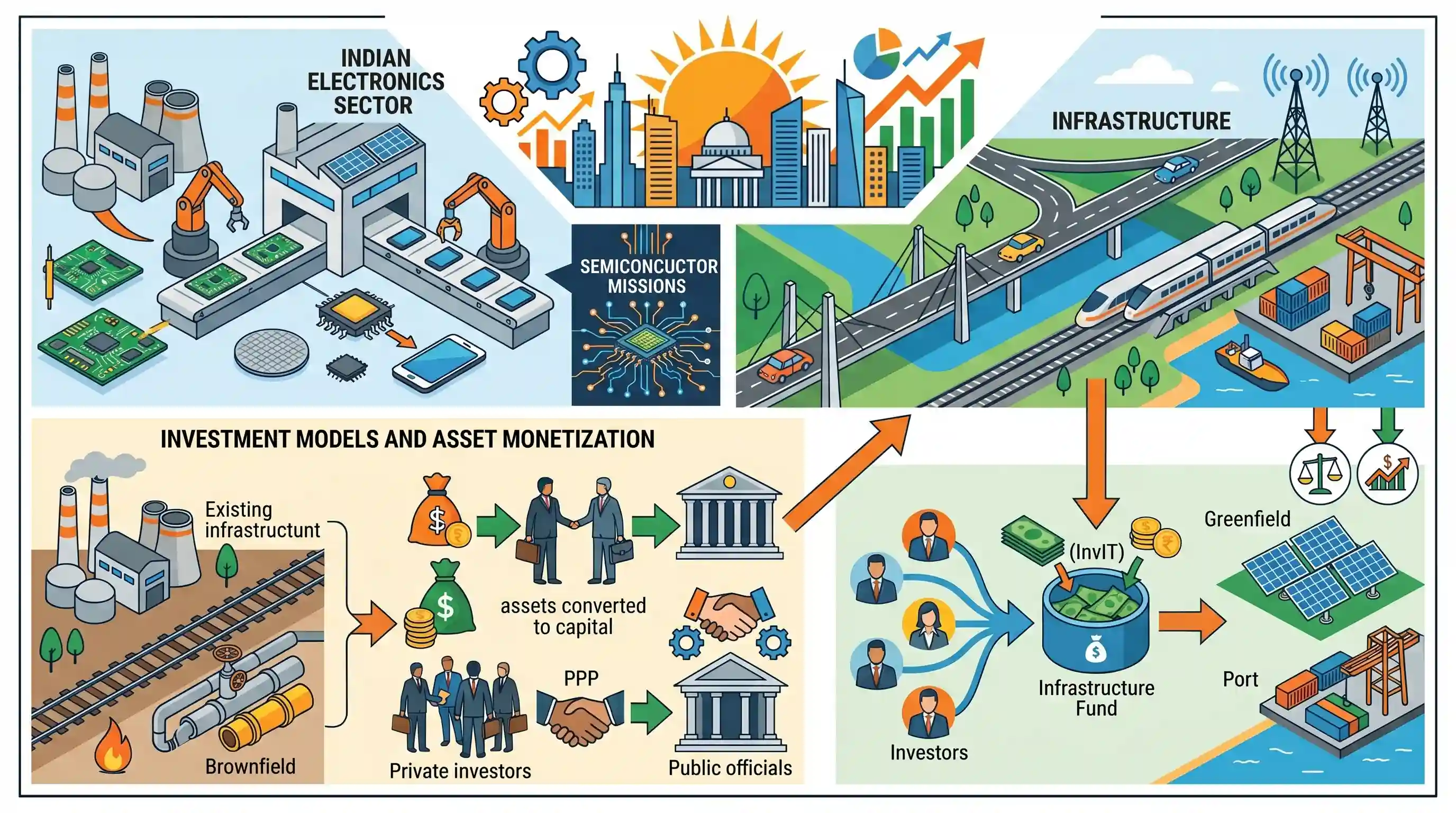
Why It Matters
Understanding government policies for industrial growth (like PLI) and infrastructure financing (like NMP) is crucial for GS Paper 3. These topics directly address India's macroeconomic strategies for self-reliance and capital expenditure generation.
Summary
This UPSC Essentials quiz focuses on key economic developments, specifically evaluating concepts surrounding India's electronic sector and the National Monetisation Pipeline 2.0. The electronic sector highlights involve evaluating government policies like the Production Linked Incentive (PLI) scheme and semiconductor missions aimed at building domestic manufacturing capabilities. The National Monetisation Pipeline (NMP) 2.0 questions likely test the understanding of infrastructure asset monetization, the role of brownfield assets, and mechanisms like PPPs and InvITs designed to fund future infrastructure creation without burdening the fiscal deficit.
Key Points
- The electronic sector in India is a major focus area for government interventions like the Production Linked Incentive (PLI) scheme to boost domestic manufacturing and reduce import reliance.
- India Semiconductor Mission aims to establish a robust semiconductor and display ecosystem, addressing supply chain vulnerabilities.
- National Monetisation Pipeline (NMP) 2.0 focuses on unlocking the value of government-owned brownfield infrastructure assets through private sector participation.
- Asset monetization relies heavily on models like Public Private Partnerships (PPP), Infrastructure Investment Trusts (InvITs), and Real Estate Investment Trusts (REITs).
Important Terms
National Monetisation Pipeline 2.0

A medium-term roadmap (FY 2026–2030) for leasing operational brownfield public infrastructure assets to private players to unlock capital for new greenfield projects without transferring ownership.
UPSC context
GS Paper 3: Infrastructure and Investment Models; tests understanding of asset recycling and fiscal management.
Production Linked Incentive (PLI) Scheme
A government initiative providing financial incentives (typically 4-6%) to companies based on incremental sales from products manufactured in domestic units to boost manufacturing and exports.
UPSC context
GS Paper 3: Industrial Policy and Growth; key for evaluating Atmanirbhar Bharat and domestic manufacturing.
India Semiconductor Mission
A mission-mode initiative under MeitY to develop a sustainable semiconductor and display ecosystem in India through fiscal support for fabrication facilities and design innovation.
UPSC context
GS Paper 3: Indigenization of Technology; tests strategy for technological sovereignty and global supply chain integration.
NITI Aayog
The premier policy think-tank of the Government of India, mandated to develop the National Monetisation Pipeline and foster cooperative federalism through strategic policy advice.
UPSC context
GS Paper 2: Statutory and Quasi-judicial bodies; relevant for institutional frameworks in economic planning.
Ministry of Electronics and Information Technology (MeitY)
The nodal ministry responsible for formulating policies to develop India's electronics, IT, and IT-enabled services, including overseeing the India Semiconductor Mission and PLI for electronics.
UPSC context
GS Paper 3: Industrial Policy; tests awareness of departmental roles in sectoral development.
Prelims Trap
"The National Monetisation Pipeline involves the sale of government land and greenfield infrastructure assets to private entities."
NMP only covers operational, revenue-generating brownfield core infrastructure. Ownership remains with the government (asset recycling, not privatization), and it strictly excludes surplus land.
Static Concepts Connected
How do Infrastructure Investment Trusts (InvITs) function under Indian financial regulations?
- Structure & Regulation: They function similarly to mutual funds, are regulated by SEBI, and pool capital from retail and institutional investors.
- Asset Focus: They invest primarily in completed, revenue-generating brownfield infrastructure projects (e.g., toll roads, power transmission lines).
- Yield Generation: They provide regular income to investors (unitholders) primarily through dividends generated by the cash flows of the underlying assets.
What is the core mechanism of the Production Linked Incentive (PLI) scheme?
- Incentive Basis: Provides financial incentives calculated strictly as a percentage of incremental sales of goods manufactured domestically, over a base year.
- WTO Compliance: Structured as a production-based subsidy rather than a direct export subsidy, making it compliant with World Trade Organization (WTO) norms.
Cross-Topic Patterns
Semiconductors & Geopolitics (iCET/Quad)
The India Semiconductor Mission aligns with the US-India iCET and Quad tech agreements, reflecting a strategic shift to de-risk critical electronics supply chains away from China.
NMP as a fiscal consolidation tool
Proceeds from NMP's brownfield asset monetization are channeled directly into the National Infrastructure Pipeline (NIP) to fund greenfield projects, acting as a crucial off-budget fiscal consolidation tool.

Expect a multi-statement question mixing NMP's brownfield-only restriction with InvITs' regulatory structure under SEBI in Prelims 2026.
Linked PYQs · 4
Linked PYQs · 4
- 2025MainsGS3
Discuss the rationale of the Production Linked Incentive (PLI) scheme. What are its achievements? In what way can the functioning and outcomes of the scheme be improved?
- 2025MainsGS3
India aims to become a semiconductor manufacturing hub. What are the challenges faced by the semiconductor industry in India? Mention the salient features of the India Semiconductor Mission.
- 2022MainsGS3
Why is Public Private Partnership (PPP) required in infrastructural projects ? Examine the role of PPP model in the redevelopment of Railway Stations in India.
- 2023MainsGS3
What is the status of digitalization in the Indian economy? Examine the problems faced in this regard and suggest improvements.
