Weekly Current Affairs Consolidation for Civil Services
Source:Indian Express ↗
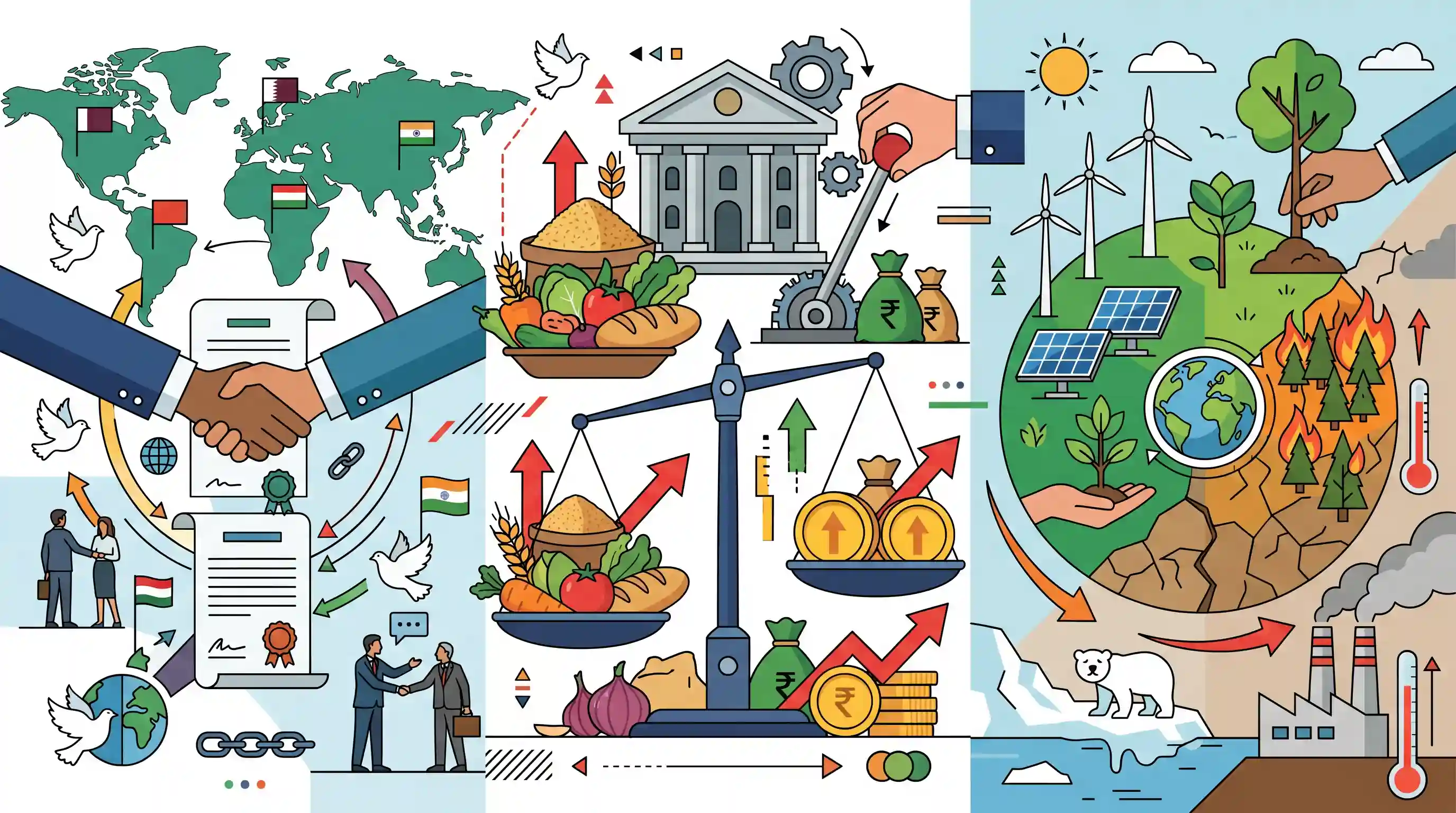
Why It Matters
Weekly current affairs pointers help aspirants consolidate scattered news across economy, environment, and international relations. Tracking inflation metrics and climate change initiatives directly maps to GS Paper 3 core topics, while bilateral ties cover critical GS Paper 2 requirements.
Summary
The article offers a comprehensive weekly roundup of critical current affairs for UPSC aspirants covering the period from September 8 to 14, 2025. It focuses on major economic and environmental developments, notably the challenges of persistent food inflation, the Reserve Bank of India's monetary policy actions, and the broader impacts of global warming. Additionally, it touches upon important geopolitical events and bilateral agreements, providing a vital summary of ongoing issues relevant to the civil services examination syllabus.
Key Points
- Highlights key trends in the Indian economy, focusing on persistent food inflation and the Reserve Bank of India's monetary policy responses.
- Outlines recent environmental developments, specifically addressing global warming effects and measures to curb greenhouse gas emissions.
- Covers significant international relations events, including India's bilateral agreements and strategic global partnerships.
- Provides essential updates for UPSC aspirants across GS Paper 2 and GS Paper 3 topics, bridging current events with foundational syllabus themes.
Important Terms
Reserve Bank of India (RBI)

India's central bank responsible for monetary policy, currency issuance, and regulating the banking sector to ensure financial stability and maintain price stability via inflation targeting.
UPSC context
GS Paper III (Economy); central bank functions, monetary policy, and inflation management.
Kyoto Protocol
A 1997 international treaty (UNFCCC) committing industrialized nations to binding greenhouse gas reductions. A 2025 ICJ ruling reaffirmed its legal validity despite the subsequent Paris Agreement.
UPSC context
GS Paper III (Environment); international climate agreements and binding emission targets.
Food Inflation
The increase in food prices over time. In late 2025, India saw significant deflation in this category due to bumper harvests and favorable monsoon conditions.
UPSC context
GS Paper III (Economy); CPI components and agricultural impact on macroeconomics.
Monetary Policy Committee (MPC)
A six-member statutory body of the RBI that determines the benchmark repo rate to achieve specific inflation targets while aiming to support economic growth.
UPSC context
GS Paper III (Economy); institutional framework for price stability and financial policy.
Base Effect
A statistical effect where the choice of a high or low value for the base year makes current year-on-year inflation figures look misleadingly low or high.
UPSC context
GS Paper III (Economy); critical analysis of economic indicators and statistical trends.
International Court of Justice (ICJ)
The principal judicial organ of the United Nations, based in The Hague, which settles disputes between states and provides advisory opinions on international legal issues.
UPSC context
GS Paper II (International Institutions); global judicial oversight and environmental law rulings.
Consumer Price Index (CPI)
The primary measure used to calculate retail inflation in India, based on price changes in a specific basket of consumer goods and services.
UPSC context
GS Paper III (Economy); tracking inflation trends and purchasing power.
Common but Differentiated Responsibilities (CBDR)
The principle that while all countries share an obligation to address climate change, developed nations bear greater responsibility due to historical emissions and greater capabilities.
UPSC context
GS Paper III (Environment); equity and justice in global climate negotiations.
Prelims Trap
RBI's repo rate adjustments are the primary and most effective tool to resolve structural food inflation.
Monetary policy targets demand-pull inflation. Structural food inflation is supply-driven (monsoons, logistics), making interest rate changes largely ineffective at directly lowering food prices.
Static Concepts Connected
Why does RBI struggle to control food inflation using monetary policy?
- Demand vs Supply: Repo rates control money supply and aggregate demand, but food inflation is typically driven by structural supply shocks (monsoons, logistics).
- CPI Weightage: Food (CFPI) constitutes nearly 39% of India's CPI basket, making headline inflation highly vulnerable to uncontrollable agricultural shocks.
What are the core mechanisms of NDCs under the Paris Agreement?
- Ratchet Mechanism: Countries must submit updated NDCs every five years, each reflecting a progression or higher ambition than the previous submission.
- Legal Nature: Submitting NDCs is a legally binding procedural obligation under the treaty, but achieving the specific domestic targets within them is not legally binding.
Cross-Topic Patterns
India-Japan Indo-Pacific convergence
Ties have evolved from pure official development assistance (ODA) to joint military exercises (JIMEX, Dharma Guardian) and Quad-driven maritime domain awareness.
Climate Action + Fiscal Subsidy
Phasing out inefficient fossil fuel subsidies connects GS3 Environment (emissions reduction) directly with GS3 Economy (rationalization of government revenue expenditure).

Expect a tricky 2026 Prelims statement differentiating demand-pull vs supply-side inflation, specifically testing RBI's limits on food prices.
Linked PYQs · 3
Linked PYQs · 3
- 2024MainsGS3
What are the causes of persistent high food inflation in India? Comment on the effectiveness of the monetary policy of the RBI to control this type of inflation.
- 2022MainsGS3
Discuss global warming and mention its effects on the global climate. Explain the control measures to bring down the level of greenhouse gases which cause global warming, in the light of the Kyoto Protocol, 1997.
- 2019MainsGS2
‘The time has come for India and Japan to build a strong contemporary relationship, one involving global and strategic partnership that will have a great significance for Asia and the world as a whole.’ Comment.
