Weekly Current Affairs Review for Civil Services Exam
Source:Indian Express ↗
Why It Matters
Weekly current affairs compilations are vital for UPSC aspirants as they bridge the gap between static syllabus concepts (such as monetary policy, constitutional checks and balances, and geopolitical strategy) and contemporary real-world developments, aiding in both Prelims fact-retention and Mains answer enrichment.
Summary
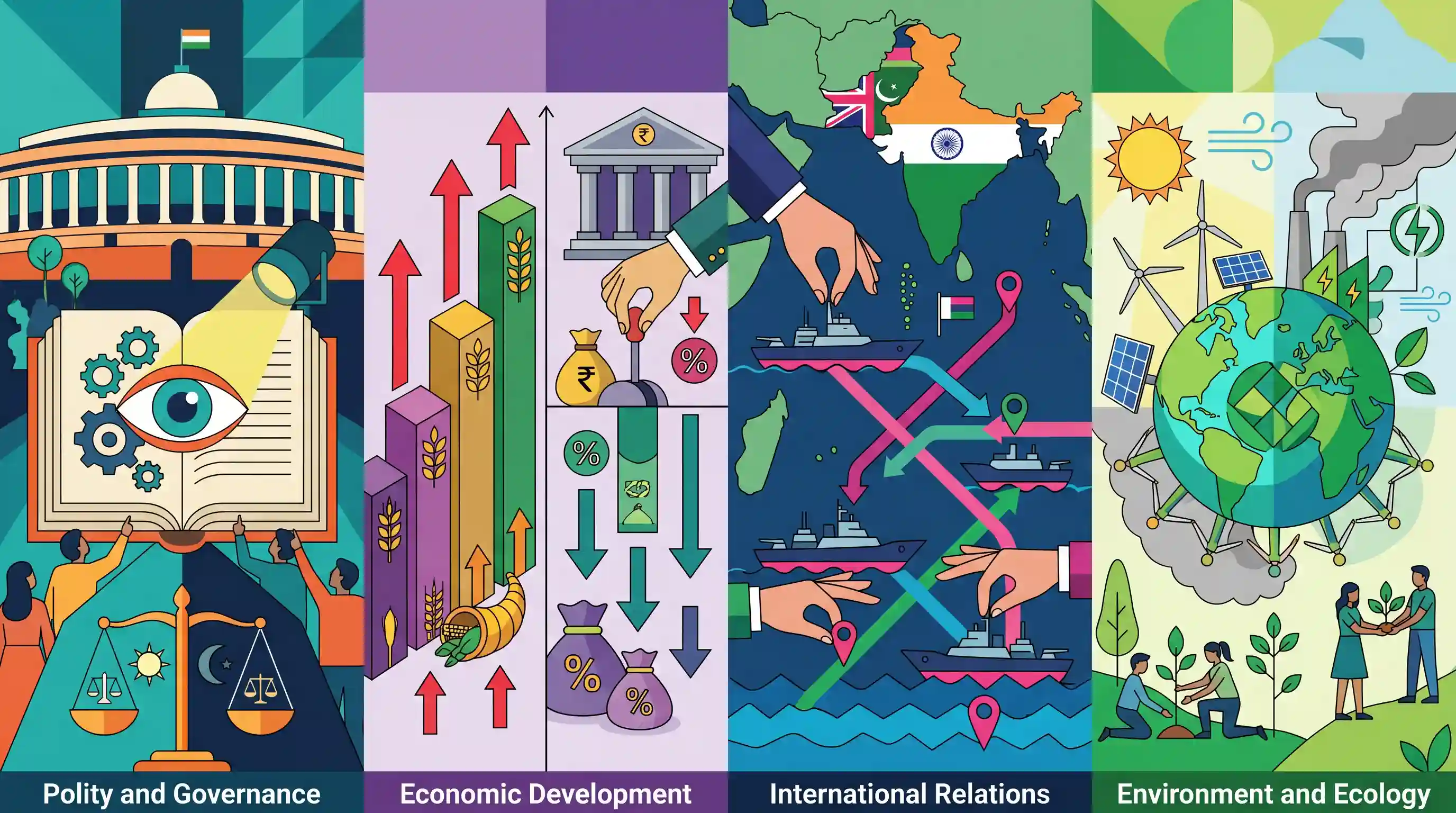
The weekly UPSC Current Affairs Pointers (March 16-22, 2026) provide a concise summary of critical national and international developments. Key highlights include governance issues surrounding transparency and constitutional morality, economic challenges like persistent food inflation and the RBI's monetary response, shifting geopolitical dynamics in the Indian Ocean involving the Maldives, and global environmental mitigation efforts. These pointers serve as a consolidated revision tool for aspirants to track dynamic syllabus areas.
Key Points
- Overview of the Supreme Court's push for transparency in political funding and its implications for electoral integrity.
- Analysis of RBI's monetary policy effectiveness in dealing with persistent food inflation.
- Strategic evaluation of India-Maldives relations within the broader context of maritime security and Indian Ocean geopolitics.
- Updates on climate action commitments and mitigation measures aligned with UNFCCC guidelines.
Important Terms
Constitutional Morality

The principle of adherence to the spirit and core values of the Constitution, such as liberty and equality, rather than just its literal text.
UPSC context
GS Paper II (Polity); vital for essays and ethics (GS IV) regarding judicial interpretation and governance.
Electoral Bonds Scheme
A former interest-free financial instrument for anonymous political funding, struck down by the Supreme Court in 2024 for violating the Right to Information.
UPSC context
GS Paper II (Polity/Governance); tests transparency, electoral reforms, and the right to information.
Reserve Bank of India (RBI)
India's central bank responsible for monetary policy and maintaining price stability, currently targeting a retail inflation rate of 4% (with a +/-2% margin).
UPSC context
GS Paper III (Economy); tests knowledge of inflation targeting, monetary policy tools, and economic stability.
Election Commission of India (ECI)
An autonomous constitutional body under Article 324 mandated to conduct free and fair elections for Parliament, State Legislatures, and top national offices.
UPSC context
GS Paper II (Polity); essential for understanding democratic processes, electoral integrity, and constitutional bodies.
UNFCCC
A 1992 international environmental treaty aiming to stabilize greenhouse gas concentrations to prevent dangerous human-induced interference with the global climate system.
UPSC context
GS Paper III (Environment); key for international climate negotiations, mitigation strategies, and the Paris Agreement.
Indian Ocean Region (IOR)
A strategically vital maritime area where India seeks to maintain its role as a 'Net Security Provider' amid shifting geopolitical alignments.
UPSC context
GS Paper II (International Relations); tests maritime security, 'SAGAR' initiative, and neighborhood-first policy.
Prelims Trap
"RBI repo rate hikes are an effective primary tool to control structural food inflation in India."
Monetary policy targets demand-pull inflation. India's food inflation is structurally supply-driven (weather variations, import dependence on pulses/oils), rendering interest rate hikes largely ineffective.
Static Concepts Connected
How does Article 19(1)(a) govern political funding and voter rights?
- Right to Know: The 'right to know' is intrinsic to freedom of speech and expression, empowering voters to make informed electoral choices.
- Proportionality Test: State restrictions on fundamental rights must be proportionate. The SC held that anonymous bonds failed this test as a means to curb black money.
- Corporate Opacity: Unlimited, undisclosed corporate funding under amended Section 182 of the Companies Act was ruled manifestly arbitrary and violative of informational rights.
What is the strategic and geographical significance of the Maldives for India?
- Eight Degree Channel: It separates Minicoy Island (part of India's Lakshadweep) from the Maldives, serving as a critical maritime transit route.
- SLOC Security: The region straddles vital Sea Lines of Communication through which 50% of India's external trade and 80% of energy imports pass.
Cross-Topic Patterns
Inflation + Agri Import Dependency
Links RBI's inflation-targeting limits with India's structural agricultural deficits, showing how global edible oil and pulse prices dictate domestic retail inflation.
SLOCs + Neighbourhood First Policy
Combines physical geography (Eight Degree Channel) with strategic doctrines like SAGAR and Neighbourhood First, frequently tested together in map-based IR questions.
Article 19 + Companies Act
Bridges constitutional fundamental rights with corporate regulatory frameworks, demonstrating how the Supreme Court applies public law principles to private corporate funding limits.

Expect a multi-statement Prelims question testing the limits of RBI's repo rate in curbing supply-driven food vs core inflation in 2026.
Linked PYQs · 5
Linked PYQs · 5
- 2025MainsGS2
"Constitutional morality is the fulcrum which acts as an essential check upon the high functionaries and citizens alike...." In view of the above observation of the Supreme Court, explain the concept of constitutional morality and its application to ensure balance between judicial independence and judicial accountability in India.
- 2024MainsGS3
What are the causes of persistent high food inflation in India? Comment on the effectiveness of the monetary policy of the RBI to control this type of inflation.
- 2024MainsGS2
Discuss the geopolitical and geostrategic importance of Maldives for India with a focus on global trade and energy flows. Further also discuss how this relationship affects India's maritime security and regional stability amidst international competition ?
- 2022MainsGS3
Discuss global warming and mention its effects on the global climate. Explain the control measures to bring down the level of greenhouse gases which cause global warming, in the light of the Kyoto Protocol, 1997.
- 2021MainsGS3
Describe the major outcomes of the 26th session of the Conference of the Parties (COP) to the United Nations Framework Convention on Climate Change (UNFCCC). What are the commitments made by India in this conference?
