Weekly Economic Indicators and Environmental Conservation Review
Source:Indian Express ↗
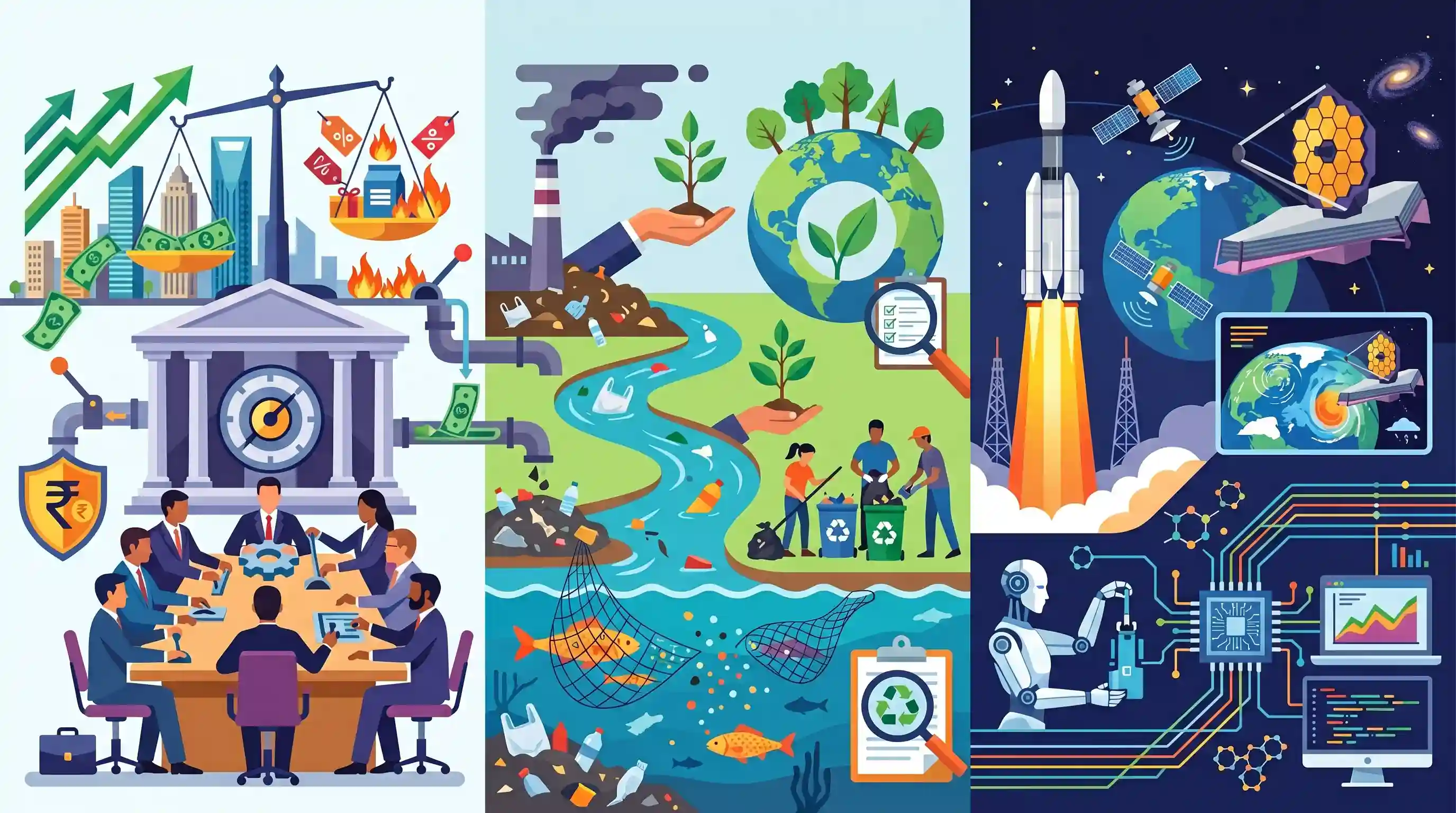
Why It Matters
Weekly current affairs compendiums are fundamental for UPSC aspirants. Tracking the RBI's monetary policy decisions helps in understanding inflation targeting and forex management (GS3 Economy). Concurrently, tracking global environmental commitments and ISRO's space initiatives directly informs the Environment and Science & Technology sections of both Prelims and Mains.
Summary
The UPSC Current Affairs Pointers for the week of June 2 to June 8, 2025, cover crucial developments across economy, environment, and science. The week's highlights include the RBI's bi-monthly Monetary Policy Committee (MPC) meeting, which strategized on the repo rate and inflation targeting to balance domestic economic growth. Coinciding with World Environment Day (June 5), the pointers emphasize global efforts to combat persistent environmental challenges like plastic and microplastic pollution. Additionally, the compilation touches upon space technology developments, notably ISRO's upcoming missions and the broader utility of advanced space telescopes for humanity and climate observation.
Key Points
- The RBI Monetary Policy Committee (MPC) reviewed macroeconomic indicators, focusing on maintaining price stability and managing the repo rate amidst global inflation pressures.
- World Environment Day (June 5) brought renewed global focus on mitigating microplastic pollution and accelerating land restoration initiatives.
- Advancements in space technology were highlighted, particularly ISRO's earth observation capabilities and the contributions of space telescopes in monitoring climate and deep space.
- The interplay between global interest rates (like those of the US) and the RBI's interventions in the forex market to stabilize the depreciating rupee was analyzed.
Important Terms
Monetary Policy Committee (MPC)

A statutory body under the RBI Act, 1934, consisting of six members who determine the policy repo rate required to achieve the inflation target while supporting economic growth.
UPSC context
GS Paper III (Indian Economy). Tests understanding of monetary policy formulation, institutional frameworks, and interest rate mechanisms.
Flexible Inflation Targeting (FIT) Framework
A monetary policy regime where the RBI targets a 4% retail inflation rate (within a 2-6% band) to ensure price stability while accommodating economic growth shocks.
UPSC context
GS Paper III (Indian Economy). Relevant for questions on price stability, RBI’s mandate, and macroeconomic indicators.
United Nations Environment Programme (UNEP)
The leading global environmental authority, established in 1972, that coordinates UN environmental activities and assists countries in implementing environmentally sound policies and international treaties.
UPSC context
GS Paper III (Environment). Crucial for topics on global environmental governance, pollution control, and sustainable development.
Indian Space Research Organisation (ISRO)
India's primary space agency, responsible for advancing space technology and exploration through indigenous missions like Gaganyaan, NISAR, and the Chandrayaan series.
UPSC context
GS Paper III (Science & Technology). Tests awareness of indigenous space capabilities, satellite applications, and international collaborations.
Reserve Bank of India (RBI)
The central bank of India and a statutory body that regulates the monetary system, issues currency, manages foreign exchange, and supervises the banking sector.
UPSC context
GS Paper III (Indian Economy). A fundamental topic for banking, financial regulation, and credit control.
Prelims Trap
"The inflation target of 4% is determined and set by the Reserve Bank of India."
The inflation target (currently 4% with a +/- 2% tolerance band) is actually set by the Government of India, in consultation with the RBI, once every five years.
Static Concepts Connected
How is the Monetary Policy Committee (MPC) structured and governed?
- Composition: It is a statutory body under the RBI Act, 1934, consisting of 6 members (3 from RBI, 3 nominated by the Central Government).
- Voting & Veto: Decisions are taken by a majority vote. The RBI Governor does not have a veto, but holds a casting vote in the event of a tie.
- Mandate: To determine the policy repo rate required to achieve the inflation target while keeping in mind the objective of growth.
What are microplastics and how are they classified?
- Size threshold: Microplastics are defined as any plastic fragments that are less than 5 millimeters in length.
- Primary microplastics: Intentionally manufactured at that size for commercial use (e.g., microbeads in cosmetics, synthetic textiles).
- Secondary microplastics: Formed from the breakdown of larger plastic items (like water bottles or fishing nets) due to environmental exposure and degradation.
Cross-Topic Patterns
Global rate hikes + RBI forex intervention
US Federal Reserve rate hikes trigger capital flight, depreciating the Rupee. UPSC routinely links domestic MPC decisions to RBI's defensive sale of USD from forex reserves.
ISRO Earth Observation + Climate Tracking
Space tech questions increasingly combine S&T with environmental monitoring, testing knowledge on specific satellite payloads measuring GHGs, aerosol levels, or desertification.

Expect a multi-statement question in 2026 combining RBI's MPC mechanics with the external sector impacts of US interest rate movements.
Linked PYQs · 5
Linked PYQs · 5
- 2017PrelimsGS1
Which of the following statements is/are correct regarding the Monetary Policy Committee (MPC)? 1. It decides the RBI's benchmark interest rates. 2. It is a 12-member body including the Governor of RBI and is reconstituted every year. 3. It functions under the chairmanship of the Union Finance Minister. Select the correct answer using the code given below:
- 2022PrelimsGS1
In India, which one of the following is responsible for maintaining price stability by controlling inflation?
- 2024PrelimsGS1
Consider the following statements : Statement-I: Many chewing gums found in the market are considered a source of environmental pollution. Statement-II : Many chewing gums contain plastic as gum base. Which one of the following is correct in respect of the above statements?
- 2025PrelimsGS1
Consider the following: I. Cigarette butts II. Eyeglass lenses III. Car tyres How many of them contain plastic?
- 2022MainsGS3
Launched on 25th December, 2021, James Webb Space Telescope has been much in the news since then. What are its unique features which make it superior to its predecessor Space Telescopes ? What are the key goals of this mission ? What potential benefits does it hold for the human race?
