Weekly current affairs digest on economic survey and budget milestones
Source:Indian Express ↗
Why It Matters
The Jan-Feb transition week is arguably the most important time of the year for UPSC preparation. The release of the Economic Survey and Union Budget dictates the economic curriculum, while Republic Day and Padma Awards provide direct material for Polity and Governance questions in Prelims.
Summary
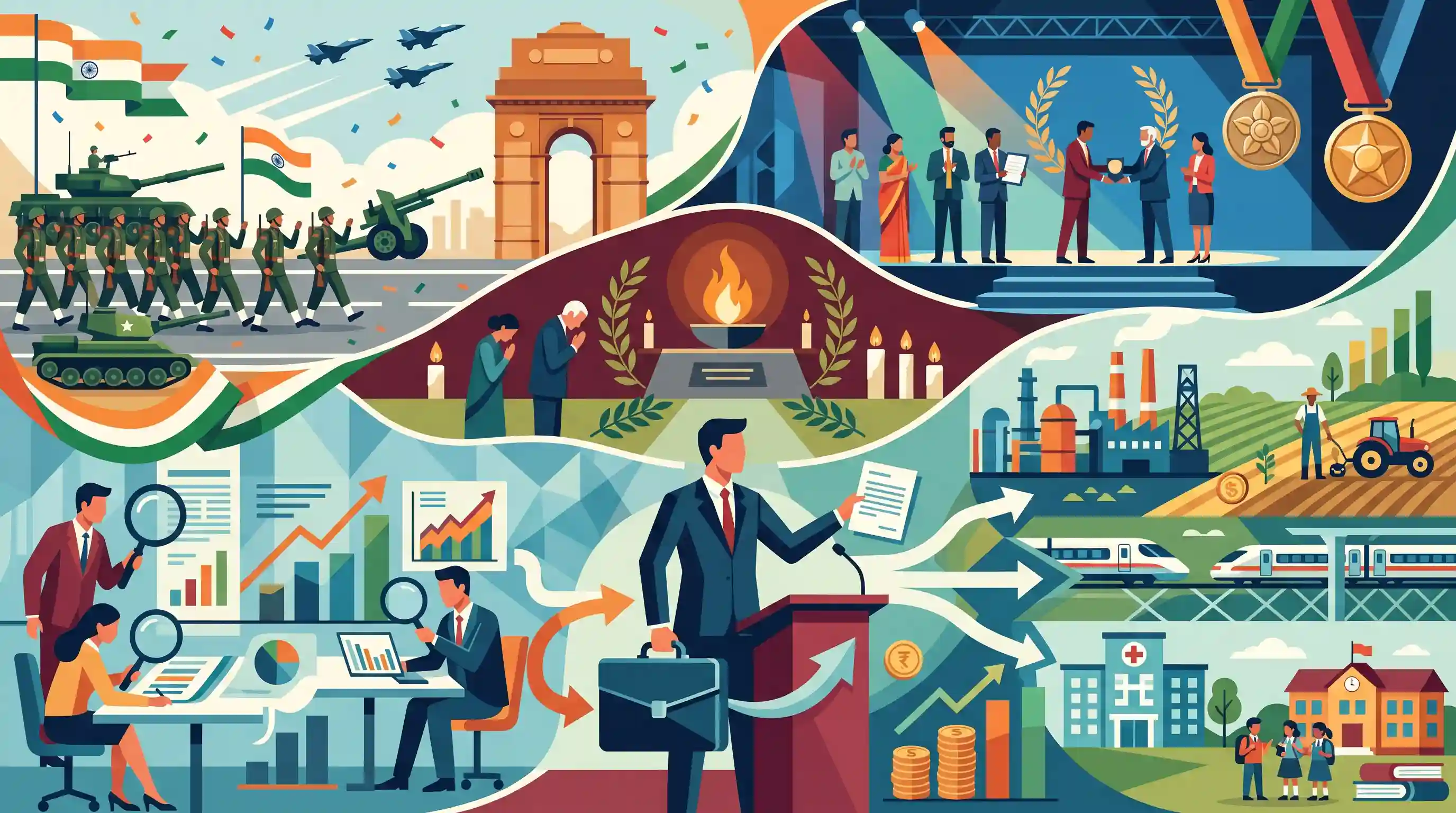
This UPSC Essentials weekly digest encapsulates the critical current affairs pointers from January 26 to February 1, 2026. This highly significant week for aspirants covers the Republic Day ceremonies, the announcement of the Padma Awards, the observance of Martyrs' Day, and the foundational economic documents of the year: the Economic Survey and the Union Budget.
Key Points
- The week covers the 77th Republic Day celebrations, highlighting India's constitutional heritage and military/cultural showcases.
- The announcement of the Padma Awards, which frequently tests aspirants on the historical and constitutional nuances of civilian honors (e.g., Article 18).
- Observance of Martyrs' Day on January 30, honoring Mahatma Gandhi's legacy and contributions to the Indian freedom struggle.
- The tabling of the Economic Survey 2025-26, which reviews the nation's macroeconomic health, structural challenges, and growth projections.
- The presentation of the Union Budget 2026-27, focusing on government fiscal policy, capital versus revenue expenditure, and deficit management.
Important Terms
Union Budget

The 'Annual Financial Statement' (Article 112) detailing the government's estimated receipts and expenditures for the upcoming financial year.
UPSC context
GS-II (Polity) and GS-III (Economy); tests constitutional procedures, resource allocation, and fiscal priorities.
Economic Survey
A flagship Ministry of Finance document reviewing the economy's performance over the past year and providing a forward-looking macroeconomic outlook.
UPSC context
GS-III (Economy); essential for analyzing growth trends, sectoral performance, and official economic narratives.
Padma Awards
High civilian honors (Vibhushan, Bhushan, Shri) announced on Republic Day, recognizing exceptional service in art, social work, and public affairs.
UPSC context
Prelims and GS-I (Culture); tests knowledge of national recognition systems and contributions of eminent personalities.
Fiscal Policy
The use of government spending, taxation, and borrowing to influence the nation's economy and ensure macroeconomic stability.
UPSC context
GS-III (Economy); tests ability to evaluate government's revenue mobilization and debt management strategies.
Martyrs' Day (Shaheed Diwas)
Commemorated on January 30 to honor Mahatma Gandhi's death anniversary and the sacrifices of all freedom fighters for India.
UPSC context
GS-I (Modern Indian History); tests knowledge of the freedom struggle and key historical milestones.
Fiscal Deficit
The difference between the government's total expenditure and its total receipts excluding borrowings; it indicates total borrowing needs.
UPSC context
GS-III (Economy); a core indicator for fiscal health, inflation control, and economic stability.
Prelims Trap
"Padma Awards are considered titles under Article 18 and their institution violates the Constitution."
The Supreme Court (Balaji Raghavan case, 1996) clarified these are civilian 'decorations', not titles under Article 18(1), provided they are not used as prefixes or suffixes to the recipient's name.
Static Concepts Connected
What distinguishes Capital from Revenue Expenditure in the Union Budget?
- Asset & Liability: Capital expenditure creates physical or financial assets (like infrastructure, loans) or reduces the government's financial liabilities (like repayment of principal on borrowings).
- Routine Upkeep: Revenue expenditure covers non-asset-creating, recurring administrative costs necessary for day-to-day government functioning, such as salaries, pensions, subsidies, and interest payments.
What is the historical significance of January 26 in India's freedom struggle?
- Lahore Session 1929: During this session, the Indian National Congress, presided over by Jawaharlal Nehru, passed the historic 'Purna Swaraj' (complete independence) resolution.
- First Independence Day: January 26, 1930, was celebrated as the first Independence Day across India. This legacy inspired the Constituent Assembly to choose January 26 to enact the Constitution.
Cross-Topic Patterns
Budget + Constitutional Mandates
The strict division of Capital and Revenue accounts is not just an economic classification, but a constitutional mandate under Article 112, ensuring parliamentary oversight on executive spending.
Gandhian Strategy + Economic Empowerment
Martyrs' Day honors Gandhi, whose Constructive Programme (Khadi, village industries) acted as the critical economic and social backbone for political mobilization during the Civil Disobedience movements.

Expect a multi-statement question in Prelims 2026 classifying tricky budget items (e.g., grants-in-aid for capital assets) as Revenue vs. Capital.
Linked PYQs · 3
Linked PYQs · 3
- 2021MainsGS3
Distinguish between Capital Budget and Revenue Budget. Explain the components of both these Budgets.
- 2021PrelimsGS1
Consider the following statements in respect of Bharat Ratna and Padma Awards : 1. Bharat Ratna and Padma Awards are titles under the Article 18(1) of the Constitution of India. 2. Padma Awards, which were instituted in the year 1954, were suspended only once. 3. The number of Bharat Ratna Awards is restricted to a maximum of five in a particular year. Which of the above statements are not correct?
- 2015MainsGS1
How different would have been the achievement of Indian independence without Mahatma Gandhi? Discuss.
