Weekly UPSC Current Affairs Compilation for Civil Services
Source:Indian Express ↗
Why It Matters
Weekly current affairs compilations are indispensable for UPSC preparation, helping aspirants connect static syllabus concepts—like constitutional morality, central bank functions, and international climate treaties—to dynamic, real-world developments.
Summary
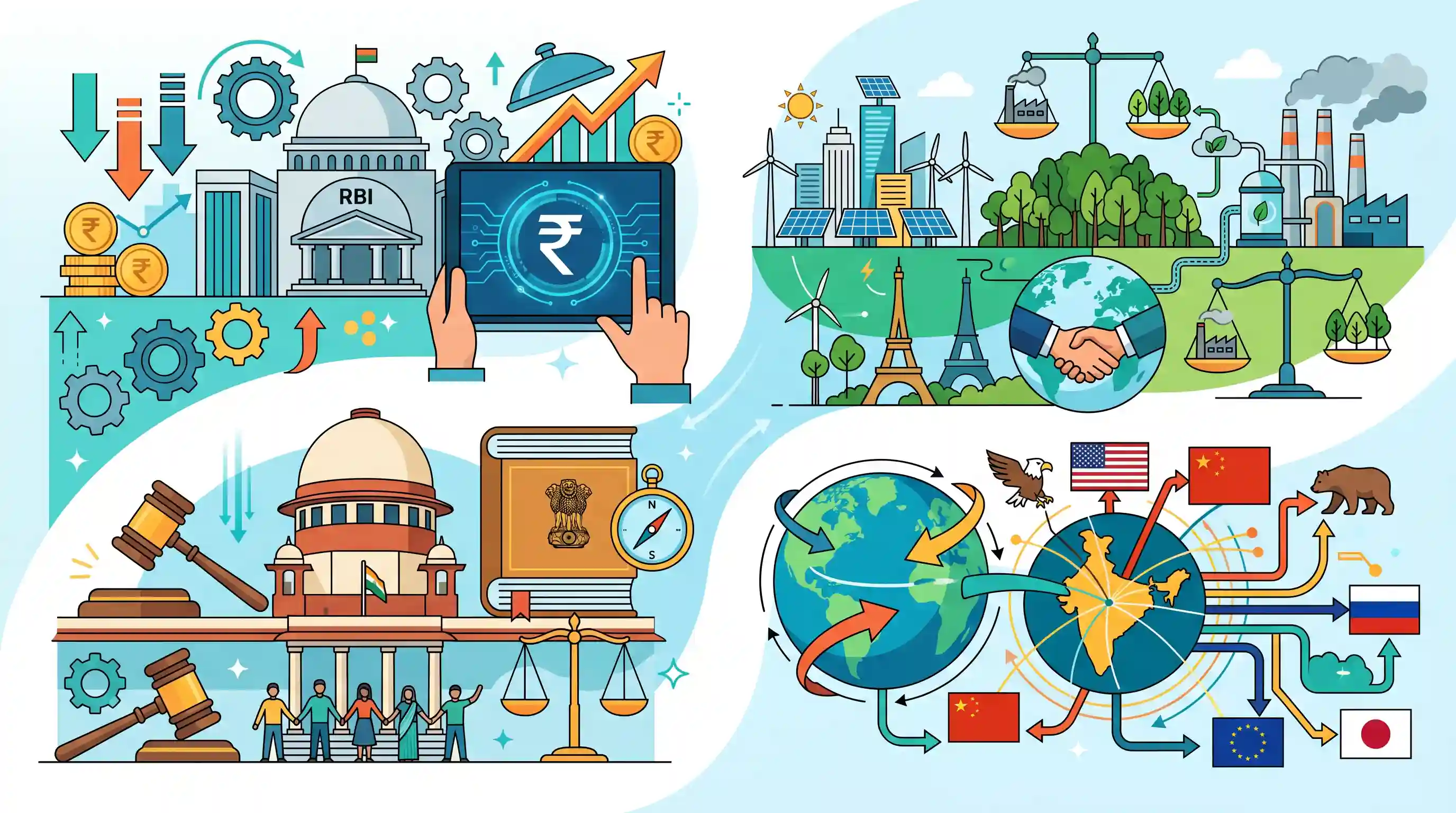
This weekly compilation of UPSC Current Affairs Pointers highlights crucial developments across multiple dimensions of the syllabus. In the economic sphere, it covers the RBI's ongoing strategies to manage inflation and the digital rupee's framework. On the polity front, it emphasizes the Supreme Court's continuous interpretation of fundamental rights and constitutional morality. Additionally, the pointers touch upon international relations and environmental ecology, featuring updates on the Paris Agreement's carbon market mechanisms and global geopolitical shifts.
Key Points
- Reserve Bank of India (RBI) monetary policy measures and their implications for inflation, liquidity, and currency depreciation.
- Key Supreme Court observations impacting constitutional morality, privacy, and fundamental rights.
- Global environmental conservation efforts, particularly focusing on Carbon Capture, Utilization and Storage (CCUS) and Article 6 of the Paris Agreement.
- Geopolitical instability and economic crises across different regions, notably in parts of Africa and the Middle East.
Important Terms
Paris Agreement

A 2015 legally binding treaty to limit global warming. In 2026, its Article 6 mechanisms for international carbon trading were operationalized, allowing countries to trade emission credits to meet climate targets.
UPSC context
GS III (Environment); key for climate finance, international carbon markets, and India's NDCs.
Digital Rupee (e-Rupee)
India’s Central Bank Digital Currency (CBDC) issued by the RBI as digital legal tender. It uses blockchain technology to provide a safe, electronic alternative to physical cash and promote financial inclusion.
UPSC context
GS III (Economy); tests knowledge of banking reforms, digital economy, and monetary policy tools.
Constitutional Morality
A judicial doctrine requiring adherence to constitutional values like justice and liberty over societal norms. The Supreme Court invokes it to protect individual rights and check arbitrary state power.
UPSC context
GS II (Polity); essential for judicial review, fundamental rights, and landmark Supreme Court interpretations.
Reserve Bank of India (RBI)
India's central bank that manages monetary policy through the Flexible Inflation Targeting (FIT) framework. It targets a 4% CPI inflation rate within a 2-6% tolerance band to ensure price stability.
UPSC context
GS III (Economy); critical for monetary policy, inflation control, and financial sector governance.
UNFCCC
The primary UN body for international climate negotiations. It oversees the implementation of global treaties like the Paris Agreement and coordinates international efforts to combat greenhouse gas emissions.
UPSC context
GS III (Environment); central to global governance, international environmental treaties, and climate diplomacy.
World Bank
A global financial institution providing development and climate finance to emerging economies. It focuses on poverty reduction and is a leading provider of funding for climate adaptation and mitigation projects.
UPSC context
GS II/III (International Relations/Economy); tests role of multilateral institutions in global development and climate finance.
Prelims Trap
Constitutional Morality is explicitly defined under Part III of the Constitution to protect Fundamental Rights.
The term 'Constitutional Morality' is not mentioned anywhere in the Constitution. It is a judicial innovation evolved through Supreme Court judgments to interpret rights and check state power.
Static Concepts Connected
How does the RBI manage excess liquidity during high inflation?
- Open Market Operations: The RBI sells government securities in the open market to absorb excess rupee liquidity from the banking system.
- Policy Rate Hikes: RBI increases the Repo Rate, making borrowing costlier, which curtails aggregate demand, investment, and consumer spending.
- Reserve Ratios: Increasing the Cash Reserve Ratio (CRR) forces commercial banks to park more funds with the RBI, limiting their credit creation capacity.
What are the core components of Paris Agreement Article 6?
- Article 6.2 (Bilateral): Allows two countries to enter into bilateral agreements to trade carbon credits, known as Internationally Transferred Mitigation Outcomes (ITMOs).
- Article 6.4 (Mechanism): Establishes a centralized, UN-supervised global carbon market for trading emission reductions generated by specific projects.
- Article 6.8 (Non-market): Provides a formal framework for climate cooperation without trading credits, focusing on finance, technology transfer, and capacity building.
Cross-Topic Patterns
CBDC and sovereign monetary policy
The Digital Rupee acts as a technological tool for the RBI to potentially bypass intermediary banks in monetary transmission, linking digital tech directly to macroeconomic stability and financial inclusion.
African instability and critical mineral security
Political volatility in Chad and Guinea (a major bauxite exporter) directly threatens global supply chains, mapping international relations crises to India's economic and critical mineral security.
CCUS tech and Article 6 carbon markets
Carbon Capture, Utilization, and Storage (CCUS) projects generate tradable carbon credits, bridging technological climate mitigation (GS3 Science) with the economic mechanisms of the Paris Agreement (GS3 Environment).

Expect a multi-statement question mapping Paris Agreement Article 6 mechanisms (ITMOs) against CCUS technology applications in 2026.
Linked PYQs · 5
Linked PYQs · 5
- 2021PrelimsGS1
'R2 Code of Practices' constitutes a tool available for promoting the adoption of
- 2025PrelimsGS1
Consider the following statements : Statement I: Article 6 of the Paris Agreement on climate change is frequently discussed in global discussions on sustainable development and climate change. Statement II: Article 6 of the Paris Agreement on climate change sets out the principles of carbon markets. Statement III : Article 6 of the Paris Agreement on climate change intends to promote inter-country non-market strategies to reach their climate targets. Which one of the following is correct in respect of the above statements?
- 2022PrelimsGS1
Consider the following pairs: Country Important reason for being in the news recently 1. Chad - Setting up of permanent military base by China 2. Guinea - Suspension of Constitution and Government by military 3. Lebanon - Severe and prolonged economic depression 4. Tunisia - Suspension of Parliament by President How many pairs given above are correctly matched?
- 2022PrelimsGS1
With reference to the Indian economy, consider the following statements: 1. If the inflation is too high, Reserve Bank of India (RBI) is likely to buy government securities. 2. If the rupee is rapidly depreciating, RBI is likely to sell dollars in the market. 3. If interest rates in the USA or European Union were to fall, that is likely to induce RBI to buy dollars. Which of the statements given above are correct?
- 2024PrelimsGS1
Consider the following statements in respect of the digital rupee : 1. It is a sovereign currency issued by the Reserve Bank of India (RBI) in alignment with its monetary policy. 2. It appears as a liability on the RBI's balance sheet. 3. It is insured against inflation by its very design. 4. It is freely convertible against commercial bank money and cash. Which of the statements given above are correct?
