Weekly Current Affairs Digest for UPSC Civil Services Aspirants
Source:Indian Express ↗
Why It Matters
Weekly current affairs compilations are crucial for UPSC aspirants to stay updated on ongoing issues, revise factual details for Prelims, and build analytical perspectives for Mains answers.
Summary
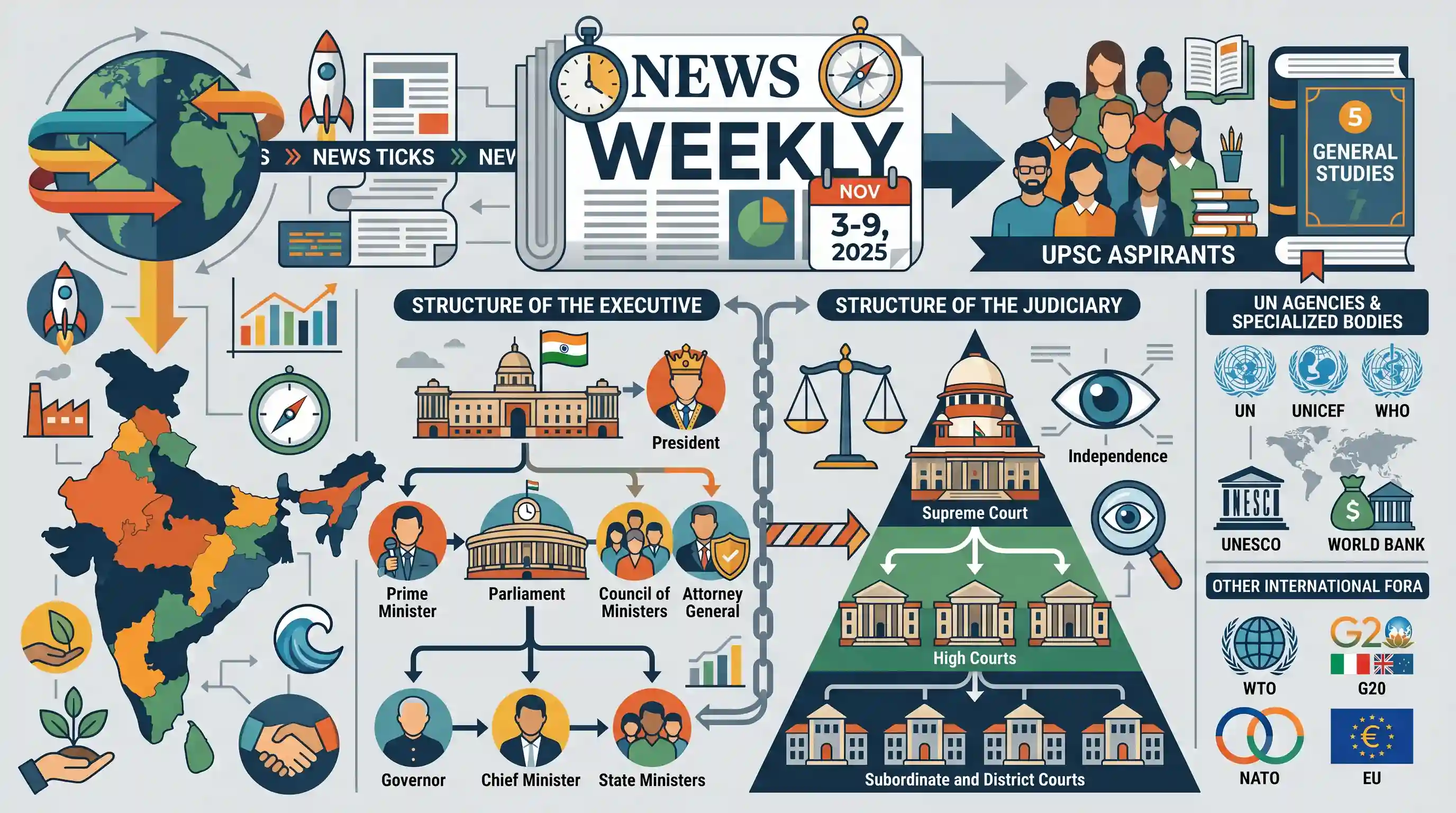
The Indian Express 'UPSC Essentials' column provides a weekly round-up of key current affairs pointers for the week of November 3-9, 2025. Designed specifically for UPSC Civil Services Examination aspirants, the compilation covers significant developments pertinent to both the Prelims and Mains examinations across various subjects including polity, economy, and international relations.
Key Points
- The article is a weekly compilation of essential current affairs pointers for UPSC preparation, covering the period of November 3-9, 2025.
- Weekly pointers typically encapsulate the most critical developments across polity, economy, international relations, environment, and science for both Prelims and Mains exams.
- Significant global and national events during early November 2025 typically shape the context of such compilations.
Important Terms
Dumpsite Remediation Accelerator Programme (DRAP)

A year-long mission-mode initiative under Swachh Bharat Mission-Urban 2.0 aimed at fast-tracking the scientific remediation of legacy waste dumpsites to achieve 'Zero Dumpsite India' by September 2026.
UPSC context
GS Paper II (Governance) & GS Paper III (Environment). Relevant for waste management, urban health, and government missions.
Aadhaar Vision 2032
A ten-year strategic and technological roadmap unveiled by UIDAI to modernize Aadhaar with AI, Blockchain, and Quantum Computing, aligning it with the Digital Personal Data Protection (DPDP) Act.
UPSC context
GS Paper II (E-governance). Tests knowledge of digital infrastructure, data privacy, and emerging technologies in public service.
Article 200
The constitutional provision defining a Governor's powers regarding Bills passed by State Legislatures, including granting assent, withholding it, returning for reconsideration, or reserving it for the President.
UPSC context
GS Paper II (Polity/Federalism). Critical for understanding Governor-State relations and legislative procedures.
Presidential Reference
The power under Article 143 where the President seeks the Supreme Court's advisory opinion on questions of public importance; recently used to clarify judicial timelines for Governors.
UPSC context
GS Paper II (Judiciary). Tests understanding of the Supreme Court's advisory jurisdiction and constitutional checks and balances.
National Urban Conclave 2025
A high-level summit organized by the Ministry of Housing and Urban Affairs focusing on 'Sustainable Urban Development and Governance' through intensive brainstorming across thematic areas.
UPSC context
GS Paper II/III (Urbanization/Governance). Relevant for urban planning, sustainability, and administrative reforms.
Special Intensive Revision (SIR)
A pan-India electoral roll update process conducted by the Election Commission of India to ensure accuracy, which became a subject of judicial scrutiny regarding name deletions and inclusion.
UPSC context
GS Paper II (Elections). Important for topics related to the Representation of the People Act and Election Commission functioning.
Prelims Trap
"The Global Climate Risk Index (CRI) is published annually by the United Nations Environment Programme (UNEP)."
UPSC frequently tests index publishers by deceptively substituting environmental NGOs (like Germanwatch, the actual publisher of the CRI) with official UN agencies.
Static Concepts Connected
Who is eligible for free legal aid under the Legal Services Authorities Act, 1987?
- Vulnerable Groups: Women, children, members of Scheduled Castes (SC) or Scheduled Tribes (ST), and victims of human trafficking or begar.
- Economic Criteria: Persons with an annual income below the limit prescribed by respective state governments (usually ₹1-3 lakh) or the Central Government.
- Special Circumstances: Victims of mass disasters, ethnic violence, industrial workmen, and persons held in custody or juvenile homes.
What are the defining targets of India's National TB Elimination Programme (NTEP)?
- Aggressive Target Year: India aims to eliminate TB by 2025, a full five years ahead of the global Sustainable Development Goal (SDG) target of 2030.
- Ni-kshay Poshan Yojana: Provides direct benefit transfers (₹500/month) to notified TB patients to support their nutritional needs during the course of treatment.
- Private Sector Engagement: Engages private medical practitioners to notify cases on the Ni-kshay portal, ensuring missing TB cases are brought into the tracking network.
Cross-Topic Patterns
Net-Negative and CBDR Principles
India's COP30 demand for developed nations to adopt net-negative targets directly invokes the historical 'Common But Differentiated Responsibilities' (CBDR) doctrine in international relations.
Jan Vishwas and Judicial Pendency
Decriminalizing minor economic offenses via the Jan Vishwas Act bridges corporate 'Ease of Doing Business' with the polity goal of reducing systemic backlog in subordinate courts.

Expect a Prelims 2026 paired-matching question testing environmental indices (like Germanwatch's CRI) and their publishing NGOs vs UN bodies.
Linked PYQs · 2
Linked PYQs · 2
- 2022MainsGS2
Critically examine the procedures through which the Presidents of India and France are elected.
- 2024MainsGS2
Explain the reasons for the growth of public interest litigation in India. As a result of it, has the Indian Supreme Court emerged as the world's most powerful judiciary ?
