Civil Services Examination Attempt Limits and Seat Blocking Reforms
Source:Indian Express ↗
Why It Matters
Highlights ongoing systemic reforms in India's premier bureaucratic recruitment process, balancing fairness for aspirants with administrative efficiency and effective human resource management.
Summary
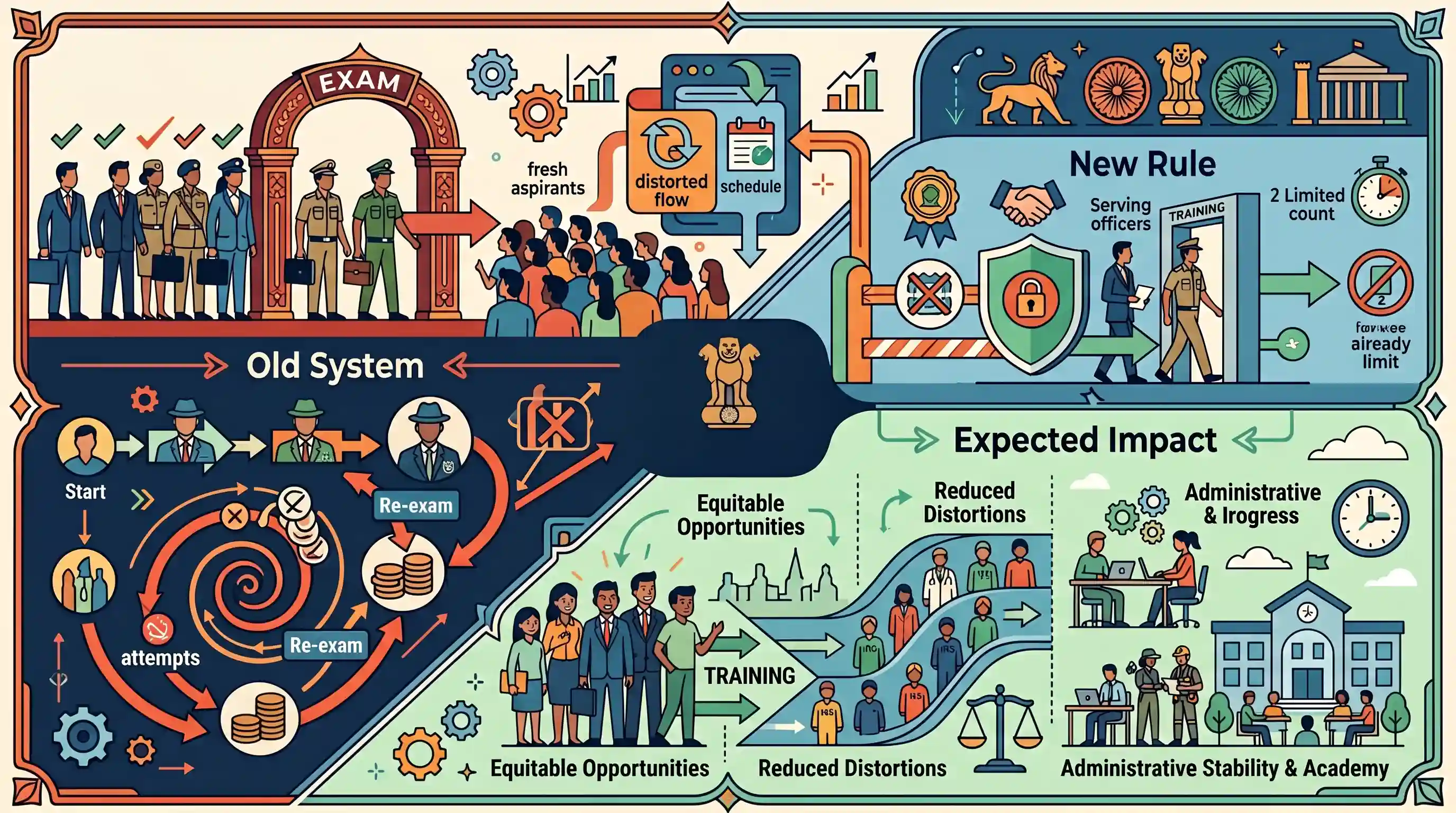
The Union Public Service Commission (UPSC) has announced new regulations restricting the number of attempts for candidates who have already cleared the Civil Services Examination (CSE). These changes target the phenomenon of 'seat blocking' by serving bureaucrats who repeatedly retake the exam to upgrade their service allocation (e.g., from IRS or IPS to IAS). By curbing continuous reappearing by already-selected candidates, the UPSC aims to ensure equitable opportunities for fresh aspirants, reduce vacancy distortions, and minimize administrative and training disruptions at academies.
Key Points
- UPSC has updated rules to restrict the number of future attempts for candidates who have already qualified the Civil Services Examination (CSE).
- Traditionally, candidates appointed to the IAS or IFS are entirely barred from reappearing, while IPS officers could retake the exam but could not opt for IPS again.
- The new limitations aim to prevent 'seat blocking', wherein serving officers (e.g., IRS, IPS) repeatedly take the exam to upgrade to IAS, inadvertently denying seats to fresh or waitlisted candidates.
- The reform addresses administrative inefficiencies, reduces training disruptions caused by probationers going on extra-ordinary leave to study, and ensures a smoother allocation process.
Important Terms
Union Public Service Commission (UPSC)

A constitutional body (Articles 315-323) responsible for conducting the Civil Services Examination and advising the government on recruitment, promotions, and disciplinary matters for the Union services.
UPSC context
GS Paper 2: Constitutional Bodies. Tests the institutional framework for recruitment and the independence of civil service oversight.
Civil Services Examination (CSE) Rules
The regulatory framework defining eligibility (age, attempts), exam pattern, and service allocation procedures. Recent 2026 updates strictly limit reappearance for candidates already appointed to premier services.
UPSC context
GS Paper 2: Governance/Civil Services. Relevant for analyzing reforms aimed at administrative efficiency and curbing seat blocking.
Indian Administrative Service (IAS)
India's premier All-India Service where officers manage district administration and contribute to policy-making at state and central levels. IAS officers are now barred from reappearing in the CSE while serving.
UPSC context
GS Paper 2: Role of Civil Services in a Democracy. Essential for discussing the administrative executive structure.
Indian Police Service (IPS)
An All-India Service tasked with maintaining public order and internal security. New rules prevent current IPS officers from opting for the IPS again to improve their rank or cadre.
UPSC context
GS Paper 2: Governance and GS Paper 3: Internal Security. Tests knowledge of the law-and-order administrative machinery.
Indian Foreign Service (IFS)
A Central Group 'A' service responsible for India's external affairs and diplomacy. Like the IAS, serving IFS officers are no longer eligible to re-take the CSE without resigning.
UPSC context
GS Paper 2: International Relations. Relevant for understanding the personnel executing India's global diplomatic strategies.
Lal Bahadur Shastri National Academy of Administration (LBSNAA)
The premier national training academy in Mussoorie for civil servants. It provides the mandatory Foundation Course for all successful CSE candidates and specialized training for IAS probationers.
UPSC context
GS Paper 2: Institutional Reforms. Tests understanding of the training and professionalization of the Indian bureaucracy.
Prelims Trap
"The UPSC has the independent constitutional authority to notify and amend the Civil Services Examination Rules."
While UPSC conducts the exam, the Civil Services Examination (CSE) Rules are framed and notified by the Department of Personnel and Training (DoPT), not the UPSC.
Static Concepts Connected
What are the key constitutional provisions governing the UPSC?
- Articles 315-323: Part XIV of the Constitution covers the composition, appointment, and removal of members of the UPSC.
- Advisory Role (Art 320): UPSC is consulted on matters related to recruitment methods and disciplinary actions, but its recommendations are advisory, not binding.
How are civil services broadly classified under the Indian administrative framework?
- All India Services (Art 312): Includes IAS, IPS, and IFoS (Forest). Officers are recruited by the Centre but serve both the Centre and States.
- Central Civil Services (Group A/B): Includes services like Indian Foreign Service (IFS) and IRS. These officers serve exclusively under the jurisdiction of the Central Government.
Cross-Topic Patterns
Civil service reforms & resource optimization
The 'seat blocking' issue connects to ethics in public service and broader governance reforms, specifically regarding the optimization of state resources spent on training probationers.
Executive control vs. Advisory bodies
Highlights the functional boundary between DoPT (cadre controlling rule-maker) and UPSC (advisory recruiting agency), a frequent theme in Polity statements on constitutional bodies.

Expect a prelims statement differentiating All India Services from Central Services regarding CSE eligibility and DoPT rule-making powers.
Linked PYQs · 3
Linked PYQs · 3
- 2020MainsGS2
Institutional quality is a crucial driver of economic performance". In this context suggest reforms in Civil Service for strengthening democracy.
- 2024MainsGS2
The Doctrine of Democratic Governance makes it necessary that the public perception of the integrity and commitment of civil servants becomes absolutely positive. Discuss.
- 2017MainsGS2
Initially Civil Services in India were designed to achieve the goals of neutrality and effectiveness, which seems to be lacking in the present context. Do you agree with the view that drastic reforms are required in Civil Services? Comment.
