Uttar Pradesh Sugar Policy and Ethanol Production Expansion
Source:chinimandi ↗
Why It Matters
Demonstrates how state-level industrial policy can integrate with national energy security goals (ethanol blending) while simultaneously resolving regional agricultural challenges like pending cane dues and excess sugar supply. High relevance for UP-specific questions on economy and commercial crops.
Summary
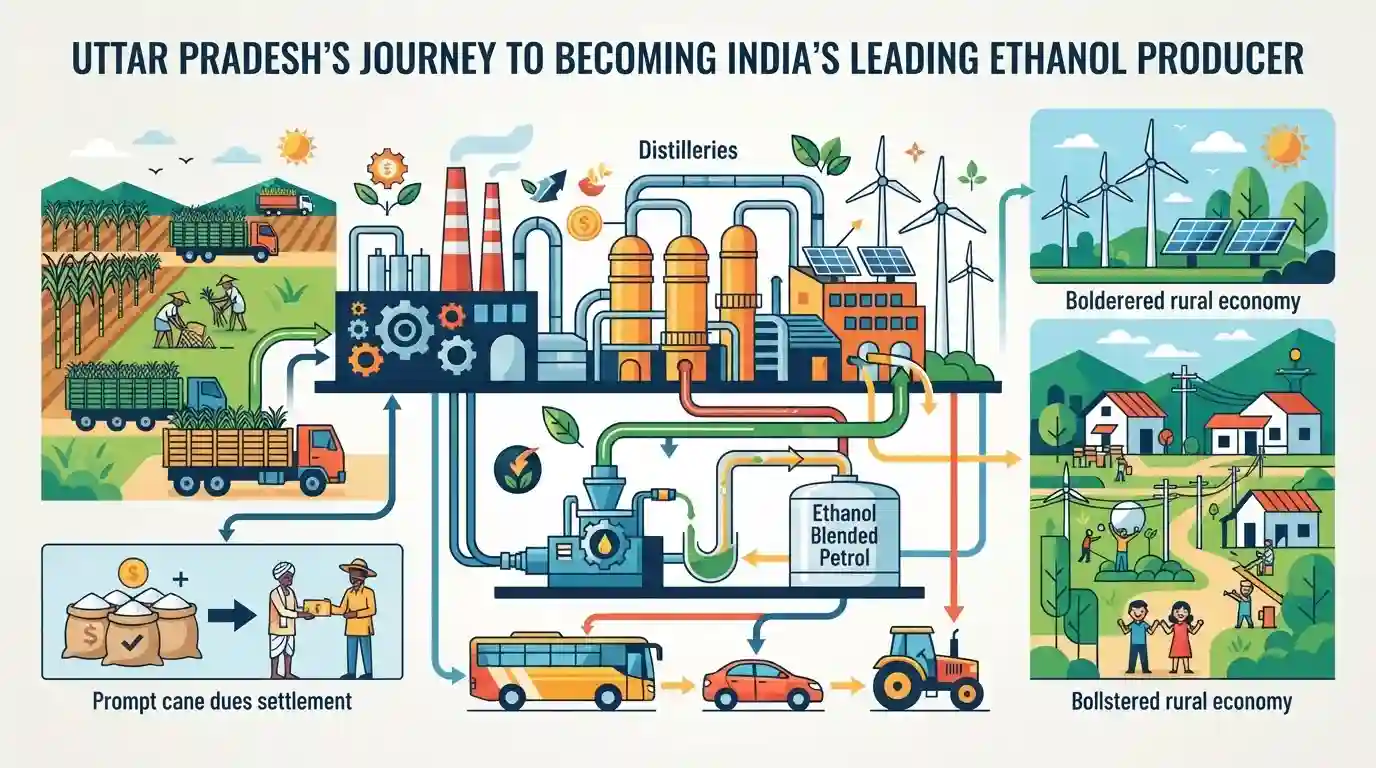
Uttar Pradesh has successfully positioned itself as India's leading ethanol producer through the implementation of the Sugar Industry, Co-generation and Distillery Promotion Policy. This framework incentivizes sugar mills to diversify into ethanol and renewable power generation, thereby supporting the Centre's Ethanol Blended Petrol (EBP) programme. The strategy effectively manages excess sugar production, facilitates prompt payment of cane dues, and bolsters the rural agricultural economy while promoting sustainable energy transition.
Key Points
- Uttar Pradesh is India's leading ethanol-producing state, driven by the Sugar Industry, Co-generation and Distillery Promotion Policy.
- The state's ethanol production capacity surged from 42 crore litres in 2017 to an estimated 175 crore litres by 2025-26.
- The policy offers financial incentives such as capital subsidies, stamp duty concessions, and interest subsidies to encourage diversification into ethanol and bagasse-based co-generation.
- Bagasse-based co-generation capacity in the state has exceeded 1,000 MW, supporting a transition to clean energy.
- Diversification prevents sugar stock accumulation, ensures timely clearance of cane dues, and secures a stable income for sugarcane farmers.
Important Terms
Sugar Industry, Co-generation and Distillery Promotion Policy

An industrial policy of Uttar Pradesh aimed at modernizing the sugar sector. It offers financial incentives, tax exemptions, and subsidies to sugar mills to diversify into ethanol distilleries and bagasse-based renewable power co-generation.
UPSC context
Relevant for GS-3 (Agriculture/Economy) and UPPSC. Tests knowledge of state-level agro-industrial strategies, farmer income interventions, and bio-energy promotion.
Ethanol Blended Petrol (EBP) Programme
A Central Government initiative launched in 2003 to blend ethanol—derived from sugarcane and surplus grains—with petrol. It targets 20% ethanol blending (E20) by 2025 to promote cleaner, renewable transport fuel.
UPSC context
Crucial for GS-3 (Environment & Energy). Tests understanding of biofuels, India's energy security, emission reduction targets, and agricultural value addition.
Co-generation (Combined Heat and Power)
The simultaneous production of two forms of energy, like electricity and heat, from a single fuel source. Sugar mills burn bagasse to produce process steam while spinning turbines to generate surplus electricity.
UPSC context
Important for GS-3 (Renewable Energy). Evaluates knowledge of industrial energy efficiency, biomass utilization, and sustainable economic practices in the agricultural sector.
Bagasse
The dry, fibrous residue left after sugarcane stalks are crushed to extract juice. It is used as a primary renewable biofuel in sugar mills to co-generate steam and electricity, lowering fossil fuel dependence.
UPSC context
Features in GS-3 (Environment/Agriculture). Tests awareness of biomass resources, waste-to-wealth concepts, and circular economy applications in agro-industries.
Prelims Trap
The Fair and Remunerative Price (FRP) for sugarcane is declared by major sugarcane-producing State Governments.
The Central Government (CCEA) approves the FRP based on CACP recommendations. States like UP declare a State Advised Price (SAP), which is usually higher.
Static Concepts Connected
What is the mechanism for determining sugarcane prices in India?
- Central FRP: Recommended by CACP and approved by the Cabinet Committee on Economic Affairs (CCEA), establishing a statutory minimum price across India.
- State SAP: Key sugarcane states like UP announce a State Advised Price, generally higher than FRP, which sugar mills are legally obligated to pay farmers.
- Arrears resolution: Diverting excess sugarcane to ethanol improves mill liquidity, enabling faster clearance of these mandatory farmer dues.
How does the Ethanol Blended Petrol (EBP) programme function?
- Advanced Target: The Centre advanced its target of achieving 20% ethanol blending in petrol (E20) from 2030 to the Ethanol Supply Year 2025-26.
- Allowed Feedstocks: Production relies on molasses and cane juice, but has expanded to include maize and damaged food grains to diversify raw material sourcing.
- Nodal Ministry: Administered by the Ministry of Petroleum and Natural Gas (MoPNG) working in tandem with Oil Marketing Companies (OMCs) to procure ethanol.
Cross-Topic Patterns
Biofuels as an agricultural liquidity tool
Ethanol blending isn't just an energy transition policy; it acts as a market intervention that absorbs excess sugar, prevents price crashes, and provides liquidity to clear chronic sugarcane farmer arrears.
Circular economy via Bagasse co-generation
Bagasse, a sugar byproduct, links agricultural waste to renewable energy targets. Bagasse-based power generation reduces captive fossil-fuel use by mills while supplying surplus green energy to the grid.

Expect a 2026 question linking the 2025-26 E20 blending deadline with CACP pricing and the expansion of approved biofuel feedstocks.
Linked PYQs · 2
Linked PYQs · 2
- 2008UPPSC_PRELIMSGS1
The main commercially produced crop of Uttar Pradesh is
- 2015UPPSC_PRELIMSGS1
Which Indian State has the highest area under sugarcane cultivation?
